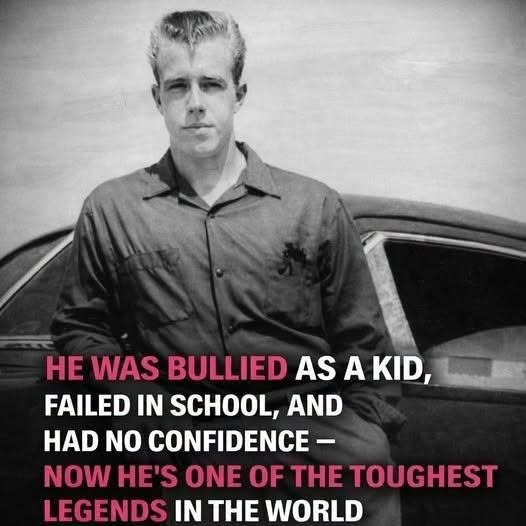
Before the world called him unstoppable, he was a boy who felt powerless. An unstable home, school struggles, and crushing insecurity left him searching for a future he could barely imagine. But a military posting thousands of miles away would introduce him to the discipline that changed everything, setting an unlikely journey in motion toward a remarkable personal tran… → Born in Ryan, Oklahoma, Chuck Norris grew up facing financial hardship and family instability, including his father’s struggles with alcohol. After his parents divorced, he moved with his mother and brothers to California. Confidence did not come easily. In 1958,…
Before the world called him unstoppable, he was a boy who felt powerless. An unstable home, school struggles, and crushing insecurity left him searching for a future he could barely imagine. But a military posting thousands of miles away would introduce him to the discipline that changed everything, setting an unlikely journey in motion toward a remarkable personal tran…
Born in Ryan, Oklahoma, Chuck Norris grew up facing financial hardship and family instability, including his father’s struggles with alcohol. After his parents divorced, he moved with his mother and brothers to California. Confidence did not come easily. In 1958, he joined the United States Air Force, and while stationed in South Korea, he began studying Tang Soo Do. Training gave him something fame never could have supplied on its own: a foundation built through effort.
After military service, Norris opened martial arts schools and became a celebrated competitor and instructor. His connection with Bruce Lee brought a defining screen appearance in Way of the Dragon, followed by action films and lasting television success with Walker, Texas Ranger. Beyond entertainment, he supported youth programs and pursued writing, business, and fitness. His story’s enduring appeal lies not in effortless toughness, but in the patient work of becoming stronger than he once believed possible.
The connection between those early hardships and his later discipline gives Norris’s story its shape. A childhood marked by financial uncertainty and family instability did not resemble the confident image audiences would eventually recognize. The move to California after his parents separated was another major change in a life that had already required adjustment. His later success therefore cannot be understood only through the screen persona that made him famous.
Military service introduced the setting in which his interest in martial arts developed. While stationed in South Korea, he encountered Tang Soo Do and began the sustained training that became central to his identity. Practice offered a clear relationship between effort and progress. Confidence emerged through learning skills and repeating them, rather than through the instant transformation often suggested by an action scene.
After his service, opening martial arts schools connected his training to teaching. Competition tested his abilities in a different way, while instruction required him to explain the same principles to other people. Those experiences helped establish a public reputation before the film and television roles that later reached much larger audiences. The schools and competitive work belong to the foundation of his career, rather than serving merely as background to Hollywood.
His connection with Bruce Lee and his appearance in The Way of the Dragon brought martial arts into the story of his screen career. Later, Walker, Texas Ranger gave television audiences a recurring character associated with determination and physical skill. The continuity between instructor, competitor, and performer helps explain why that image became so recognizable.
The youth programs, writing, business interests, and emphasis on fitness described in his biography extend the same themes beyond acting. Together, they present a career built across several kinds of work. The enduring point is the distance traveled from an uncertain childhood to a life organized around practice, teaching, and persistence.