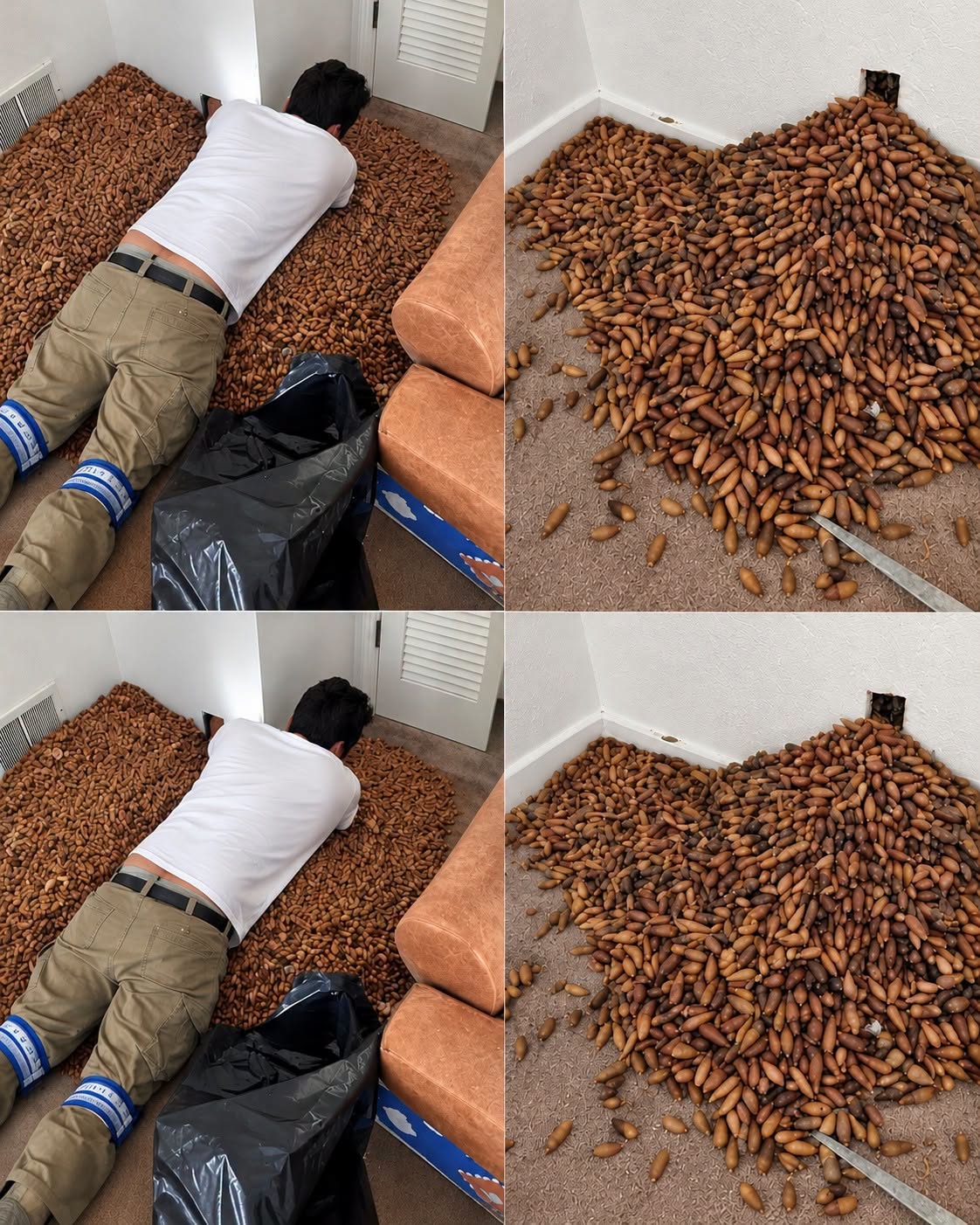
The source of the remarkable collection was a woodpecker that had been using openings in the home’s siding to store its food. Rather than simply leaving a few acorns behind, the bird had apparently been carrying them to the property and placing them inside gaps in the exterior structure. Over time, these repeated trips transformed the space behind the siding into a huge natural pantry. Each individual acorn represented only a small addition, but the cumulative effect was astonishing. Eventually, the hidden cavity contained hundreds of pounds of stored food.
From outside the house, there was little indication of the true scale of the problem. The openings in the siding did not reveal how much material had accumulated behind the walls, and the homeowner could not easily see what was happening inside the structure. This made the discovery particularly surprising. What might have looked like a relatively minor exterior issue had concealed a substantial quantity of organic material, requiring considerable effort to remove and creating a situation that could not be resolved with a simple patch.
For Nick Castro, who had spent more than two decades working in pest control, the job stood out as an especially unusual experience. Professionals in this field regularly encounter animals entering homes, nesting in sheltered spaces, or searching for food and protection. However, finding such an enormous quantity of acorns packed inside a home’s exterior was a different kind of challenge. The cleanup required the accumulated material to be removed carefully, revealing just how extensively the bird had used the structure as a storage location.
The reported quantity—approximately 700 pounds—also illustrates how a seemingly harmless wildlife behavior can become a significant household problem when it occurs repeatedly in the same location. A woodpecker carrying one acorn at a time may not attract much attention, particularly if its movements are difficult to observe. But when the bird continues using the same openings over an extended period, the amount of stored food can increase dramatically. Without a clear view of the cavity behind the siding, the homeowner may have no idea how much material is accumulating until the problem is finally investigated.
Fortunately, the bird was left unharmed during the process. Rather than treating the animal itself as the problem, the response focused on addressing the conditions that had allowed the unusual storage site to develop. The openings in the home’s exterior were patched, and new siding helped close off access to the spaces the woodpecker had been using. These repairs were intended to make the property less attractive as a place to store food while protecting the structure from further accumulation.
The episode also highlights the importance of approaching wildlife-related problems carefully. Animals often use buildings because they offer convenient shelter, protected cavities, or access to suitable places for nesting and storing food. In this case, the woodpecker’s behavior appears to have been driven by food storage rather than an intention to damage the home. Understanding the reason an animal is repeatedly returning to a particular location can help homeowners and professionals choose a solution that addresses the underlying cause without unnecessarily harming the wildlife involved.
For homeowners, the incident offers a practical lesson: recurring holes or gaps in exterior walls deserve closer investigation rather than repeated superficial repairs. Even small openings can provide access to sheltered spaces that animals may use in unexpected ways. If signs of animal activity continue to appear, examining the area carefully can help determine whether the structure is being used for nesting, shelter, or food storage. Professional guidance may be particularly useful when the source of the problem is hidden inside walls or other difficult-to-access spaces.
Preventive maintenance can also make a difference. Repairing damaged siding, sealing suitable entry points, and checking vulnerable areas of a building can reduce opportunities for wildlife to establish themselves in unwanted locations. At the same time, any repairs should be carried out with care to avoid trapping animals inside cavities or disrupting active nests. A humane and effective response considers both the condition of the property and the behavior of the wildlife involved.
Ultimately, the California house became the setting for a remarkable example of how ordinary animal behavior can produce an extraordinary result. A woodpecker had gradually transformed a hidden section of the home into a storage space containing hundreds of pounds of acorns, while the people living there remained largely unaware of the growing collection. The bird was unharmed, the accumulated food was removed, and the home’s exterior was repaired to discourage the behavior from continuing.
One question, however, remained unanswered: how long had it taken the woodpecker to build such an enormous stockpile? There was no clear explanation of the exact time involved, leaving the duration of the process uncertain. Perhaps the most remarkable part of the story was that the collection had been created through countless small trips, each carrying only a little more food into the wall. One acorn at a time, an ordinary act of wildlife behavior had become one of the most unusual pest-control discoveries imaginable.