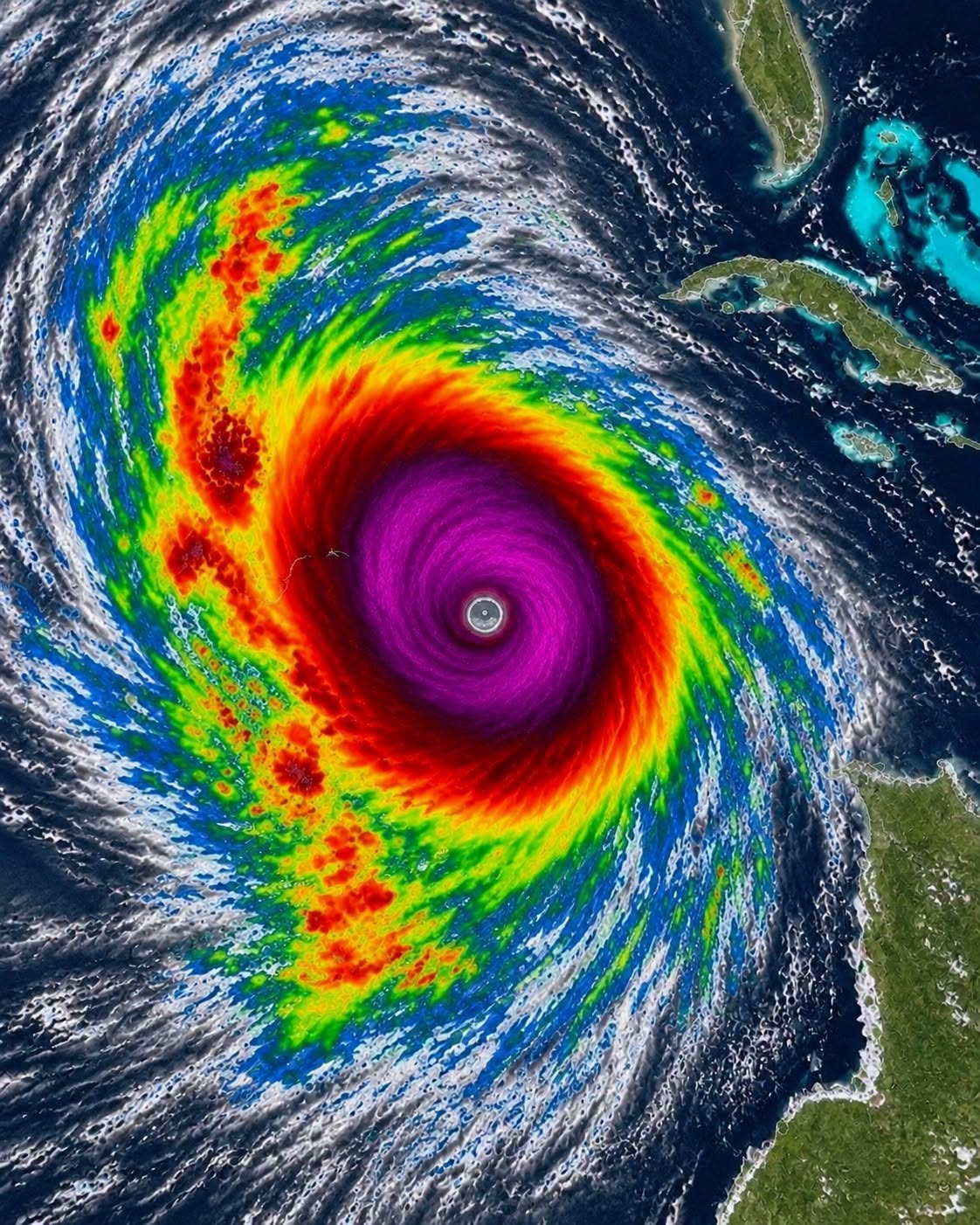
The account portrays Melissa as a storm strengthening rapidly, creating a situation in which households may have far less time than expected to prepare. Rapid intensification can change the character of a storm in a relatively short period, turning what initially appears manageable into a serious threat before families have finished making decisions.
That is why waiting for certainty can be dangerous.
A Category 5 hurricane is defined by sustained winds reaching at least 157 miles per hour, a level capable of causing catastrophic damage. But the category number alone cannot describe everything people may experience. Wind speed is only one part of the danger associated with a major hurricane.
For people living along the coast, storm surge can become one of the greatest threats. Rising seawater pushed toward shore by powerful winds can inundate communities, damage buildings, block roads, and make evacuation routes dangerous or impossible. Areas that appear relatively calm before the storm can change dramatically as water begins moving inland.
The danger does not stop at the coastline.
Heavy rainfall can produce widespread inland flooding, sometimes far from where the hurricane makes landfall. Rivers can rise, drainage systems can become overwhelmed, and low-lying roads can disappear beneath rapidly moving water. A person who is well outside the center of the storm may still face life-threatening conditions.
Tornadoes can also occur in association with tropical systems, adding another layer of uncertainty. They may develop away from the hurricane’s center and can appear with relatively little warning compared with the broader movement of the storm.
This is why focusing only on the hurricane’s eye or center can create a false sense of security.
The forecast cone is another point that often causes confusion. The cone is designed to show uncertainty surrounding the projected path of the storm’s center. It does not represent the full area that could experience dangerous winds, flooding, storm surge, tornadoes, or other hazardous conditions.
Being outside the cone does not automatically mean being outside the danger zone.
That distinction becomes especially important when a storm is changing rapidly.
Forecasts are updated as meteorologists receive new information from satellites, aircraft, weather stations, ocean observations, computer models, and other sources. A projected track can shift as those observations improve understanding of the storm’s structure and environment.
A change in the forecast does not necessarily mean that earlier forecasts were careless. It reflects the reality that hurricanes are complex systems and that their future movement cannot be known with absolute certainty.
For families in or near a threatened area, the practical lesson is straightforward: current official advisories matter more than an older forecast shared online.
Preparation should begin before conditions deteriorate.
Families should discuss where they would go if evacuation becomes necessary. They should know which routes are available, where they could stay, and how they would get there if roads become crowded or conditions worsen.
Transportation needs to be considered in advance.
A family may have access to a vehicle, but that does not guarantee everyone can leave quickly. Elderly relatives, young children, people with disabilities, or anyone with medical needs may require additional time and assistance.
Pets also need a plan.
Animals should not be treated as an afterthought when evacuation becomes urgent. Families should determine in advance where pets can safely go, what supplies they need, and how they will be transported.
Medications are another priority.
Anyone who relies on prescription medicine or essential medical equipment should prepare before the storm becomes difficult to navigate. Waiting until the last moment can create unnecessary complications, particularly if pharmacies, roads, hospitals, or electricity services are affected.
Basic supplies should also be gathered ahead of time.
Water, food, flashlights, batteries, necessary medications, communication devices, and other essentials can become difficult to obtain once a major storm threatens an area. Preparing early reduces the need to travel during increasingly dangerous conditions.
The most important decision, however, may be knowing when to leave.
If authorities issue an evacuation order, people should take it seriously and leave promptly according to local instructions. Waiting to see how bad conditions become can create a dangerous situation because evacuation routes may become congested or flooded later.
The purpose of evacuation is not to predict exactly how much damage a particular home will receive.
It is to reduce exposure to potentially life-threatening conditions.
Once people are told to leave, the time for debating whether the storm “looks bad enough” has effectively passed.
For those who remain in place under appropriate official guidance, shelter selection matters. A sturdy building and an interior location away from windows can provide greater protection from dangerous winds and flying debris.
People should avoid unnecessary exposure as conditions deteriorate.
Windows should remain closed and people should stay away from them. Outdoor objects that can become dangerous debris should be secured before the storm arrives whenever it is safe to do so.
Flooding presents another critical danger.
Never drive through floodwater simply because a road appears passable. Water can be deeper or faster-moving than it looks, and road surfaces may have been damaged or washed away underneath.
A vehicle can lose traction or become disabled surprisingly quickly.
The safest choice is to avoid flooded roads altogether and follow official instructions regarding closures and evacuation routes.
Power outages also create additional hazards.
People using portable generators must keep them outdoors and well away from doors, windows, vents, and other openings. Generators can produce carbon monoxide, an invisible and potentially deadly gas that can accumulate indoors or in enclosed areas.
A generator should never be operated inside a home, garage, basement, or other enclosed space.
These precautions may sound basic, but during a crisis, people can make dangerous decisions simply because they are trying to solve an immediate problem. A family without electricity may be tempted to place a generator somewhere convenient, but convenience is not worth the risk of carbon monoxide poisoning.
The same principle applies throughout hurricane preparation.
Do not prioritize possessions over people.
Furniture can be replaced.
Electronics can be replaced.
Vehicles can be replaced.
Homes can be repaired or rebuilt.
Lives cannot.
That becomes especially important when people feel emotionally attached to their homes or belongings. A family may want to remain behind to protect property, but no possession is worth exposing someone to extreme wind, rising water, or an unsafe evacuation route.
Helping vulnerable neighbors can also make a major difference.
Older residents, people living alone, individuals with disabilities, and families without reliable transportation may face additional challenges when a hurricane approaches. Checking on them before conditions become dangerous can help identify problems while there is still time to respond safely.
Community preparation can be just as important as individual preparation.
A neighborhood in which people communicate and look out for one another is better positioned to respond when conditions deteriorate. But assistance should always be balanced with personal safety. People should not place themselves in danger attempting to rescue someone during extreme weather unless they are trained and equipped to do so.
The uncertainty surrounding Melissa’s eventual course makes preparation even more important in this scenario.
There may be uncertainty about where the storm will travel, how strong it will become, or where its most dangerous impacts will occur. But uncertainty does not mean people should wait.
Preparation is valuable precisely because the future is uncertain.
A family does not need to know the exact location of landfall before deciding what to do with medications, pets, transportation, or important documents. Those decisions can be made in advance.
As official forecasts change, families can adjust their plans rather than beginning from zero.
The central message is therefore not to panic.
It is to prepare early and remain flexible.
Monitor current official advisories. Pay attention to evacuation orders and local emergency instructions. Understand that the forecast cone represents uncertainty in the storm’s center, not a boundary between danger and safety.
And remember that hurricanes are more than wind.
A powerful storm can bring surge, flooding, tornadoes, destructive winds, falling trees, power outages, dangerous debris, and prolonged disruptions. These threats can affect different communities at different times.
Distance from the storm’s center is not a guarantee of safety.
Being outside the forecast cone is not a guarantee of safety.
And seeing relatively calm conditions outside your window does not mean the situation cannot change.
The safest approach is to respect the uncertainty and prepare for the hazards officials are warning about.
For families facing a rapidly strengthening hurricane, preparation may feel inconvenient or overly cautious when the worst-case scenario does not materialize. But that inconvenience is a small price compared with the consequences of being unprepared when conditions suddenly become dangerous.
Gather what is necessary.
Make the evacuation plan.
Know where everyone will go.
Arrange transportation.
Prepare for children, older relatives, people with medical needs, and pets.
Keep essential medications and supplies accessible.
Follow official instructions.
And if an evacuation order comes, leave before the situation makes leaving more difficult.
Melissa’s eventual course may remain unresolved in the scenario described, but the priority does not need to be uncertain.
Protect people before possessions.
Take official warnings seriously.
Do not mistake a forecast line for a wall around the danger.
And remember that the most valuable preparation is the preparation completed before the storm makes the decision for you.
When a powerful hurricane is approaching, there may never be a perfect moment when every detail is known.
There is only the opportunity to make the safest decision with the information available now.
That is why preparation is not an expression of fear.
It is an expression of responsibility.