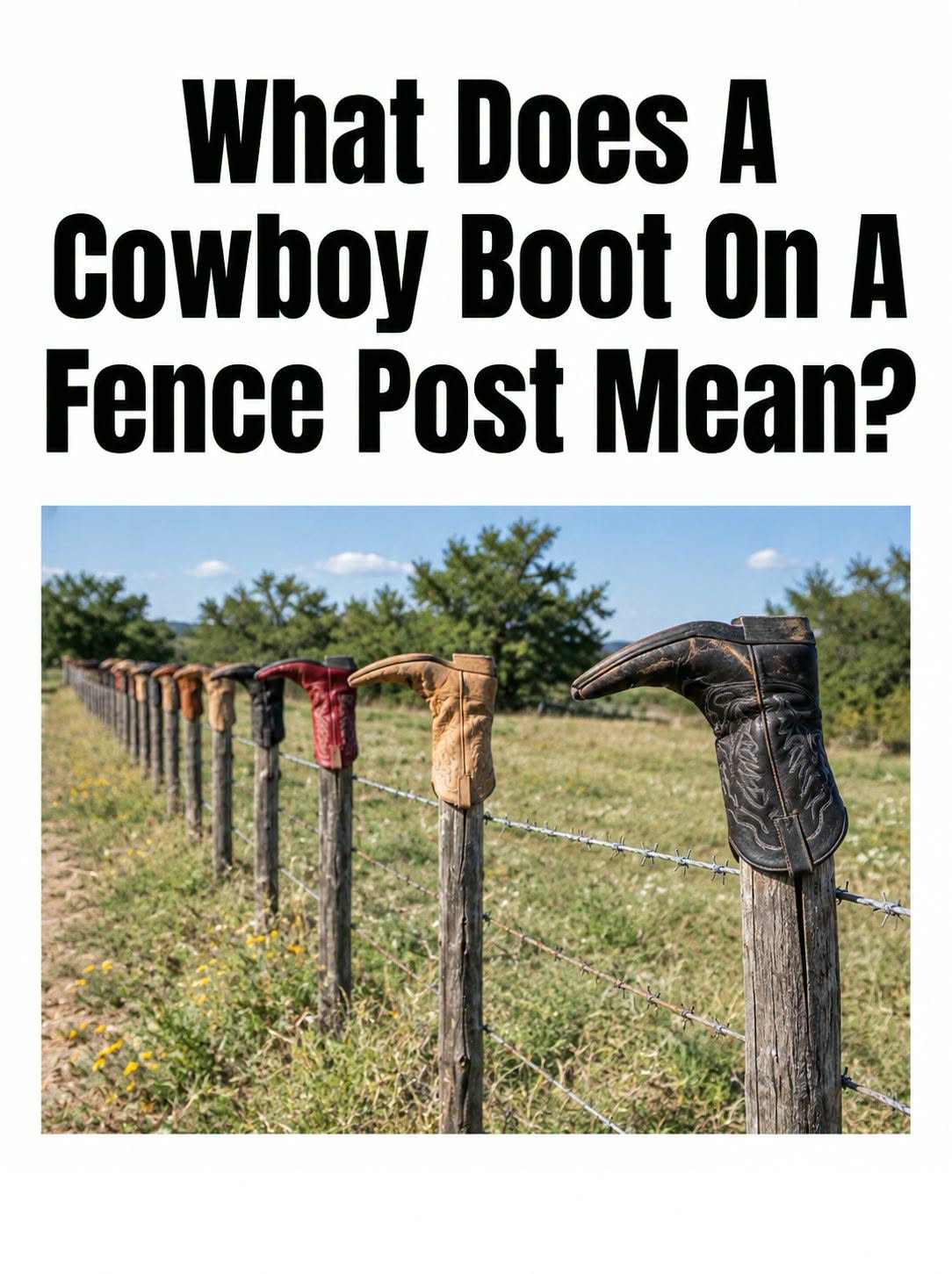
Across ranch country, worn boots sometimes find a second life long after they have stopped serving their original purpose. A pair that once crossed muddy fields, climbed into saddles, walked dusty roads, or endured countless hours of hard work may eventually appear in an unexpected place: hanging from a fence, balanced on a wooden post, or resting upside down along a property line.
To someone passing by, the sight can seem strangely deliberate.
Why would anyone leave an old boot there?
Is it a message?
A marker?
A warning?
A memorial?
Or is it simply an old piece of footwear that someone could not bring themselves to throw away?
The answer can be surprisingly simple.
In some cases, an inverted boot can serve a practical purpose. Placed over the exposed top of a wooden fence post, it can help cover the end of the post and provide some protection from weather. On certain fences, an old boot may also cushion or cover a sharp metal point that could otherwise become a hazard to people, animals, or equipment.
It is not necessarily an elaborate system.
Sometimes, it is simply someone making use of what is already available.
Ranch life has traditionally encouraged that kind of practicality. Objects that have outlived their original function are often given another purpose rather than immediately discarded. A worn piece of equipment, an old container, a section of rope, or a battered boot may remain useful in a completely different way.
A boot that can no longer be comfortably worn may still have a place on the fence.
Its condition and fit matter, of course. A badly deteriorated boot may provide little protection, while one that does not sit securely could simply fall away. But when the circumstances are right, an old boot can become a convenient improvised cover.
There is also another possibility.
Sometimes the boot is there simply because someone likes it.
That may sound almost too ordinary, but everyday objects can become surprisingly meaningful over time. A pair of boots may have been worn for years by someone who spent most of their life working outdoors. They may carry scratches, stains, worn soles, and other marks that tell a story without saying a word.
Throwing them away can feel wrong.
So instead, the owner finds a place where they can remain visible.
The fence becomes a kind of display.
From a distance, the boot may look like a curious piece of decoration. Up close, it can represent years of work and memories that outsiders could never know simply by looking at it.
The same idea can apply to distinctive footwear used as a landmark.
Rural roads can look remarkably similar, especially to someone unfamiliar with the area. A long stretch of fence, a cluster of trees, a particular gate, or an unusual object can become a useful visual reference.
A brightly colored or unusually positioned boot may stand out against the landscape.
Someone giving directions might say, in effect, “Keep going until you see the old boot on the fence.”
That kind of landmark does not need to have an official meaning.
It only needs to be memorable.
Before modern navigation technology became common, people often relied heavily on recognizable physical features to describe where they were going. A large tree, old barn, water tower, mailbox, painted rock, or unusual piece of farm equipment could serve as a reference point.
An old boot can perform the same basic function.
It catches the eye.
It is unusual enough to be remembered.
And it can help someone recognize that they have reached the right stretch of road.
But not every boot is there for practical reasons.
Some carry a much more personal meaning.
Families sometimes preserve objects associated with someone who has died, particularly when those objects were strongly connected to that person’s everyday life.
For a rancher, boots can be especially symbolic.
They may have been worn while working cattle, repairing fences, walking fields, riding horses, or completing countless ordinary tasks that defined the person’s life. After their death, those boots can become more than clothing.
They become reminders.
Placing them somewhere visible can create a quiet tribute without requiring a formal monument.
A boot on a fence can say something that words sometimes struggle to express: someone was here, someone worked here, someone belonged to this place, and someone is still remembered.
The same can happen when the boots belonged to a beloved horseman, neighbor, family member, or friend.
The object becomes meaningful because of the person attached to it.
To a stranger, it may simply look like old leather.
To the family, it may represent decades of memories.
That difference is important because there is no universal explanation for the practice.
Stories sometimes circulate claiming that the direction of a boot’s toe carries a specific message. Other interpretations suggest that certain arrangements communicate information to travelers, visitors, or members of the local community.
Some of those explanations may be true in particular places or families.
But they should not automatically be treated as universal rules.
Rural traditions often vary from one region to another, and individual families can create their own customs. Something that means one thing in one community may have an entirely different explanation somewhere else.
That is why interpreting an old boot from a distance can be misleading.
You might see a boot hanging from a fence and immediately assume it represents a memorial.
Someone else might see it and assume it is simply protecting a fence post.
Another person might think it is a landmark.
All three interpretations could be wrong—or, depending on the circumstances, all could contain part of the truth.
The person who placed the boot there is usually the one who knows the real story.
That is what makes these small rural details so interesting.
They are ordinary objects carrying extraordinary amounts of ambiguity.
A boot is normally associated with movement.
It is something designed to be worn, used, and eventually replaced.
But once it is placed on a fence, its function changes.
It becomes part of the landscape.
It can become a marker, decoration, protection, memory, or tribute.
Sometimes it can be several of those things at once.
The old boot may have once belonged to someone who spent years working that very property. Perhaps it was finally too worn to use, but throwing it away felt like throwing away a piece of personal history.
So it was given a new home.
The fence became its final resting place.
There is something quietly poetic about that.
A working boot that spent its life carrying someone across the land eventually becomes part of the landscape itself.
It no longer travels.
It simply remains.
Weather changes around it.
Seasons pass.
New generations grow up.
Vehicles travel down the same road.
The boot slowly becomes familiar to everyone who passes.
Eventually, someone may ask why it is there.
And that question can bring the story back to life.
Perhaps an older neighbor remembers who owned it.
Perhaps a family member explains what it meant.
Perhaps nobody remembers anymore.
Even then, the boot can remain as a small piece of local character.
Rural landscapes often contain these kinds of unexplained objects.
An old sign.
A weathered chair.
A piece of machinery.
A painted stone.
A horseshoe.
A boot.
To an outsider, they may appear random.
To local residents, they can be part of the visual language of the place.
They tell stories without explaining themselves.
That is why it is tempting to search for a universal meaning behind every unusual object.
People naturally want symbols to have rules.
We want to know that a particular arrangement always means the same thing.
But real life is often less organized than that.
A boot may be there because someone needed to cover a post.
It may be there because someone thought it looked interesting.
It may be there because a family member wanted to preserve a memory.
It may have been placed there years ago for a reason that nobody remembers today.
The uncertainty is part of the charm.
What matters most is not assuming that the object has a hidden code when there may be a much simpler explanation.
And when the boot does have a sentimental meaning, that meaning may belong exclusively to the people who know the story behind it.
That can make the object even more powerful.
A memorial does not always need a plaque.
Sometimes remembrance takes the form of something completely ordinary.
A favorite hat.
A pair of boots.
A saddle.
A photograph.
A jacket.
A tool that was used every day.
These objects can preserve a sense of presence because they are connected to routines that once seemed completely normal.
The person may be gone, but the object remains.
For someone who loved them, that can be enough to make the memory feel close.
The same is true of horses.
For people whose lives revolve around ranching and riding, animals can become deeply important members of the family. A boot placed somewhere near a barn, pasture, or fence may sometimes carry memories of a horse or rider whose absence is still felt.
Again, there is no universal code.
The meaning depends on the people involved.
That is perhaps the most important point to remember when encountering unusual rural traditions.
Not everything needs a secret explanation.
Not every object is a signal.
Not every boot points toward a specific message.
Sometimes an old boot is simply an old boot.
And sometimes it is much more.
It might be practical.
It might be decorative.
It might be sentimental.
It might be a landmark.
Or it might be a private symbol whose meaning belongs to one family and no one else.
The difference cannot always be seen from the road.
That is what makes the image so memorable.
You can see the leather.
You can see the worn sole.
You can see the position of the boot against the fence.
But you cannot see the memories attached to it.
You cannot see the years of work.
You cannot see the person who wore it.
You cannot see the conversation that led someone to place it there.
You cannot know whether it was put there yesterday or twenty years ago.
The physical object is visible.
The story behind it is not.
And perhaps that is why an old boot along a fence can feel strangely emotional.
It is an ordinary object transformed by context.
Something once used for work becomes part of the landscape.
Something once worn by a person becomes a reminder of that person.
Something once disposable becomes worth preserving.
Something that looks meaningless from the highway may carry a deeply personal story for someone standing on the other side of the fence.
So the next time you see a weathered boot resting on a fence post or hanging from a ranch gate, there may be no need to immediately search for a secret code.
Look at it first as what it might be: a practical solution, a landmark, a piece of decoration, a keepsake, or a quiet memorial.
And if you really want to know why it is there, the most reliable answer will probably not be found in an old legend or an internet list of supposed meanings.
It will come from the person who placed it there.
From the road, all we see is leather.
The real story belongs to the people.