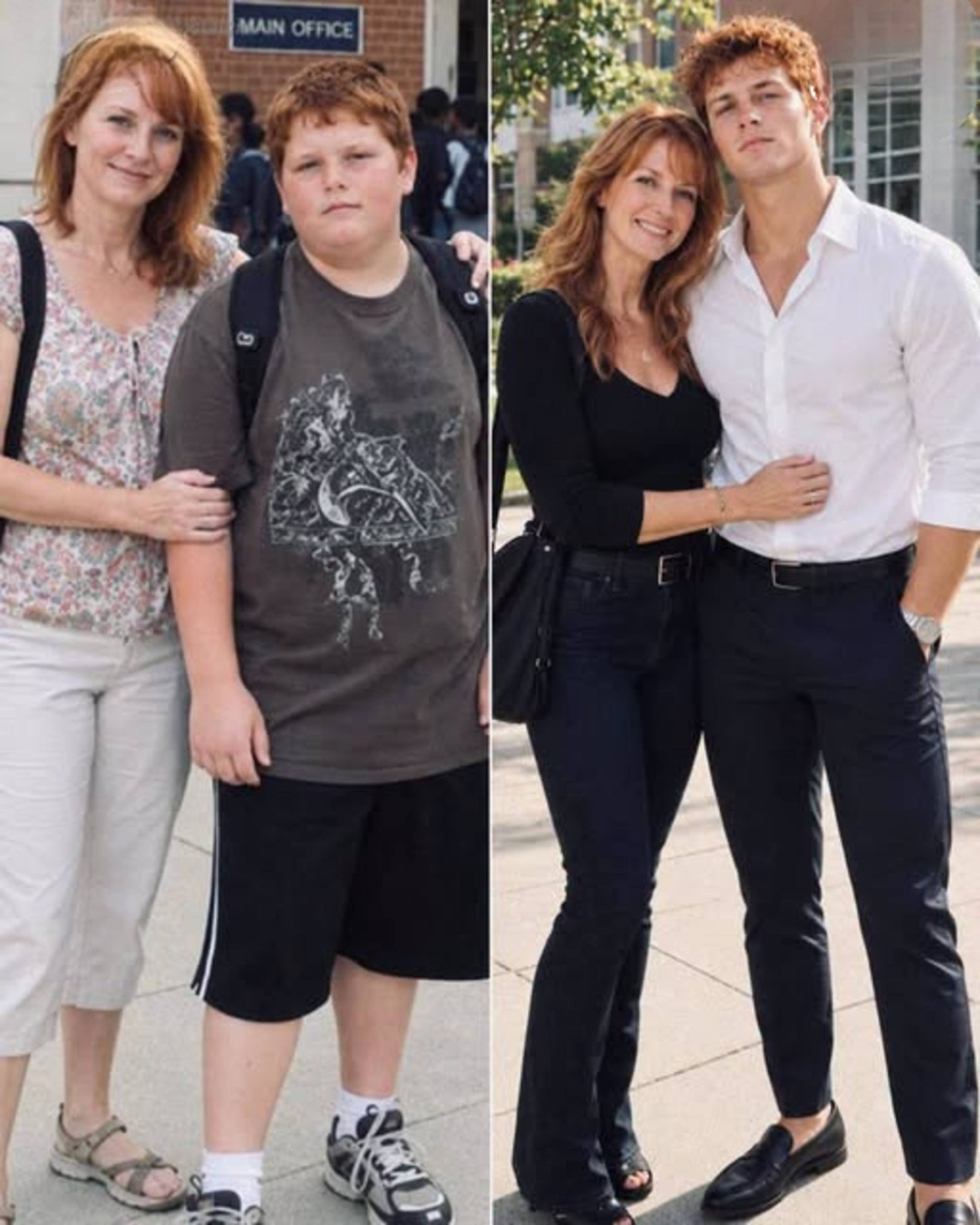
**For years, my son was the kid nobody picked, nobody invited, and nobody seemed to notice. Then his entire graduating class organized a ten-year reunion and somehow forgot to invite him again. They thought the story would end the same way it always had. They were wrong.**
The night my son walked into his high school class reunion without an invitation, every conversation in the room stopped.
Some people looked confused.
Others looked uncomfortable.
A few exchanged glances as if they were trying to figure out who had invited him.
Evan noticed all of it.
And smiled.
Not an embarrassed smile.
Not the nervous smile I’d seen so many times when he was seventeen and pretending rejection didn’t hurt.
It was a calm smile.
The kind worn by someone who already knew something everyone else in the room didn’t.
Five minutes later, he stepped onto the stage, took the microphone, and left every person in that room speechless.
But to understand why, you have to understand what those same people were like a decade earlier.
### The Kid Nobody Picked
While other students filled cafeterias with laughter and plans for the weekend, Evan usually sat by himself.
Sometimes he’d bring a book.
Sometimes he’d scroll through his phone.
Sometimes he’d stare out the window and pretend he didn’t notice the empty seats around him.
But I was his mother.
I noticed everything.
I noticed the way his shoulders dropped when he walked through the front door.
I noticed when he suddenly became interested in eating dinner in his room.
I noticed when he stopped asking whether anyone was going to invite him somewhere.
That last part hurt the most.
When Evan was little, I used to believe kindness would be enough.
Maybe that was naïve.
But it was true.
He was the kind of child who held doors open for people without being asked.
If another student forgot a pencil, he’d lend them one.
If someone dropped their books, he’d stop and help pick them up.
If a new student looked lost, Evan would be the one to show them where the classroom was.
He never asked whether someone was popular before deciding whether they deserved kindness.
I thought other children would eventually notice that.
Instead, school taught him a different lesson.
### Invisible
The other kids didn’t necessarily target him every day.
That almost would have been easier to understand.
Most of the time, they simply acted as if he didn’t belong.
Birthday parties came and went without invitations.
Weekend plans were discussed in front of him as though he wasn’t there.
When teachers assigned group projects, his face would fall ever so slightly as everyone else paired off before he had the chance.
He learned to wait.
Then he learned not to expect anyone to choose him.
Then, eventually, he learned to stop asking.
No child should become familiar with that feeling.
Yet somehow, my son did.
One afternoon, he came home from school and dropped his backpack beside the door.
“Everything okay?” I asked.
“Yeah.”
“Did something happen?”
“No.”
I knew that answer.
It was the answer he gave when something had happened but he didn’t want me to worry.
I sat beside him.
“You know you can tell me anything.”
He looked at the floor.
Then he said something I’ll never forget.
“Mom, maybe I’m just not the kind of person people invite.”
I felt something break inside me.
“You don’t believe that.”
He shrugged.
“I don’t know.”
I hugged him.
He let me.
But I knew a hug couldn’t erase years of feeling unwanted.
### Graduation
At graduation, Evan didn’t have a large group of friends surrounding him.
There were no elaborate plans for summer.
No beach trip.
No final party.
No group photograph with twenty teenagers throwing their arms around each other.
He walked across the stage.
Collected his diploma.
Shook the principal’s hand.
And came back to me.
I was crying.
He laughed.
“Mom, it’s just high school.”
I knew what he was trying to do.
He was making it smaller so it wouldn’t hurt as much.
After graduation, he left town for college.
And something changed.
Slowly.
He found people who valued curiosity more than popularity.
He joined a student organization.
Made friends.
Started working on projects.
He discovered that being quiet didn’t mean being invisible.
It simply meant he had spent years surrounded by people who weren’t looking.
By the time he graduated college, he was different.
Not louder.
Not arrogant.
Just confident.
He stopped measuring his worth by invitations.
He built a career.
Started a small company.
Hired people.
Failed at things.
Tried again.
Eventually, he became very successful.
But whenever I asked about high school, he changed the subject.
I assumed he had moved on.
Maybe he had.
Until the invitation that never came.
### Ten Years Later
The graduating class organized a ten-year reunion.
Photos started appearing online.
Old classmates posted memories.
There were pictures of football games, dances, teachers, parties, and graduation night.
Evan saw some of them.
He didn’t say anything.
Then I noticed something.
“Did you get an invitation?”
He looked up.
“No.”
I waited.
“Are you sure?”
He smiled.
“Mom.”
“What?”
“They didn’t invite me.”
I felt the old anger rising.
“That’s unbelievable.”
He shrugged.
“It’s okay.”
“No, it’s not.”
“It was ten years ago.”
“Apparently they haven’t changed.”
He laughed.
“Maybe they forgot.”
But I knew.
You don’t forget one person when you’re sending invitations to an entire graduating class.
A week later, I expected Evan to ignore the reunion.
Instead, he came downstairs wearing a dark suit.
I stared at him.
“Where are you going?”
“To the reunion.”
I blinked.
“You weren’t invited.”
“I know.”
“Evan.”
He smiled.
“Mom, relax.”
“What are you planning?”
“Nothing.”
That was the exact moment I knew he was planning something.
### The Door
The reunion was held at a hotel ballroom.
Evan walked in alone.
The room was full.
Music played.
People laughed.
Someone was taking photographs near the entrance.
Then Evan appeared.
The laughter faded.
A woman near the bar stared at him.
Someone whispered:
“Is that Evan?”
Another person answered:
“Why is he here?”
He heard them.
He kept walking.
A former classmate approached.
“Hey.”
Evan smiled.
“Hey.”
“You came.”
“Looks like it.”
There was an awkward pause.
“Who invited you?”
Evan looked at him.
“No one.”
The man’s face changed.
“Oh.”
Evan nodded.
“Don’t worry. I’m not here to ruin anything.”
Then he walked toward the back of the room.
For nearly twenty minutes, he said almost nothing.
He watched.
He listened.
He saw the same social hierarchy he remembered.
The same people clustered together.
The same people laughing loudly.
The same people acting as though they owned the room.
Then someone announced that there would be a short presentation.
A slideshow of the graduating class.
Photographs appeared on a large screen.
Football players.
Cheerleaders.
Homecoming.
Prom.
Graduation.
Everyone laughed.
Then the screen showed a group photo.
Evan was in it.
Standing at the very edge.
Almost cropped out.
Someone laughed.
“I forgot he was even in that picture.”
Evan looked at the screen.
Then at the stage.
And finally, he stood up.
### The Microphone
He walked onto the stage.
The person holding the microphone looked confused.
“Can I help you?”
Evan smiled.
“I’d like to say something.”
The room became quiet.
He took the microphone.
For a moment, he simply looked at everyone.
Then he said:
“Ten years ago, most of you probably didn’t notice me.”
Nobody moved.
“That’s okay.”
He smiled.
“I noticed you.”
A few people lowered their eyes.
“I noticed who got invited.”
“I noticed who got ignored.”
“I noticed the group projects where everyone chose their friends before looking at me.”
“I noticed the birthday parties I wasn’t invited to.”
“I noticed the weekend plans discussed three feet away from me.”
His voice never became angry.
That made it harder to hear.
“I also noticed something else.”
He paused.
“None of it destroyed me.”
The room was completely silent.
### The Reveal
Evan reached into his jacket.
He pulled out a folder.
“I brought something tonight.”
He opened it.
Inside were photographs.
Certificates.
Newspaper clippings.
A business award.
Pictures of his team.
People he’d worked with.
People who had become his friends.
He held up one photograph.
“This is my company.”
Another.
“This is the team I built.”
Another.
“These are the people who showed up when I needed them.”
Then he lowered the folder.
“I spent a long time wondering what was wrong with me.”
His voice softened.
“Eventually, I realized nothing was wrong with me.”
Someone in the audience began crying.
Evan continued.
“I was just trying to belong in a room that had already decided I didn’t.”
He looked around.
“And that’s why I came tonight.”
Everyone waited.
“I didn’t come for revenge.”
He shook his head.
“I came because I wanted to see whether the people who made me feel invisible had changed.”
He looked toward the crowd.
“Some of you have.”
A few people smiled uncertainly.
“Some of you haven’t.”
Nobody laughed.
### The Last Thing He Said
Evan placed the microphone back on the stand.
Then he turned toward the audience.
“But here’s what I want you to remember.”
He paused.
“Being ignored didn’t make me stronger.”
That surprised everyone.
“People say things like that all the time. They tell you rejection builds character.”
He shook his head.
“Sometimes rejection just hurts.”
His eyes moved across the room.
“What made me stronger was finding people who didn’t require me to earn a place at their table.”
Nobody spoke.
“My life didn’t begin when you finally noticed me.”
He smiled.
“It began when I stopped waiting for you to.”
Then he walked off the stage.
No dramatic exit.
No applause.
No victory pose.
He simply walked back toward the door.
### Outside
I was waiting for him in the parking lot.
He had asked me to pick him up.
When he got into the car, I looked at him.
“How do you feel?”
He stared through the windshield.
“Honestly?”
“Honestly.”
“Relieved.”
I nodded.
“Did it hurt?”
“Yes.”
He was quiet for a moment.
“But not like before.”
We drove home.
After several minutes, he laughed.
“What?”
“I just realized something.”
“What?”
“They still didn’t invite me.”
I laughed too.
“No.”
He shook his head.
“But I invited myself.”
I looked at him.
“And?”
He smiled.
“And I don’t think I need another reunion.”
I reached over and squeezed his hand.
For years, I’d wanted someone to choose my son.
A teacher.
A friend.
A classmate.
Anyone.
But sitting there beside the man he’d become, I finally understood something.
He hadn’t needed their approval.
He had needed to discover that their rejection wasn’t a definition.
The boy who once sat alone at lunch had grown into a man who could walk into the room without asking permission to belong.
And perhaps that was the real reason they went silent when he entered.
Not because he was the lonely kid from ten years ago.
Because he wasn’t anymore.
**Sometimes the most powerful response to being excluded isn’t proving the people who rejected you wrong. It’s building a life so full that their invitation no longer matters.**