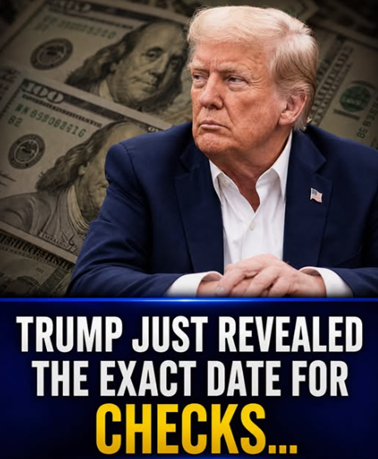
The promise is simple. The reality is anything but. As 2026 moves forward, millions of Americans are still wondering whether Donald Trump’s proposed **$2,000 “tariff dividend”** will ever become a real payment. The idea has generated enormous attention, but as of August 2026, there is still **no enacted federal program, no approved nationwide $2,000 payment, and no payment date**. A separate tariff-rebate bill has been introduced in Congress, but it has not become law.
Trump originally promoted the idea as a way to return part of the money collected through tariffs to Americans, particularly lower- and middle-income households. The promise sounded straightforward: tariffs generate revenue, Washington collects that money, and some of it comes back to ordinary Americans in the form of a dividend.
But the numbers are where the story becomes much more complicated.
A $2,000 payment to hundreds of millions of people would require an enormous amount of money. Analysts have questioned whether tariff collections could realistically support payments at that level while also covering other federal priorities. One analysis estimated that a $2,000 rebate could cost roughly $450 billion—far more than some projections of annual tariff revenue. ([CSSH][2])
And there is another problem.
Tariffs aren’t simply money that appears out of nowhere.
They are collected from importers when foreign goods enter the United States, and businesses can respond by raising prices, changing suppliers, reducing imports, or absorbing some of the cost. In other words, the economic effects are much more complicated than simply saying that “foreign countries are paying Americans $2,000.”
The legal situation has also changed dramatically.
In February 2026, the Supreme Court ruled that the administration’s use of the International Emergency Economic Powers Act to impose certain tariffs exceeded presidential authority. Other tariffs imposed under different laws were not automatically eliminated by that decision, but the ruling significantly altered the legal and financial landscape surrounding the original tariff program.
That makes the idea of simply distributing the original tariff proceeds even more complicated.
Congress is therefore central to the question.
A presidential announcement is not the same thing as an appropriated federal payment. Congress would need to authorize the necessary program and establish the rules governing who qualifies, how much they receive, and where the money comes from.
And Congress has not yet done that for the proposed $2,000 nationwide dividend.
There are, however, actual pieces of legislation related to tariff rebates. The **Tariff Refunds for Working Families Act**, Senate bill S. 4093, appears in the 119th Congress, while the **American Consumer Tariff Rebate Act**, H.R. 7865, is also listed in the Congressional Record. Their existence demonstrates that lawmakers are discussing tariff-funded payments—but a bill being introduced is very different from a law being enacted.
That distinction is crucial for anyone seeing posts online claiming that a $2,000 check is already “approved.”
It isn’t.
There is currently no IRS application that Americans need to complete to claim the $2,000 payment, and there is no official nationwide payment schedule. Claims that people need to “register now” or provide banking information to receive the money should be treated with extreme caution. Fraudulent messages claiming that people must act to receive a supposed tariff payout have already circulated.
The political argument is also becoming increasingly complicated.
Supporters see the proposal as a way to return tariff revenue to working families and provide relief at a time when household budgets remain under pressure.
Critics argue that tariff revenue should instead be used to reduce the federal deficit and debt, rather than creating another round of government payments. Others question whether sending checks would simply offset some of the higher prices that tariffs themselves can contribute to.
And then there is the question of who would actually qualify.
Trump has previously suggested that higher-income Americans could be excluded, but no final nationwide eligibility formula has been established. That means claims circulating online about exact income limits, payment dates, direct-deposit amounts, or automatic eligibility should not be treated as settled policy.
The same is true of the amount.
The phrase **“$2,000 check”** has become attached to the proposal, but there is no enacted law guaranteeing every American $2,000.
That is the most important fact to remember.
For now, the $2,000 tariff dividend remains a **proposal and political promise, not a guaranteed payment**.
The idea could still evolve. Congress could write and pass legislation. Lawmakers could change the amount. Eligibility could be narrowed. Funding could come from a different source. Or the proposal could ultimately disappear.
Until legislation is enacted and an official payment program is established, nobody can honestly promise an American household that a $2,000 check is coming.
The dream is simple:
Tariffs come in.
Money goes back out.
Families receive a dividend.
But Washington still has to solve the difficult part—the law, the funding, the eligibility, and the math.
Until then, the $2,000 remains a powerful promise hanging over American politics, but **not money that Americans can currently count on receiving**.