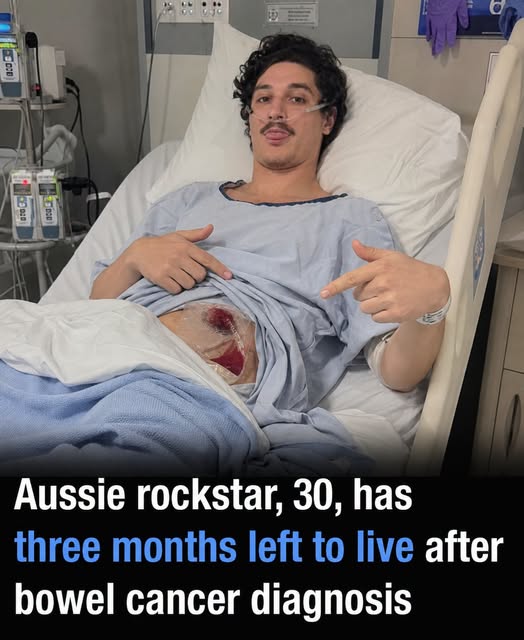
A 30-year-old musician has just announced that he is entering the “final chapter” of his life. Doctors say he may have only months left. His cancer is incurable, aggressive, and has already taken another beloved star from the world. Yet instead of disappearing into the silence of a hospital room, Jordan Brunoli is racing against the clock to finish one last album, play one last tour, and create as many moments of defiant joy as possible before everything changes forever.
For someone so young, the words “final chapter” feel almost impossible to comprehend. Thirty is supposed to be an age filled with beginnings—new records, new relationships, new opportunities, new plans, and years of possibility stretching ahead. Jordan’s future once seemed like something he could build gradually, one song and one show at a time. Instead, cancer has forced him to think about time in months rather than decades, turning ordinary plans into urgent missions and making every remaining day feel impossibly valuable.
His story began with something many young people never imagine could happen to them. He was dismissed, ignored, and told that his symptoms were likely “just a virus” while his body continued sending increasingly serious warnings. The reassurance might have seemed harmless at first, but the symptoms did not disappear. Something was wrong, and by the time doctors finally listened closely enough, Jordan Brunoli’s colorectal cancer had already spread to his liver and lymph nodes.
The diagnosis changed everything. It was not simply the discovery of cancer; it was the discovery that the disease had already advanced much further than anyone had expected. Suddenly, the future Jordan had been planning became uncertain. The things that once seemed guaranteed—more albums, more tours, more birthdays, more ordinary days—were no longer promises. They became possibilities measured against treatment schedules, scans, side effects, and the relentless progression of an aggressive disease.
His experience also exposed a painful misconception that cancer is primarily an older person’s disease. Young adults can become seriously ill too, and symptoms in younger people can sometimes be attributed to less serious conditions. Jordan’s story has therefore become bigger than his own diagnosis. By speaking openly, he has forced attention toward the warning signs of colorectal cancer and the importance of taking persistent symptoms seriously, regardless of someone’s age.
He could have disappeared quietly. He could have chosen to spend every remaining moment away from cameras, away from interviews, and away from the public conversation. Instead, he chose the opposite. Jordan turned his prognosis into a spotlight, using the limited time available to him to talk about what happened, challenge assumptions, and remind other young people that persistent pain or unusual symptoms deserve to be taken seriously.
The tragedy is that the disease did not simply threaten his health. It attacked the future he had spent years building through music. Every musician imagines the next record, the next show, the next song that might become something special. Jordan had his own plans, and cancer suddenly placed a deadline over all of them.
But there was one thing the disease could not easily take away: his connection to music.
As treatment after treatment failed, Jordan continued creating. He recorded through surgeries, chemotherapy, exhaustion, and neuropathy so severe that he struggled to feel the guitar in his hands. For a musician, that kind of side effect is more than physical discomfort. The instrument is an extension of expression, and losing sensation in your fingers can make the simplest movement feel unfamiliar.
Yet Jordan kept going.
He continued writing and recording even when his body was exhausted. He continued making music when the circumstances might have given him every reason to stop. The studio became more than a workplace. It became a place where he could still be himself rather than simply being a cancer patient.
That distinction matters. Cancer can quickly become an identity imposed upon someone. Appointments, medications, scans, blood tests, procedures, and conversations about prognosis can consume daily life. A person can begin to feel as though every part of their existence is organized around the disease.
Jordan has resisted that transformation. He refuses to let the word “cancer” become the only word that describes him.
He is still a musician. He is still a friend. He is still a person with jokes, frustrations, memories, ambitions, and things he wants to experience. He still wants to hear music played loudly, feel the energy of a crowd, and stand on a stage doing the thing that gave his life meaning long before cancer entered the picture.
That is why finishing *Head Noise* has become so important. The album represents more than another collection of songs. It is a physical piece of Jordan that can exist beyond the limits of his illness. Every track carries time, effort, emotion, and a piece of the person who created it.
Recording the album while undergoing treatment transformed the process into something completely different from a normal studio project. There was no guarantee that there would be another album after it. No assumption that there would be years to refine the next one. Every session mattered because the clock was no longer theoretical.
Now, with *Head Noise* finally ready and farewell shows booked, Jordan has made his intentions clear. He does not want his final months to be defined exclusively by hospitals, medication, and fear. He wants to live them as fully as he can.
That does not mean pretending the situation is easy. There is nothing easy about knowing that time may be running out. There will be difficult days, painful treatments, fear, exhaustion, and moments when optimism feels impossible. But Jordan appears determined not to surrender every remaining moment to those realities.
Instead, he is choosing experiences.
He wants to play music. He wants to see friends. He wants to perform. He wants to laugh. He wants to make memories. He wants to enjoy the time that remains rather than allowing cancer to dictate every second of it.
His attitude can be summed up in the bluntness of his own words: he intends to “enjoy the f* out” of whatever time he has left.
There is something profoundly human in that decision. When people are confronted with mortality, they often begin to understand time differently. An ordinary afternoon can become meaningful. A conversation with a friend can feel more important. A favorite song can hit differently. A meal, a drive, a rehearsal, or a laugh can become something worth remembering.
Jordan is trying to live inside those moments rather than constantly looking toward the end.
His story also carries a message for people who may never meet him. It is a reminder that age does not provide immunity from serious illness. Being young does not mean every symptom is harmless. It does not mean persistent pain, unexplained changes, or unusual health problems should automatically be dismissed.
His diagnosis demonstrates how devastating delayed recognition can be. The earlier a serious disease is identified, the more options a patient may have. That is why Jordan has chosen to speak publicly, even when doing so means repeatedly revisiting some of the most painful moments of his life.
He wants his experience to matter beyond himself.
He wants someone who hears his story to trust their instincts when something feels wrong. He wants another young person to ask another question, seek another opinion, or insist that persistent symptoms deserve investigation. If sharing his own experience helps even one person avoid being ignored, then the painful parts of his story may carry a purpose beyond his own fight.
Still, beneath the advocacy is a musician trying to finish what he started.
There is something almost poetic about the idea of a final album being created while time is running out. Musicians often spend years wondering whether a song will survive them. Jordan now knows that his music may become part of the way people remember him, which gives every recording an emotional weight that no ordinary release could carry.
The farewell shows carry that same significance. They are not simply concerts. They are opportunities to stand in front of the people who supported his music and say goodbye on his own terms. Instead of allowing the final image of him to be a hospital bed or a medical chart, Jordan wants it to be a stage, a guitar, an audience, and the sound of music filling the room.
For his friends and fans, those shows may be painful. Knowing that a performance could be one of the last times they ever see him makes every moment heavier. But it also makes the experience more meaningful. The applause becomes more than applause. It becomes recognition—not just of the music, but of the person who refused to stop creating.
Jordan’s story is not a simple story about optimism overcoming cancer. The disease is real. The prognosis is devastating. Treatment has failed him, and he knows the limits of what medicine can offer. His strength comes from something different: accepting the reality without allowing it to completely control the way he lives.
That may be the most powerful part of his message.
He is not pretending he has unlimited time. He is acknowledging that time is limited and asking what he can still do with it.
He can make music.
He can play shows.
He can spend time with people he loves.
He can laugh.
He can create.
He can speak honestly about what happened to him.
And he can refuse to let the final chapter be written entirely by cancer.
At 30, Jordan Brunoli should have had decades ahead of him. Instead, he is measuring his remaining time in months and turning that devastating reality into a reason to create as much meaning as possible.
His story is heartbreaking, but it is not only about dying young. It is about refusing to disappear before the end. It is about taking whatever time remains and filling it with the things that still make life feel like life.
The album will exist. The songs will remain. The recordings will carry his voice and his hands long after his final performance. The people who stand in those farewell crowds will remember what it felt like to hear him play. And somewhere in those memories, Jordan will continue to exist—not only as the young man cancer took too soon, but as the musician who kept creating when time was running out.
He cannot control how many months remain.
But he can decide what those months contain.
And for now, they contain music, friendship, unfinished songs, crowded rooms, loud guitars, and a determination to enjoy the hell out of every moment he still has.