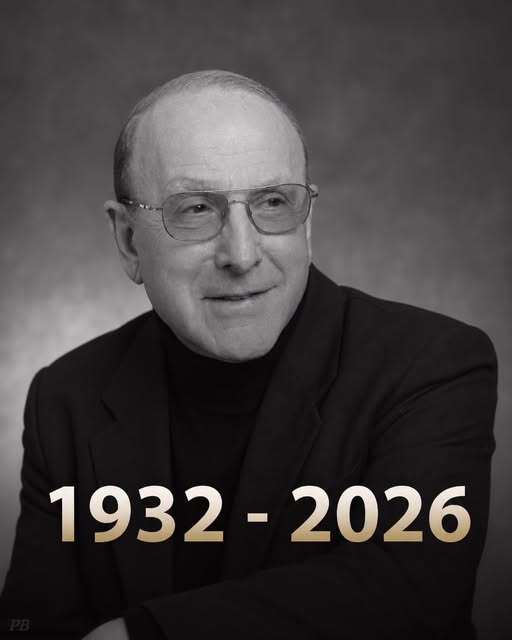
The news hit like a final, shattering chord. Clive Davis is gone, and with him, an extraordinary era of music history has come to an end. Davis died peacefully at his home in Manhattan on June 22, 2026, at the age of 94, surrounded by family and loved ones. For more than six decades, he stood at one of the most influential crossroads in popular music, helping transform unknown voices into artists whose songs would eventually become part of the soundtrack of millions of lives.
Legends owe part of their stories to him. Janis Joplin, Bruce Springsteen, Whitney Houston, Carlos Santana, Alicia Keys, Aretha Franklin, Barry Manilow, and many others crossed paths with Davis at crucial moments in their careers. His gift was not simply recognizing talent; it was understanding what that talent could become. He could hear possibility before the rest of the industry caught up.
For more than sixty years, Davis stood at the fault line where raw talent met impossible expectations. He began his career as a lawyer before moving into the record business, eventually becoming one of the most powerful executives in music. His instincts helped shape Columbia Records, Arista Records, J Records, and later Sony Music, allowing his influence to stretch across rock, pop, soul, R&B, country, and beyond.
He heard Janis Joplin’s intensity and understood that her voice carried something audiences could not ignore. He recognized Bruce Springsteen’s urgency and helped give that young New Jersey songwriter a path toward a much larger audience. And when Whitney Houston emerged, Davis didn’t simply hear a remarkable singer—he recognized the possibility of a voice capable of becoming a global cultural force.
Houston became one of the clearest examples of his vision. Under Davis’s guidance, her extraordinary vocal ability was paired with songs and production that helped turn her into one of the defining artists of her generation. Her success wasn’t accidental. It was the result of talent meeting someone who understood how to develop, position, and protect that talent.
Then there was Santana.
Davis helped revive Carlos Santana’s career decades after the guitarist had already established himself, demonstrating one of the qualities that separated Davis from executives who were focused only on the newest stars. He understood that careers could have second acts. Artists could evolve. Music could be rediscovered.
That instinct continued into the 2000s with Alicia Keys. After leaving Arista, Davis helped launch J Records, where he signed Keys and helped guide the beginning of another extraordinary career. Her combination of songwriting, piano playing, soul, and contemporary R&B became another example of Davis’s ability to recognize something distinctive and give it room to grow.
His influence eventually reached even further, including artists emerging through *American Idol*. Carrie Underwood and Kelly Clarkson were among the performers whose careers he helped shape. By then, his ability to identify commercially powerful talent had survived multiple generations of music technology, changing audiences, and shifting industry trends.
But Clive Davis’s story was never completely simple.
He experienced extraordinary triumphs, but also professional setbacks and controversy. Columbia Records fired him in 1973 amid accusations involving expense-account violations and financial misconduct. Davis pleaded guilty to tax evasion and paid a fine, while maintaining that the dispute had been handled unfairly. Rather than ending his career, the setback became the beginning of another chapter. He went on to build Arista Records into another major force in the industry.
That resilience became part of his legend.
Davis understood that the music business was constantly changing. Labels rose and fell. Formats changed from vinyl to cassette to CD to digital streaming. Audiences moved from radio to MTV to the internet. Yet somehow, Davis continued finding artists capable of cutting through the noise.
His famous pre-Grammy gala became another symbol of his influence. For decades, the event brought together some of the biggest names in entertainment, turning a single evening into one of the industry’s most important annual gatherings. Even late in his life, his ability to bring artists and executives into the same room remained remarkable.
Behind all the awards and boardrooms, however, was a man deeply fascinated by possibility.
He understood that artists were not simply products to be placed on shelves. They were complicated people carrying something unpredictable inside them. Sometimes the talent was obvious. Sometimes it was fragile. Sometimes it needed patience. Sometimes it needed someone willing to fight for it.
Davis was often that person.
That does not mean every decision he made was universally accepted. His career included disagreements with artists, executives, and corporate leaders. Some performers resisted his creative direction, while others credited him with changing their lives. But even those disagreements revealed how deeply involved he was in the artistic process.
His influence became so widespread that musicians and colleagues repeatedly described him as someone who could hear things other people missed. Barack Obama once praised his ability to “see and hear what other people don’t,” a description that captures much of what made Davis unusual.
By the time he died, Davis had accumulated five Grammy Awards and had become an indisputable figure in modern music history. But perhaps his greatest achievement cannot be counted in awards.
It can be heard.
It is in the songs.
In the voices.
In the records that survived their era.
In the artists who went from unknown performers to names recognized around the world.
Davis’s death therefore feels larger than the loss of one executive. It feels like the closing of a door on a particular kind of music industry—the era when one person’s instincts, relationships, persistence, and willingness to take a chance could redirect the course of popular culture.
Yet his influence will not disappear with him.
Every time a Whitney Houston song fills a room, every time Santana’s guitar cuts through a recording, every time a Springsteen anthem comes through the speakers, or every time Alicia Keys sits behind a piano, there is another reminder of the choices Davis made throughout his remarkable career.
Clive Davis is gone.
But the sound he helped create is still everywhere.
It lives on playlists, in old records, in concert halls, in memories, and in the unmistakable feeling that comes when a perfect chorus arrives at exactly the right moment.
His era may have ended.
His music never will.