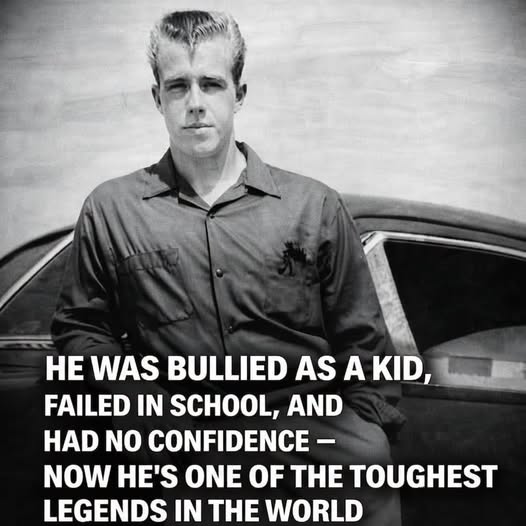
He wasn’t supposed to become a legend. He was supposed to disappear—another quiet kid from a broken home, swallowed by fear, poverty, insecurity, and the silence that often follows a childhood filled with uncertainty. Instead, Chuck Norris walked straight into the fire. He was a lost teenager searching for direction, a young man sent to a foreign country, and a fighter who initially knew very little about where his life was heading. What happened in South Korea would eventually reshape his identity, giving him a discipline and confidence he had never known before.
Chuck Norris did not begin as the invincible warrior the world would later cheer for. Long before the famous action roles, the television appearances, and the endless jokes about his supposed superhuman abilities, he was a shy and insecure young man trying to understand himself. His early life was marked by instability, and watching his family struggle left him carrying doubts that he rarely expressed openly.
He wasn’t naturally the fearless figure people would eventually associate with him.
He had to become that person.
The Air Force offered him an escape from the uncertainty of his younger years. Military service gave him structure, but being stationed in South Korea placed him in an environment that would ultimately change the direction of his life. He was far from home, surrounded by a culture he barely understood, and searching for something that could give meaning to the discipline he was beginning to develop.
That was when martial arts entered his life.
Tang Soo Do became more than a physical activity. It became a lifeline.
At first, martial arts demanded things that did not come naturally to him. Patience. Discipline. Repetition. Confidence. The willingness to be uncomfortable without immediately giving up.
Every training session forced him to confront weaknesses he might previously have tried to hide.
Every mistake became something he had to examine.
Every defeat became another opportunity to improve.
The process wasn’t glamorous.
There were bruises.
There was exhaustion.
There were moments when progress seemed almost invisible.
But slowly, something inside him began to change.
The young man who had once struggled with insecurity was discovering that confidence didn’t necessarily come from believing you were the best.
It came from knowing you were willing to keep working when you weren’t.
That lesson became one of the defining principles of his life.
Martial arts gave him a framework for turning fear into action. Instead of allowing insecurity to decide what he could or could not become, he began measuring himself by effort and discipline.
The transformation wasn’t immediate.
He lost tournaments.
He experienced setbacks.
There were opponents who were stronger, faster, or more experienced.
But those losses often taught him more than victories did.
Winning could make someone feel powerful.
Losing forced him to ask why.
What had he done wrong?
What could he improve?
Where had he become careless?
What would happen if he trained harder?
That mindset eventually became a habit.
He learned to return.
Again.
And again.
And again.
The willingness to keep returning after disappointment became more important than any individual victory.
Over time, his martial arts achievements began to establish a reputation that reached far beyond the training room. The shy young man who had once struggled to find direction was becoming a respected martial artist.
But another transformation was waiting.
Hollywood.
The transition from martial artist to actor was not guaranteed. Being physically capable did not automatically make someone a successful performer. Norris had to learn another set of skills, another kind of discipline, and another way of communicating with an audience.
His martial arts background, however, gave him something distinctive.
He could move with authority.
He understood combat choreography.
He knew how to project physical confidence.
And he had developed the persistence required to keep improving.
One of the most memorable chapters of his early film career came when he appeared opposite Bruce Lee in *Way of the Dragon*. Their confrontation became one of the most recognizable martial-arts sequences in cinema, helping establish Norris as a performer capable of standing alongside some of the genre’s biggest names.
But the significance of that moment went beyond a fight scene.
It represented how far he had traveled.
The insecure young man who once struggled to find his place had entered an entirely different world, standing in front of cameras and participating in a scene that would eventually become iconic.
His career continued to grow.
Action films followed.
His public image became increasingly associated with strength, discipline, and determination.
Eventually came *Walker, Texas Ranger*, the television series that introduced him to an even larger audience. As Cordell Walker, Norris played a character whose sense of justice, physical toughness, and moral certainty became closely associated with his public persona.
For many viewers, Walker seemed almost impossible to defeat.
But the irony was that Norris’s real story was much more complicated.
He had not started out as an unstoppable hero.
He had started out afraid.
He had started out uncertain.
He had started out without knowing exactly what he wanted his life to become.
The strength audiences saw later was built through years of repetition, disappointment, and deliberate effort.
That is perhaps why his story has remained so compelling even after the jokes and internet mythology transformed him into something almost larger than life.
The famous Chuck Norris jokes portray him as someone who never struggles.
The real story is almost the opposite.
He struggled.
He lost.
He doubted himself.
He had to learn.
And he kept going.
That distinction matters because it turns his journey into something more relatable.
A person doesn’t have to be fearless to become strong.
Sometimes strength begins when someone is frightened but chooses to move anyway.
The young man who arrived in South Korea did not know that martial arts would eventually become a defining part of his identity. He likely couldn’t have predicted the tournaments, the films, the television success, or the cultural legacy that would follow.
He was simply looking for direction.
And he found it through discipline.
That discipline eventually followed him everywhere.
It influenced the way he approached competition.
It shaped the way he trained.
It helped him endure rejection.
It gave him the patience to develop an acting career.
And it reinforced a philosophy that would become central to his public image: improvement comes from refusing to stop.
The bruises mattered.
The losses mattered.
The failures mattered.
They weren’t interruptions to the story.
They were part of the story.
Without them, the transformation would have looked almost impossible.
The lesson from Norris’s journey is therefore not that anyone can become an action-movie legend simply by trying hard. Life is far more complicated than that. Opportunity, timing, circumstances, talent, and countless other factors matter.
But discipline can change the direction of a person’s life.
It can give structure to someone who feels lost.
It can create confidence where insecurity once dominated.
It can turn setbacks into information rather than final judgments.
And it can teach someone that a bad chapter does not have to become the entire story.
Chuck Norris eventually became famous for playing men who seemed impossible to break.
But perhaps the more meaningful story is the person he had to build before he could play those characters.
A frightened boy became a disciplined young man.
A disciplined young man became a martial artist.
The martial artist became an actor.
The actor became a television icon.
And the television icon became something even larger through decades of popular culture.
Yet underneath all of it is a much simpler story.
A young person who could have surrendered to insecurity found something that demanded he keep showing up.
One training session became another.
One failure became another attempt.
One setback became another lesson.
And eventually, the life that once seemed directionless had a path.
That is what changed in Korea.
Not simply his fighting ability.
Not simply his physical strength.
His understanding of himself changed.
He discovered that confidence could be built.
That discipline could be learned.
That failure could be survived.
And that a person who once felt powerless could gradually become someone capable of controlling the direction of his own life.
The legend came later.
The jokes came later.
The movie roles came later.
The television fame came later.
Before all of that, there was simply a young man trying to find his way.
And perhaps that is the part of his story worth remembering most.
He didn’t become extraordinary because he never experienced fear.
He became extraordinary because fear didn’t get the final word.