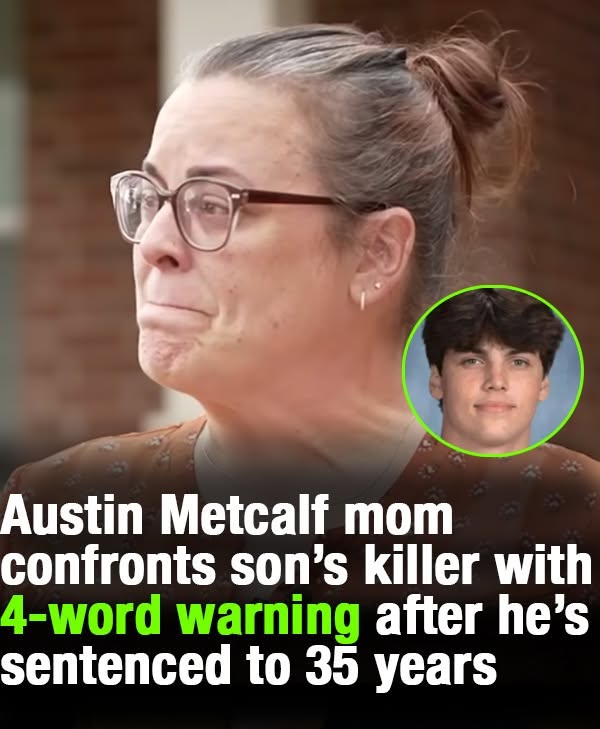
Austin Metcalf may be gone, but inside that Texas courtroom, his presence could still be felt in every tear, every trembling voice, and every painful memory shared by the family he left behind. The legal proceedings were nearly over. The verdict had been delivered. The sentence was about to be imposed. Yet for the people who loved Austin most, nothing about that day felt like justice. There would be no celebration, no relief, and certainly no closure.
Only grief.
As silence settled over the courtroom, Austin’s mother, Meghan, rose to speak. Her voice carried the weight of every sleepless night, every unanswered question, and every moment she had spent trying to understand how her son’s life could be taken so suddenly. Looking toward the young man convicted of killing Austin, she refused to allow her son to become just another name in a court file or another tragic headline forgotten by the public.
To her, Austin was not a victim.
He was her son.
She spoke about the simple things she missed most—the laughter that once filled their home, the hugs he gave freely, the way he brought people together without effort. She described him as a peacemaker, a young man who naturally made others feel welcome. Every memory painted the picture of a life interrupted far too soon.
Then her voice cracked as she spoke about the emptiness left behind.
An untouched bedroom.
A bed that would never be slept in again.
Family dinners with a chair that would forever remain empty.
The conversations that once happened across a kitchen table had been replaced by quiet visits to a gravesite.
She explained that while the defendant had received a sentence measured in years, her sentence carried no end date. One day, she said, he would leave prison and continue living his life. But as a mother, she would spend the rest of her life carrying the pain of losing her child.
No judge could reduce that sentence.
No appeal could shorten it.
No prison term could balance it.
The courtroom remained silent as her words settled over everyone present.
Then Austin’s father, Jeff Metcalf, stood to address the court.
His grief looked different.
It was quieter on the surface but no less powerful.
Looking directly toward Karmelo Anthony, Jeff spoke with a level of honesty that left the room frozen. He accused the young man of being unable to meet his eyes, despite having found the courage to commit the act that changed countless lives forever.
His words struck like a hammer.
“You found the courage to drive a knife into my son’s heart,” he said in essence, forcing everyone in the room to confront the reality of what had happened.
For a moment, the courtroom felt less like a legal proceeding and more like a father speaking directly to the person responsible for destroying his family.
Jeff admitted that Austin’s death had transformed him.
The man he had once been no longer existed.
The tragedy had reshaped every part of his life, leaving behind a grief that followed him everywhere. Yet despite the anger, despite the heartbreak, and despite the unimaginable loss, he spoke about forgiveness.
Not forgiveness for the crime.
Not forgiveness for the decision.
But forgiveness for the person.
It was a distinction that seemed difficult even for him to explain.
He made it clear that nothing could excuse what had happened. Nothing could justify it. Nothing could restore what had been taken away. Yet he refused to allow hatred to completely consume him.
The statement stunned many in attendance.
Even in the middle of unbearable pain, he was choosing a path that demanded extraordinary strength.
Jeff also pushed back against efforts to frame the tragedy through political or racial narratives. He reminded everyone in the courtroom that beneath every argument and every label, the reality remained painfully simple.
A young man had lost his life.
A family had been shattered.
And everyone involved bled the same color.
His comments shifted the focus away from public debates and back to the human cost of the tragedy.
Finally, as the sentencing phase reached its conclusion, Jeff delivered one final message.
Choices, he said, are free.
Consequences are not.
Those words echoed through the courtroom with unmistakable force. They served not only as a statement directed at Anthony, but as a reminder to everyone listening that a single decision can alter countless lives forever.
When the judge ultimately imposed a 35-year prison sentence, emotions overflowed on both sides of the courtroom.
Some cried openly.
Others sat in stunned silence.
For Austin’s family, the sentence represented accountability, but not healing. It could not restore birthdays that would never be celebrated. It could not bring back future weddings, future children, or future memories that would now exist only in imagination.
For Anthony and his family, the sentence marked the beginning of decades spent living with the consequences of a single irreversible night.
By the time the proceedings ended, one truth remained impossible to escape.
The courtroom had delivered its verdict.
The law had imposed its punishment.
But no sentence, no matter how long, could erase the pain left behind.
Austin Metcalf’s life had ended.
His family’s grief would continue.
And while the case itself may eventually fade from headlines, the people who loved him will carry its impact for the rest of their lives.