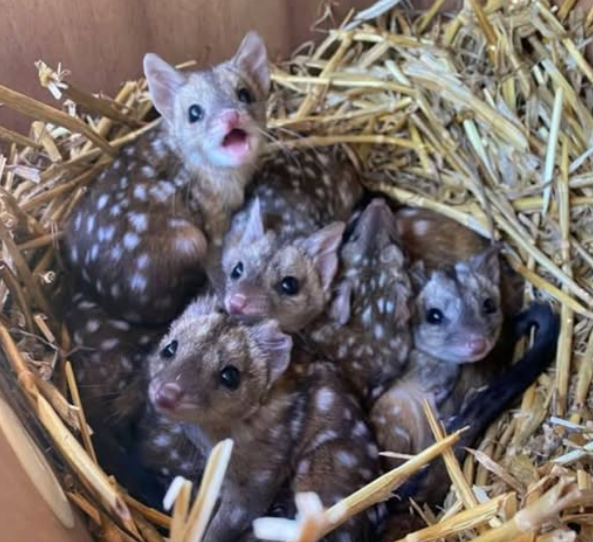
For years, conservationists feared they were watching the final chapter of a remarkable Australian animal. The western quoll—a small, spotted marsupial predator that once roamed vast stretches of the continent—had become increasingly rare, disappearing from landscapes where it had lived for thousands of years. Every passing decade seemed to bring more bad news: shrinking populations, disappearing habitats, and growing concern that future generations might know the species only through museum displays and old photographs. Then, one quiet night in Western Australia, something extraordinary happened. A faint rustle, a flash of movement captured by wildlife cameras, and a tiny life hidden inside a mother’s pouch offered a reason to believe that nature can still surprise us.
Researchers checking remote monitoring cameras hardly dared to hope.
The sanctuary had been carefully managed for years.
Animals had been released.
Habitats had been restored.
Predators had been controlled.
Still, successful reintroductions are never guaranteed.
Wild animals must do the hardest part themselves.
They must survive.
They must adapt.
And eventually, they must reproduce.
When ecologists finally examined one of the female western quolls more closely, they discovered the moment they had been working toward for years.
Tiny newborn joeys nestled safely inside her pouch.
Not one.
But several.
It was more than simply good news.
It was evidence that the animals weren’t merely surviving.
They were building a future.
For conservationists, few discoveries carry greater meaning than finding young born in the wild after a reintroduction program. Adult animals can sometimes survive for months or even years following release, but successful breeding demonstrates something much more important: the population is beginning to establish itself naturally.
The western quoll, also known by the Noongar name **chuditch**, once occupied enormous areas across Australia.
About the size of a domestic cat, these carnivorous marsupials are easily recognized by their reddish-brown fur decorated with striking white spots across the back and tail. Agile hunters, they feed on insects, reptiles, birds, small mammals, and other prey, helping maintain balance within Australia’s unique ecosystems.
For thousands of years, they played an important ecological role.
Then human settlement dramatically altered that balance.
As forests and native vegetation were cleared for agriculture and development, suitable habitat steadily disappeared. Introduced predators—including European red foxes and feral cats—placed enormous pressure on native wildlife that had evolved without such efficient hunters. Poisoning campaigns aimed at other animals, along with historical trapping and other human activities, added further challenges.
Across much of Australia, western quoll populations declined rapidly.
In many places, they vanished altogether.
Entire regions where they had once been common fell silent.
Over time, younger generations grew up never seeing one in the wild.
Stories passed down by older residents and First Nations custodians became some of the only remaining reminders that these remarkable animals had once thrived across the landscape.
Conservation organizations refused to accept that disappearance as inevitable.
Protected areas were established.
Research expanded.
Breeding programs carefully maintained genetically healthy populations.
Scientists studied habitat requirements, predator control strategies, and methods for improving survival following release.
Among the most significant efforts has been work at **Mt Gibson Wildlife Sanctuary** in Western Australia.
There, conservation teams spent years preparing suitable habitat before carefully reintroducing western quolls into areas where they had long been absent. Every release required extensive planning, health assessments, radio tracking, camera monitoring, and continuous observation to understand how the animals adapted to their new environment.
Patience became one of the project’s greatest tools.
Wildlife recovery rarely happens overnight.
Months can pass without major developments.
Sometimes years.
Each small sign of progress becomes meaningful.
Fresh footprints.
A successful hunt.
Evidence of territory establishment.
Then, finally…
Young.
The discovery of healthy joeys inside multiple females’ pouches represented a remarkable milestone.
These tiny, undeveloped marsupials spend their earliest weeks protected inside the pouch, where they continue growing while attached to their mother’s teats. As they mature, they eventually begin peeking outside before later riding on their mother’s back and ultimately becoming independent hunters themselves.
Every joey represents possibility.
Each one strengthens the future population.
Each birth increases hope that western quolls may once again become permanent residents of landscapes from which they had disappeared.
The benefits extend beyond a single species.
Predators like western quolls help regulate populations of smaller animals and contribute to healthier, more balanced ecosystems. Restoring native predators can improve ecological relationships that have been disrupted for generations, creating positive effects throughout entire food webs.
This success also demonstrates something larger about conservation itself.
Species declines are not always permanent.
When governments, scientists, Indigenous knowledge holders, land managers, volunteers, and local communities work together, damaged ecosystems can sometimes begin recovering in ways that once seemed impossible.
Of course, enormous challenges remain.
Western quolls continue facing threats from habitat fragmentation, invasive predators, road mortality, and changing environmental conditions. Long-term conservation requires ongoing funding, careful land management, continued predator control, and public support to ensure today’s progress is not reversed tomorrow.
No single success guarantees permanent recovery.
But every success matters.
For researchers who have devoted years to protecting these animals, seeing young western quolls emerge represents far more than another scientific achievement. It validates countless hours spent monitoring remote cameras, checking traps, conducting surveys, restoring habitat, and believing recovery remained possible even when evidence was scarce.
Sometimes conservation victories arrive quietly.
Not through dramatic announcements.
But through the gentle movement of a mother carrying new life inside a hidden pouch.
The western quoll’s story is ultimately about more than one remarkable marsupial.
It is about resilience.
About repairing mistakes that once seemed irreversible.
About recognizing that humans possess not only the power to damage nature but also the ability to help restore it when we choose to act with patience, knowledge, and care.
As tiny joeys begin exploring the Australian bush where their ancestors once thrived, they carry more than the future of their own species.
They carry hope.
Hope that lost wildlife can return.
Hope that damaged ecosystems can heal.
And hope that even after decades of decline, nature still has an extraordinary capacity for recovery when people decide that protection is more important than destruction.