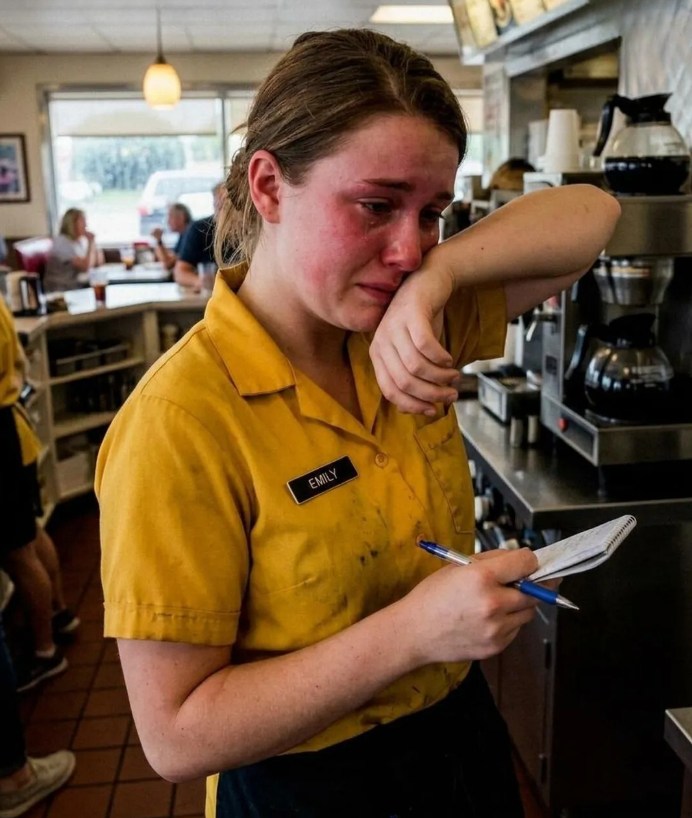
The soft clinking of ceramic spoons against coffee cups became the soundtrack of our Friday afternoons, a small ritual that somehow made the exhaustion of life feel manageable. From my usual booth tucked near the service door, I watched Maya move gracefully between crowded tables. To the busy commuters staring into phones and the tired customers lingering over half-finished novels, she was simply another teenage café worker — seventeen years old, dressed in a stained apron, balancing trays with practiced calm and greeting strangers with polite smiles. But to me, Maya was never ordinary. She was the child I held against my chest seventeen years earlier while her biological father walked away the moment he learned she did not carry his DNA. I still remember standing in that hospital room feeling my entire world collapse while he disappeared without a backward glance, abandoning both of us before our daughter had even opened her eyes properly.
For years afterward, survival became my full-time occupation.
Raising Maya alone was never something I regretted, but it demanded sacrifices that slowly carved themselves into my body over time. I worked every job I could find — overnight warehouse shifts, janitorial work in empty office buildings, diner kitchens, laundry services — anything that kept food on the table and rent paid. Some nights I came home so physically exhausted I could barely remove my shoes before falling asleep. But every difficult hour somehow felt worth it whenever Maya smiled at me from across our tiny apartment, proudly showing me school drawings taped to the refrigerator or reading stories aloud while I soaked swollen hands in warm water.
Still, the body eventually collects the cost of survival.
For months my knee had been hurting in ways I tried ignoring. At first it was just stiffness after long shifts. Then it became constant pain. Eventually it failed completely beneath me one morning while carrying boxes at work. The doctor explained calmly that surgery was no longer optional if I wanted to walk properly again. Worse still, recovery would require weeks without work — something financially impossible for us.
I tried hiding my fear from Maya.
But children raised through hardship become experts at reading silence.
Before I could fully process the diagnosis, Maya quietly announced she was applying for a part-time café job after school. I argued immediately, insisting she deserved to focus on being young rather than helping shoulder adult burdens. But Maya carried a calm determination that reminded me painfully of myself.
“I’m not little anymore,” she told me gently.
And watching her now behind the café counter, balancing impossible lunch rushes with patience and kindness, I realized she had been right.
That particular Friday, however, the café felt less like a workplace and more like a pressure cooker waiting to explode. The espresso machine malfunctioned halfway through the lunch rush, creating mounting delays and frustrated customers. The air conditioning struggled uselessly against the brutal heatwave pressing against the windows outside. Every employee looked overwhelmed. Every customer seemed impatient. The atmosphere buzzed with the dangerous energy that builds when people start believing their inconvenience matters more than another person’s humanity.
At the center of that tension sat the Sterlings.
They were regular customers — wealthy, polished, and impossible to please. Mrs. Sterling carried herself with the kind of cold elegance that made every interaction feel like a performance review. Draped in expensive silk and oversized jewelry, she treated servers as though they were defective machinery rather than people. Beside her sat Mr. Sterling, usually silent and detached, quietly reading newspapers while his wife criticized anything within reach.
That afternoon, the breaking point arrived over something painfully small.
A forgotten lemon wedge.
Maya delivered their tea during the chaos of the lunch rush, but the garnish had been accidentally left behind in the kitchen. Under ordinary circumstances, it should have been a minor inconvenience fixed within seconds. Instead, Mrs. Sterling erupted.
Her voice sliced through the café sharply enough to stop nearby conversations entirely.
At first she complained about incompetence. Then carelessness. But within moments, her anger became deeply personal. She mocked Maya’s intelligence, appearance, and future with shocking cruelty. She called her a “nothing,” a “bottom-tier girl,” and a “waste of space” who would never amount to anything meaningful.
The entire café fell silent.
I felt something inside me turn instantly from ice to fire.
Ignoring the pain tearing through my knee, I pushed myself upward from the booth ready to defend my daughter no matter how badly it hurt. No child deserves to stand alone while being humiliated publicly like that.
But before I could reach them, someone else stood first.
Mr. Sterling.
The screech of his chair against the floor sounded almost violent inside the silence.
For the first time since I’d ever seen him enter the café, he looked fully awake.
“Stop,” he said sharply.
Mrs. Sterling stared at him in disbelief, demanding to know why he was suddenly defending “some nobody waitress.”
And then everything changed forever.
“Because,” he said quietly, his voice carrying clearly across the stunned café, “that ‘nobody’ is the daughter you abandoned in a hospital hallway seventeen years ago.”
The room seemed to lose oxygen instantly.
Mrs. Sterling’s expression collapsed from fury into horror so quickly it looked physically painful. Her face drained pale while her eyes locked onto Maya — truly seeing her for the first time rather than looking through her like staff.
And suddenly I understood.
The shape of Maya’s jaw.
The eyes.
The timing.
Everything.
The woman who had just verbally destroyed my daughter was staring at her own biological child.
Mrs. Sterling collapsed backward into the booth gasping for breath as though the truth itself struck her physically. Meanwhile Mr. Sterling stepped toward Maya slowly, tears gathering in his eyes with the devastating realization of finally standing inches away from the child he lost nearly two decades earlier.
I finally reached Maya’s side then, bracing myself against the counter for support.
I expected her to be crying.
Shaking.
Furious.
But instead, she stood calm and steady in a way that stunned me completely.
When Mr. Sterling reached forward tentatively as if asking permission to touch her hand, Maya didn’t recoil — but she didn’t move toward him either. Instead, she quietly reached back and took my hand, weaving her fingers tightly through mine.
That single gesture nearly broke me.
Mr. Sterling apologized repeatedly after that, his words tumbling over one another through visible shame. He explained that years earlier, overwhelmed by fear and family pressure, they surrendered their daughter and regretted it almost immediately afterward. He claimed they searched for answers for years without success, never imagining fate would place her directly in front of them inside a neighborhood café.
Then his eyes shifted toward my knee brace, my worn clothes, and the exhaustion age and labor had carved into my body.
And suddenly he offered everything.
Surgery.
Money.
Debt relief.
Education for Maya.
A future free from financial struggle.
He insisted it came without conditions, describing it not as charity but as a debt owed to both of us for the life we carried alone.
The café remained completely silent waiting for Maya’s response.
She looked first at Mr. Sterling — emotional, guilty, desperate.
Then at Mrs. Sterling — shattered by the realization of how cruelly she treated her own daughter moments earlier.
Finally Maya spoke softly, but every word landed with impossible clarity.
“Respect shouldn’t suddenly appear because of a blood test,” she said. “People deserve kindness before you know who they are.”
No bitterness.
No screaming.
Just truth.
She explained calmly that every waitress, cashier, cleaner, and stranger deserves dignity because nobody knows the story sitting across from them. Then she told them we needed time before making any decisions about relationships or forgiveness.
As evening sunlight stretched golden shadows across the sidewalks outside, Maya and I walked home slowly together. She matched her pace carefully to my limp without saying anything about it. The entire world felt strangely different now. Secrets were exposed. Possibilities had changed. For the first time in years, financial security no longer seemed impossible.
And yet something deeper remained exactly the same.
The Sterlings may have shared Maya’s biology.
But I shared her life.
I was the one who stayed through fevers, nightmares, school plays, heartbreaks, and hungry winters. I was the one who taught her compassion strong enough to answer cruelty with dignity instead of hate. And Maya, in return, became the kind of daughter who stepped quietly into adulthood the moment she realized her mother was struggling to stand alone.
As she leaned her head gently against my shoulder during the walk home, I realized no amount of wealth could recreate what we had built together through years of sacrifice.
We weren’t connected by convenience.
Or appearances.
Or blood alone.
We were connected by survival, loyalty, and thousands of ordinary Fridays spent choosing each other over and over again.
And in the end, that bond felt richer than anything money could ever buy.