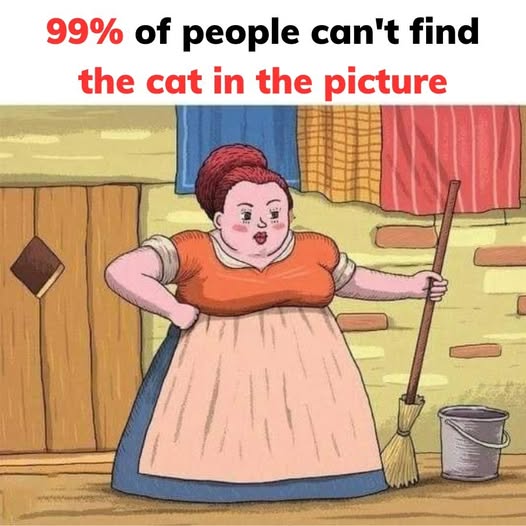
You feel foolish, and somehow the feeling reaches deeper than it should. It’s only a picture, only a red circle around some supposedly obvious shape hidden in plain sight — and yet your pulse quickens as you stare at it. Everyone else claims they can see the cat immediately. They talk about it with certainty, with casual confidence, as though the answer practically jumps off the screen. But your eyes keep scanning the image without success, moving back and forth until the lines blur together and the red circle starts to feel less like help and more like accusation.
You lean closer, convinced the problem must be you.
At first, it feels minor. Mild embarrassment. A private frustration you laugh off internally. But then something stranger begins happening beneath the surface. The longer you search without finding what everyone else insists is obvious, the more the doubt spreads. Your brain quietly starts pulling old fears into the room. Maybe you’re missing something simple. Maybe you’re slower than other people. Maybe everyone else understands the world more naturally than you do. Suddenly the image stops being about a hidden cat at all. It becomes a test — of perception, intelligence, belonging, even trust in yourself.
And the harder you force yourself to see it, the less certain you become of anything.
That is what makes moments like this surprisingly emotional. The discomfort isn’t really visual; it’s social. Human beings are deeply wired to fear exclusion, and nothing triggers that fear faster than realizing other people seem united around a reality you cannot access. When enough people confidently insist something is obvious, it becomes painfully easy to assume the flaw must exist inside you rather than question the group itself. So you keep staring, hoping that if you try hard enough, your eyes will eventually align with everyone else’s certainty.
But beneath that struggle lies something older and more familiar than the image on the screen.
The red circle becomes symbolic almost immediately. It represents every moment you laughed because everyone else laughed, even when you didn’t understand the joke. Every meeting where you nodded along while secretly confused. Every classroom, friendship, workplace, or conversation where pretending to “get it” felt safer than admitting you didn’t. Over time, many people become experts at overriding their own perception just to maintain social safety. Agreement becomes instinctive. Doubt turns inward instead of outward.
And that quiet habit carries a cost.
Each time you dismiss your own experience in favor of collective certainty, something subtle erodes inside you. Not dramatically, not all at once — just gradually enough to become invisible. You stop trusting your reactions. You second-guess your instincts before they fully form. You assume confidence from others must automatically outweigh uncertainty within yourself. Eventually, the fear of appearing wrong becomes stronger than the desire to perceive honestly.
That is why the emotional reaction feels disproportionate. The image taps into something much deeper than confusion over a hidden object. It touches the exhausting pressure of wanting desperately to belong while quietly fearing your mind works differently from everyone around you. The panic doesn’t come from not seeing the cat. It comes from wondering how many times in your life you abandoned your own perception because you believed the group must know better.
And perhaps the most painful realization is how automatic that surrender can become.
Most people are taught, directly or indirectly, that certainty equals intelligence. Hesitation feels dangerous. Saying “I don’t see it” risks embarrassment, exclusion, or judgment. So instead, people adapt. They smile. Agree. Pretend. They train themselves to distrust internal experience whenever it conflicts with social consensus. Over years, that habit becomes so normal they barely notice it happening anymore.
But there is another possibility hidden inside moments like these.
Maybe growth does not arrive the instant you finally locate the cat in the picture. Maybe the more meaningful shift happens when you stop treating your own perception as inferior simply because it differs from the crowd. Maybe the important moment is quieter: the second you allow yourself to sit with uncertainty without turning it into self-condemnation. The second you say, calmly and honestly, “I don’t see it,” without apologizing for existing differently from the people around you.
Because perception is not morality. Missing something does not make you broken. And certainty from a group is not always proof of truth.
In a strange way, the image reveals something unsettling about human nature: how quickly we sacrifice self-trust for belonging. Yet it also offers a chance to reclaim that trust. Not through arrogance or stubbornness, but through honesty. Through allowing your own experience to exist without instantly assuming it must be defective.
Maybe the real victory is not finally spotting the hidden cat after exhausting yourself trying to match everyone else’s reality. Maybe it’s realizing that your worth was never dependent on seeing what the crowd sees in the first place.
And maybe, after years of quietly betraying your own perception to stay safe, there is something profoundly healing about simply saying: “I still trust my eyes.”