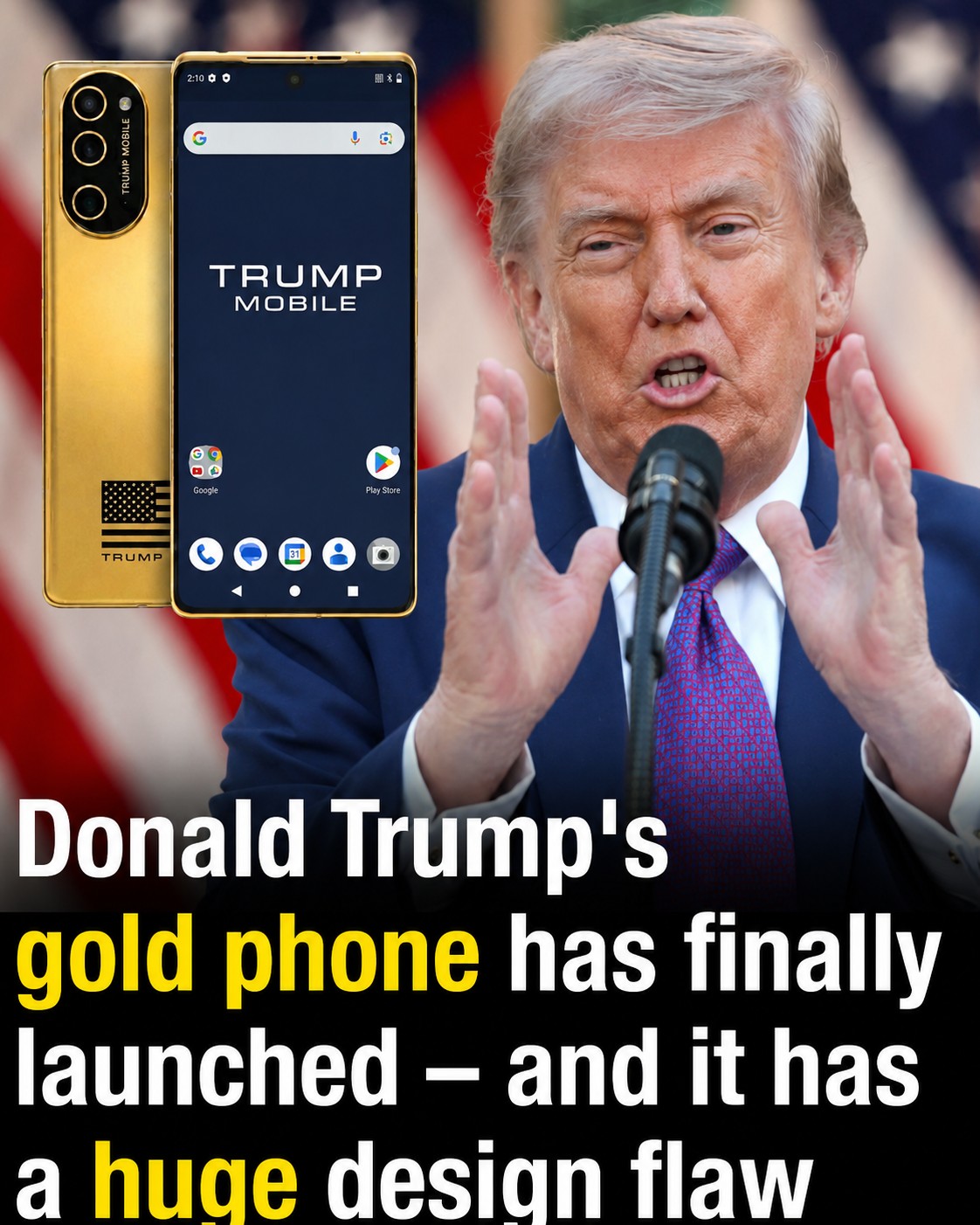
The moment the gold “T1” Trump Mobile finally reached buyers, excitement turned into scrutiny almost instantly. Supporters who had placed deposits and defended the project through delays expected a triumphant rollout — a flashy, unapologetically patriotic smartphone wrapped in promises of American manufacturing and national pride. Instead, within hours of the first photos appearing online, attention shifted to one tiny detail nobody expected to matter so much.
The flag on the back of the phone appeared to have only 11 stripes.
At first people assumed the images were fake, badly angled, or edited. Then more photos surfaced from different buyers. Social media users zoomed in obsessively, counting again and again while screenshots spread across platforms at viral speed. Suddenly the phone itself almost stopped mattering. The missing stripe became the story.
Critics pounced immediately.
To some observers, it looked like a simple design mistake — embarrassing, careless, but ultimately harmless. Yet in the hyper-symbolic world surrounding anything connected to Donald Trump, even small details rapidly absorb larger meaning. Commentators began treating the missing stripe as a metaphor for the entire project: loud patriotic branding built on shaky execution and blurry specifics.
That symbolism deepened because questions about the phone’s manufacturing origins were already circulating before launch.
Early promotional language heavily emphasized ideas like “Made in America” and domestic pride, appealing directly to consumers attracted by economic nationalism and anti-globalization messaging. But over time, wording around the device reportedly softened into broader phrases about being “designed with American values in mind,” a subtle shift critics interpreted as retreat from the original implication.
Then tech analysts began comparing the T1’s appearance and hardware layout to existing phones linked to overseas manufacturing, including models assembled in Taiwan.
That comparison fueled another wave of online mockery.
Suddenly the missing stripe stopped being just a design flaw and became shorthand for something bigger: the gap between branding and reality in modern political consumer culture. The phone transformed into a kind of cultural Rorschach test where people saw whatever confirmed their existing beliefs. Supporters dismissed the outrage as obsessive nitpicking from opponents desperate for ridicule. Critics saw the controversy as proof that symbolic patriotism often matters more to marketers than factual precision.
And honestly, the intensity of the reaction revealed something deeper about modern politics and branding itself.
Products connected to political identity rarely function as ordinary consumer goods anymore. They become emotional statements. Buying them signals belonging, loyalty, worldview, even rebellion against perceived enemies. In that environment, tiny imperfections carry disproportionate weight because people are not only evaluating hardware — they are evaluating the authenticity of the narrative attached to it.
That is why one missing stripe generated more conversation than processor speed, battery life, or camera quality combined.
The phone became less about technology and more about trust.
Can a product built around patriotic symbolism survive obvious symbolic mistakes? Does manufacturing location matter if the audience mainly wants cultural representation? How much imperfection will supporters overlook when the item itself doubles as a political statement?
For many buyers, apparently quite a lot.
Despite the criticism, preorder shipments continue arriving, and many supporters insist they simply do not care whether every component originates domestically. To them, the phone represents alignment with broader political values rather than literal manufacturing purity. They argue that nearly all modern electronics rely on global supply chains anyway, making total American production unrealistic in the current tech economy.
Critics counter that this is exactly the point: the rhetoric promised certainty while reality delivered ambiguity.
And so the T1 controversy now exists in that familiar modern space where politics, branding, consumer identity, and internet mockery blur together completely. A missing stripe on a decorative flag became national discourse because every object tied to Trump inevitably expands beyond itself into symbolic warfare.
As an actual smartphone, the T1 may function perfectly well for most users.
But as a patriotic icon meant to embody precision, strength, and all-American confidence, the rollout has already become something far messier: a reminder that in the age of viral scrutiny, even the smallest design oversight can overshadow the entire message printed around it.