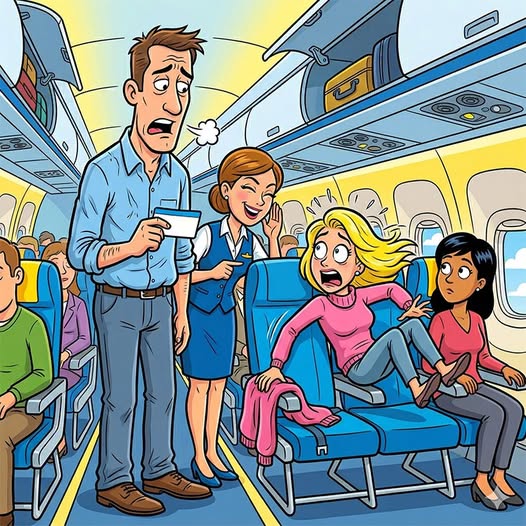
He begged. She refused.
At first, most passengers in row 17 tried pretending not to notice the tension building beside them. Airplanes are full of tiny social contracts held together by exhaustion and forced politeness. People avoid eye contact, wear headphones like armor, and silently pray nobody creates a scene before takeoff. But this disagreement had already crossed the point of quiet irritation. It sat in the cabin thick as turbulence.
The tall man standing awkwardly in the aisle — later introduced as Mr. Johnson — clearly did not fit comfortably into the tiny middle seat assigned to him. Even before sitting down, his knees pressed against the tray table in front of him at an angle that looked physically painful. Meanwhile, the blonde woman already occupying the aisle seat leaned confidently against the armrest with the relaxed posture of someone who had absolutely no intention of moving.
“I booked this seat weeks ago,” she said flatly when he politely explained the situation.
Mr. Johnson tried to smile through obvious embarrassment.
“I understand,” he replied carefully, “but I physically can’t fit comfortably in the middle for six hours.”
The woman shrugged without even looking at him directly.
“That’s not really my problem.”
A few nearby passengers exchanged uncomfortable glances. Nobody wanted involvement, but everyone was listening now. The cabin crew continued boarding while the standoff quietly expanded into public humiliation. Mr. Johnson attempted reason again, speaking softly enough to avoid making her look unreasonable in front of others.
“I’d really appreciate it if we could switch.”
“No.”
Simple. Immediate. Final.
The tension sharpened.
He explained he was over six foot five. He pointed out that aisle seats are usually recommended for taller passengers. He even offered to buy her drinks during the flight. Nothing worked. The blonde crossed her legs calmly and stared ahead as if the conversation bored her.
By now, passengers nearby had fully abandoned pretending not to watch. Some looked sympathetic toward Mr. Johnson. Others seemed fascinated by the sheer stubbornness unfolding in such a confined space. One older man muttered under his breath about “basic decency.” A woman across the aisle pulled out her phone briefly before thinking better of it.
Still, the blonde refused to move.
Eventually a flight attendant approached, carrying the polished calm of someone who had spent years diffusing human chaos in narrow metal tubes thousands of feet above the earth.
“Is there a problem here?” she asked pleasantly.
Mr. Johnson explained the situation, clearly trying not to sound angry. The blonde interrupted twice to insist the seat was legally hers and that she had done absolutely nothing wrong.
Technically, she was correct.
That somehow made the situation worse.
The flight attendant listened carefully, nodded once, then leaned down slightly toward the blonde and whispered five quiet words into her ear.
Nobody else heard them.
But the reaction was immediate.
The blonde’s entire expression changed.
Confidence vanished first. Then irritation. Then something much closer to alarm flickered across her face. Without another argument, without even a sigh of protest, she unbuckled her seatbelt, grabbed her purse, and slid silently into the middle seat.
The entire row seemed to exhale at once.
Mr. Johnson blinked in confusion before awkwardly settling gratefully into the aisle seat. Nearby passengers exchanged stunned looks. One teenager actually smirked like he had just witnessed a magic trick.
Because honestly, it felt like one.
Nothing else was said about it for the rest of the flight.
But the mystery lingered heavily in the air between rows 17 and 18.
Mr. Johnson spent the next six hours unable to stop wondering what the flight attendant had possibly said. His imagination grew increasingly dramatic somewhere over Ohio. Maybe the blonde had violated some obscure airline policy. Maybe the attendant quietly threatened removal from the flight. Maybe she had recognized her from previous incidents. The speed of the surrender felt too absolute to be explained by ordinary persuasion.
Meanwhile, the blonde remained unusually quiet for the rest of the trip.
She avoided eye contact. She barely touched her drink. At one point she glanced suspiciously toward the aisle seat beside Mr. Johnson as though replaying the whispered sentence repeatedly in her head.
After landing in New York, passengers began gathering bags and filing slowly off the plane. Mr. Johnson waited near the front until the flight attendant passed by again.
“I have to ask,” he said quietly. “What did you say to her?”
The attendant smiled immediately, clearly enjoying the memory.
“Oh,” she said casually, “I just told her the aisle seat wasn’t going to New York.”
For a second, Mr. Johnson simply stared at her.
Then the meaning hit him all at once.
The blonde had not moved because she was threatened.
She moved because, for one brief irrational moment, panic overpowered certainty. The idea that she might somehow end up in the wrong destination short-circuited the stubborn confidence she had defended so fiercely minutes earlier. Logic disappeared beneath instinct. The flight attendant had not argued harder or asserted authority. She had simply redirected the woman’s assumptions long enough for emotion to take control.
Mr. Johnson burst out laughing right there in the jet bridge.
Not cruelly. Just in disbelief at how absurdly simple the solution had been.
And honestly, that may have been the most fascinating part of the entire encounter: how easily certainty can collapse when fear quietly enters the room. The blonde had resisted logic, politeness, social pressure, even public embarrassment. Yet five carefully chosen words bypassed all of it instantly.
What began as a petty fight over legroom became something strangely unforgettable — a tiny human drama about pride, perception, and the fragile ways people hold onto control.
Because sometimes the loudest conflicts are not solved with force at all.
Sometimes they are solved with one perfectly timed sentence whispered at exactly the right moment.