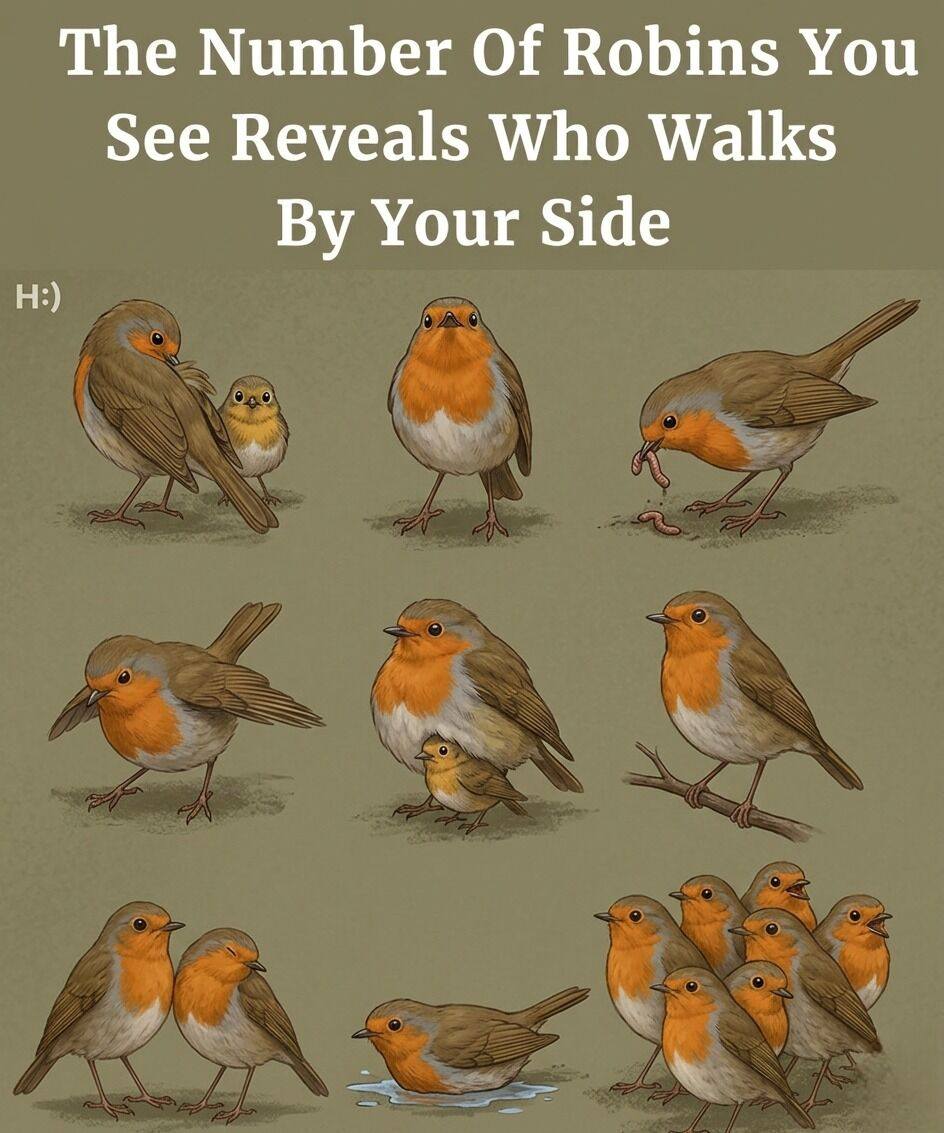
The robin arrives when you least expect it. Just a flash of red-brown in the corner of your eye… and suddenly the ordinary moment feels altered, as if something invisible has gently brushed against your thoughts. One bird. Two. A small, watchful gathering perched along a fence or hopping across wet grass. Each number seems to carry its own emotional weight, like a quiet message you almost understand before it disappears again. People pause without meaning to. Conversations soften. For a second, the noise of the day fades, and attention narrows to that tiny living thing standing calmly in the middle of a restless world.
Robins have a strange way of slipping into ordinary days and making them feel quietly significant. Their bright chests glow against grey skies, bare branches, sidewalks, patios, and forgotten park benches, becoming small points of warmth in landscapes that otherwise feel cold or distracted. Many people notice them during seasons of grief, loneliness, change, or uncertainty, which may be why their presence often feels so personal. A single robin can seem almost deliberate, as though it arrived at the exact moment you needed something gentle to notice. It does not erase pain or answer questions, but it can feel like a soft reassurance placed beside you: a reminder that life still moves, breathes, and returns even after difficult seasons.
Sometimes the feeling is tied to memory. A robin outside a hospital window, near a gravesite, or sitting silently in a morning garden can become connected to people we miss or moments we are still trying to understand. The bird itself does nothing extraordinary, yet the mind wraps meaning around it because humans naturally search for comfort in symbols. The robin becomes more than feathers and movement; it becomes a pause, a reflection, a quiet companion during moments when emotions feel too large to explain aloud. Even people who do not usually think spiritually may still feel something shift inside them when that bright little bird lingers nearby longer than expected.
When more robins appear, the emotional tone changes in subtle but powerful ways. Two robins can feel like partnership, shared burdens, mutual protection, or the hope that no one is meant to carry life completely alone. Their movements together — one following the other across the grass, both perched side by side on a branch — can mirror the human desire for balance and understanding. To someone going through heartbreak or distance, the sight may stir longing. To someone healing, it may offer comfort, suggesting that connection can still exist after loss.
A larger group creates a different feeling entirely. Several robins gathered together can resemble quiet community, a reminder that support may exist beyond what you currently see. In difficult periods, people often convince themselves they are isolated, forgotten, or carrying struggles unseen by everyone else. Yet a cluster of robins moving together across a yard can unexpectedly challenge that feeling. Their presence hints at belonging, cooperation, and survival through shared movement rather than solitude. Even if the meaning is entirely emotional, the comfort it creates is real.
None of these interpretations are scientific. The robin is not consciously delivering signs or secret messages. The meaning lives in the deeply human space between perception and feeling, where memory, hope, fear, and longing quietly shape what we notice. But perhaps that is exactly why these moments matter. In choosing to pause and pay attention, people reveal something about themselves. The person who sees reassurance in a robin may be searching for peace. The person who notices companionship may be aching for connection. The person who feels strengthened by a flock may be trying to remember they are not alone.
And maybe that is the robin’s real gift. Not prophecy. Not magic. Simply the ability to interrupt ordinary life for a few fragile seconds and remind us to feel something softer than fear. In a world that moves quickly and demands constant attention, the small bird becomes a reason to stop, breathe, and reconnect with emotions we often bury beneath routine. Its arrival does not change reality, but it changes the way a moment is experienced. Sometimes that small shift is enough to help someone keep going.
Long after the bird flies away, the feeling often remains. The branch becomes empty again. The garden returns to silence. Yet something inside the observer feels slightly lighter, steadier, or more awake than before. Perhaps that is why people continue to remember these encounters so vividly. A robin appears for only seconds, but the meaning attached to it can stay for years, woven quietly into memories of loss, healing, hope, and survival.