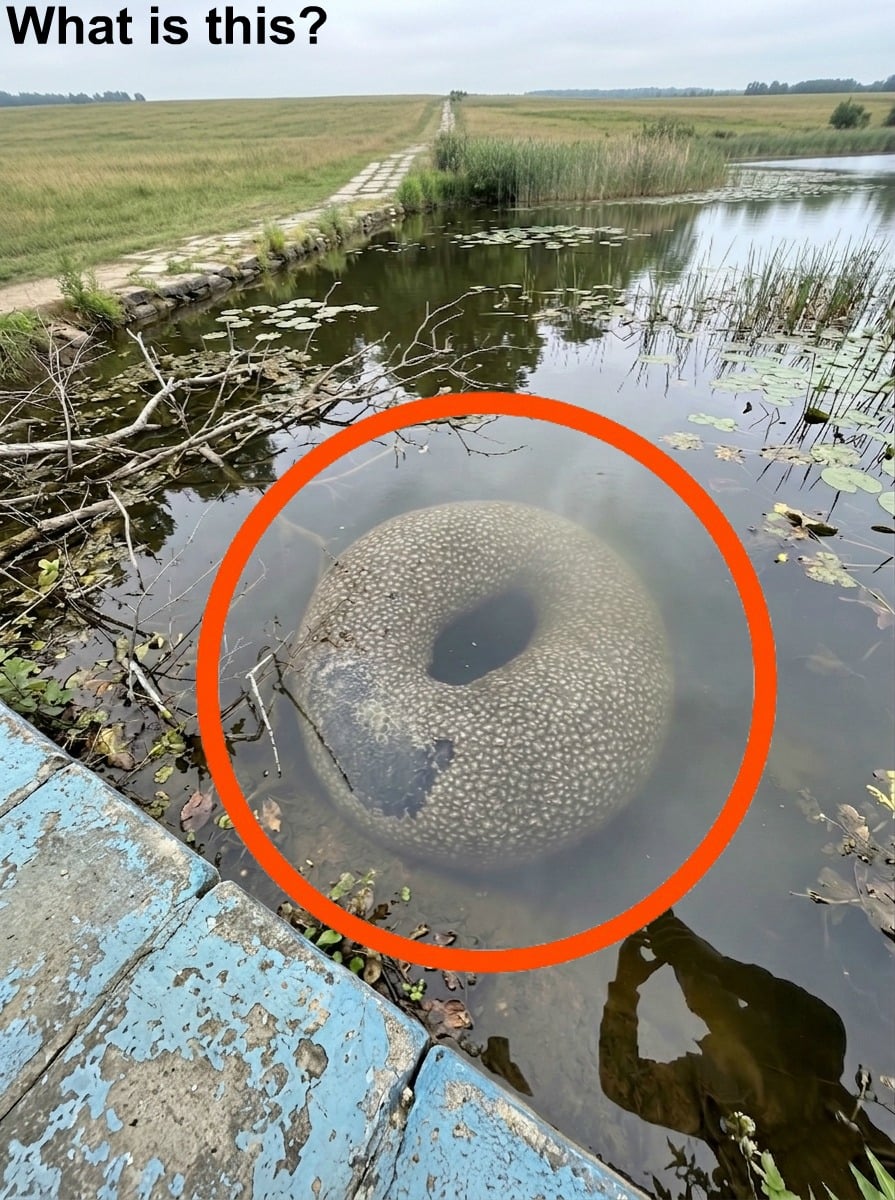
The shape in the water should not have been there.
At first, I thought my eyes were playing tricks on me. The lake had been calm only moments earlier, perfectly still beneath the gray afternoon sky. Then I noticed it floating near the far edge of the shoreline — a massive dark circle half-submerged in the water. Something about it felt immediately wrong. It was too round, too silent, too unnatural against the movement of the lake. From a distance, its surface looked burned or charred, blackened in strange uneven patches that made it seem almost alive.
I stopped walking without even realizing it.
My heartbeat suddenly sounded louder than the wind brushing through the trees. The longer I stared, the more unsettling the object became. It did not move like ordinary debris. It simply floated there, heavy and watchful, as though it belonged to something hidden beneath the water.
Within minutes, other villagers began gathering along the shore after noticing the same thing. People pointed nervously from a distance while whispering theories to one another. No one wanted to step too close. The uncertainty itself became contagious. One person suggested it might be a trap dumped in the lake years ago. Another swore it looked like part of a military device. Someone else quietly mentioned the possibility of a dead animal — or something worse.
Each new theory made the atmosphere heavier.
What had started as a peaceful walk slowly transformed into something tense and surreal. The crowd kept growing, yet nobody seemed willing to approach the object directly. Children stood behind their parents. Phones appeared as people snapped pictures and argued over what they were seeing. And standing there among strangers staring into the dark water, I felt a strange realization settle over me:
Fear expands quickly when nobody has an answer.
The human mind hates uncertainty. The moment something cannot be explained immediately, imagination rushes in to fill the empty space. Every shadow begins to feel dangerous. Every unusual shape becomes evidence of something hidden.
For a while, the lake itself no longer felt familiar.
It felt secretive.
As though something ordinary had suddenly slipped out of place, cracking open reality just enough to let panic inside.
Then the old man arrived.
He pushed through the small crowd slowly, glanced toward the floating shape for only a few seconds, and burst into laughter loud enough to cut through the tension instantly. People looked at him in confusion while he shook his head and pointed toward the water.
“It’s an old rubber inner tube,” he said casually. “Probably abandoned years ago.”
At first nobody believed him. But once a few men moved closer with sticks, the truth became obvious. Beneath layers of algae, moss, mud, and weather damage sat nothing more mysterious than a warped inner tube left floating in the lake for too long.
The crowd laughed nervously in relief.
Conversations immediately became lighter. People mocked the wild theories they had invented only minutes earlier. Slowly the fear dissolved, replaced by embarrassment and humor.
Yet even after the explanation, something about the image stayed with me.
Because for those few moments before the truth was known, the object had genuinely felt terrifying. My mind had transformed an abandoned piece of rubber into something sinister simply because it appeared strange and unexplained in the wrong setting.
And maybe that is what unsettled me most in the end.
Not the object itself.
But realizing how quickly fear can distort ordinary reality into something monstrous. How easily uncertainty allows imagination to take control. And how some images, once seen through the lens of fear, never completely return to harmlessness again — even after the mystery is solved.