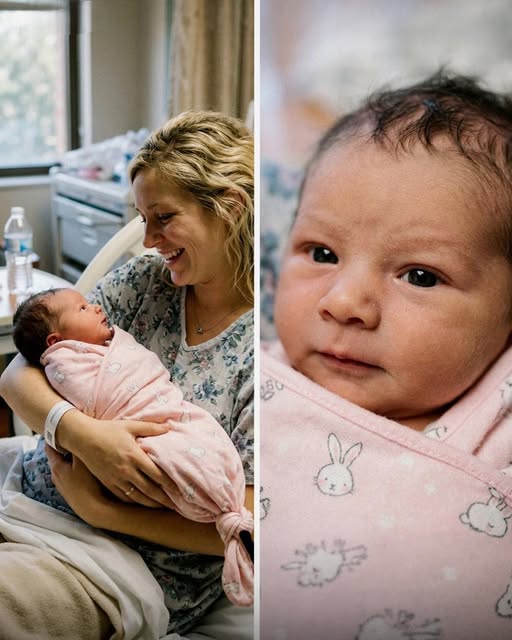
My eighteen hours in labor were a jumble of rapidly rising blood pressure, frenzied monitors, and the unsettling quiet of a medical staff that had run out of simple solutions. I expected my husband, Ryan, to be my pillar of support during the fog of my recuperation after I almost died giving birth to our daughter, Lily. But instead of the happiness I expected, he gave her a hollow, eerie look when he finally held her. Two weeks after coming home, the man I loved had turned into a ghost, leaving me alone with our newborn while he crept out of our bed at midnight and vanished into the night.
It was impossible to ignore the warning signs. Ryan stopped looking at Lily; instead, he would feed her and change her diapers while staring at the wall behind her head, avoiding her face as though it were a mirror reflecting a bad dream. He said he “just couldn’t sleep” and “needed a drive” when I challenged him about his midnight absences over breakfast. On the fifth night, I waited for the floorboards to groan and followed his taillights into the city, fearing the worst—an affair, a covert addiction, or a complete rejection of fatherhood.
He took me to a dilapidated community facility with a flickering neon sign that said, “Hope Recovery Center,” an hour away. As I saw him slump his shoulders and vanish inside, my heart pounded against my ribs. I crept over to a half open window and braced myself for the sound of another woman’s voice. Rather, I heard my husband’s heartbroken cry.
Ryan said to a group of strangers, “I keep having these nightmares.” “I see her hurting. I see the physicians hurrying. My wife is dying next to me, and I picture myself cuddling this ideal baby. I can’t even look at my baby without thinking back to that time because I feel so angry and powerless.
The truth was exposed in that dimly lighted room. Ryan was a guy broken by Secondary Birth Trauma, not a careless father or an unfaithful husband. According to statistics, after a difficult birth, about 9% of partners exhibit signs of post-traumatic stress disorder. Studies show that up to 5% of fathers may experience full-scale PTSD, but because they are expected by society to “tough it out,” they are much less likely than moms to seek professional assistance.
As I crouched in the dark, I heard him confess that he shunned skin-to-skin contact out of concern that his “poisonous anxiety” might spread to the infant. Unaware that his quiet was the same thing pulling us apart, he was attempting to shield us by putting distance between us. He informed the group leader that I had “been through enough,” thus he was unable to tell me.
I understood as I drove home in tears that Ryan was emotionally drowning while I was recovering physically. I secured a spot in a partners’ support group the following Wednesday. I discovered that birth trauma is a family issue rather than a personal one. Equipped with expert advice and the bravery I discovered among that group, I awaited Ryan’s return from his subsequent appointment.
I softly murmured, “I followed you,” as he entered the room. “I am aware of the trauma group.”
His expression changed from one of defeat to one of deep relief. Ryan sat on the couch and stared straight at Lily for the first time since the delivery room. He eventually let his fingers brush her little hand and said, “I was so scared of losing you both.”
The nocturnal drives have ceased after two months. We’ve discovered through shared vulnerability and couples counseling that Lily’s birth trauma need not loom large over her life. Ryan now hugs her every morning, his gaze concentrated on the lovely, vibrant future we nearly lost instead of the past. We came to see that the best thing a father can do is to bring his family into the light so they can all heal together, rather than to conceal his dread.