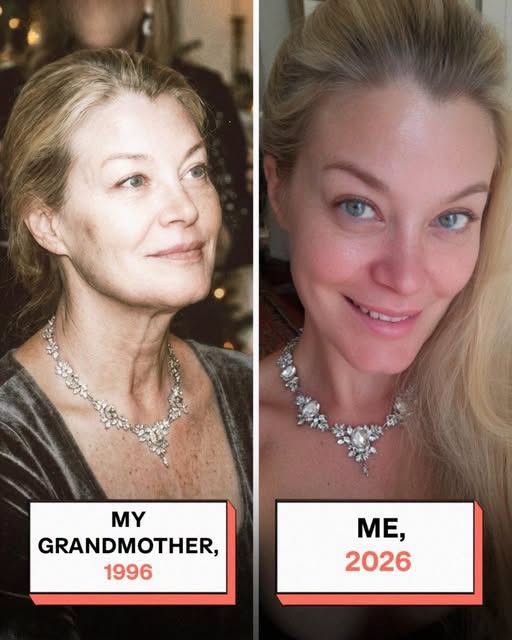
I was convinced I was about to give away the last remaining piece of meaning I had left, just to buy myself a little more time. I didn’t realize that the moment I stepped into that small pawn shop, I wasn’t closing a chapter—I was unknowingly opening a door to a past that had been waiting for me in silence for years.
After the divorce, what I walked away with could barely be called a life.
Just a phone that struggled to stay alive, and two heavy bags of clothes that no longer felt like they belonged to me. And then there was the one thing I refused to part with for as long as I could—my grandmother’s necklace.
That necklace was never just an object. It wasn’t decoration or value or sentiment in the usual sense. It was memory made physical. It was the only thing that still tied me to a version of my existence before everything collapsed—before loss, before abandonment, before survival became the only routine I knew.
But life doesn’t wait for you to be ready.
The miscarriage had already taken something from me that I couldn’t name but could always feel. And while I was still learning how to exist with that absence, my husband left—without warning, without explanation, as if I were something easily replaced. He moved on toward a life that felt lighter to him, one that didn’t carry grief in its pockets.
After that, life stopped feeling like living and started feeling like maintenance.
Work. Sleep. Repeat.
I took every shift I could at the diner, stacking hours the way other people stack stability. I counted tips like they were survival units. I smiled when required, nodded when expected, and kept moving forward because stillness meant reflection—and reflection meant collapse.
But determination only stretches so far before reality starts pulling harder.
One night, I came home and saw it waiting for me.
A notice. Bright red. Absolute in its tone.
FINAL WARNING.
It wasn’t just paper—it was pressure given form. A countdown I didn’t have the power to stop.
I stood there longer than I should have, staring at it, hoping in some irrational part of myself that ignoring it might change its meaning.
It didn’t.
And somewhere beneath the panic, I already knew what the solution was. I just hadn’t accepted it yet.
That night, I pulled the shoebox from the very back of my closet.
Inside, wrapped carefully in an old scarf, was the necklace.
I hadn’t touched it in a long time. Maybe I had been avoiding the reminder of what it meant.
But when I held it again, it didn’t feel like I remembered. It felt heavier. Almost aware. Like it had been waiting for this exact moment.
“I’m sorry,” I whispered into the quiet of my room. “I just need a little more time.”
I must have taken it out and put it back down again more times than I could count that night. Each time felt like a negotiation with myself. Each time ended the same way.
There was no other choice.
Morning arrived whether I was ready or not.
And with it, the truth I had been trying to avoid.
The pawn shop sat in the middle of downtown—one of those places people only notice when they’re running out of options.
The bell above the door rang as I stepped inside.
An older man stood behind the counter. Calm. Observant. The kind of stillness that comes from years of seeing people at their most desperate.
“Can I help you?” he asked.
I hesitated for only a second longer than I should have.
Then I placed the necklace on the counter, gently, as if releasing something fragile into a world that didn’t promise to return it.
“I need to sell this.”
At first, nothing about him changed.
Then he looked closer.
And everything in him shifted.
His hands stopped moving. His expression tightened. His eyes fixed on the necklace with a recognition that didn’t belong to a stranger.
“Where did you get this?” he asked, quieter now.
“It was my grandmother’s,” I said, a little sharper than I meant to. “I just need enough for rent.”
“What was her name?”
That question made me pause.
“Merinda,” I answered. “Why?”
He stepped back slightly, gripping the edge of the counter as if the floor beneath him had changed.
“You should sit down,” he said.
My stomach tightened. “Is something wrong with it?”
“No,” he said quickly. “No—it’s authentic. It’s very real.”
Before I could understand what that meant, he picked up the phone and dialed with shaking precision.
“I have it,” he said into the receiver. “The necklace. She’s here.”
A cold line ran through my entire body.
“Who are you talking to?” I asked.
He lowered the phone slightly, eyes still on me.
“The person who has been looking for this for twenty years.”
Nothing about that sentence belonged in my reality.
Before I could react, a door behind the counter opened.
And then she appeared.
“Desiree?” I said, almost automatically.
She looked older, shaped by time the way everyone is, but she still carried something familiar—something steady, something I remembered without fully understanding why. My grandmother’s closest friend. A presence from childhood that I had never expected to see again.
The moment she saw me, her composure cracked.
“I’ve been looking for you,” she said.
And then she crossed the room and pulled me into an embrace that felt both foreign and instinctively familiar.
I didn’t know how to respond. I just stood there, frozen in everything I didn’t understand.
“What is happening?” I asked when she finally let go.
She studied me for a long moment, as if confirming something she had only dared to hope for.
“You look exactly like her.”
“My grandmother?”
She nodded slowly. And then the story began to unfold.
The woman I had called Nana wasn’t my biological grandmother.
She had found me.
A baby, abandoned near a walking path. Wrapped carefully. Silent. Alone. Wearing only one thing that could identify anything at all—the necklace.
No name. No explanation. No trace of where I came from.
Just me.
And that necklace.
“She tried to find your family,” Desiree said softly. “We both did. But there was nothing. No records. No leads.”
So she kept me.
Raised me.
Loved me.
Chose me.
And never told me the truth—not because she was hiding it from me, but because she wanted me to grow up without feeling like I didn’t belong anywhere.
My entire sense of identity felt like it was shifting beneath my feet.
“And the necklace?” I asked quietly.
Desiree’s expression changed.
“That was never just jewelry,” she said. “It was the only clue.”
It wasn’t ordinary. Even years ago, they understood that much. It belonged to something or someone important. Something that didn’t simply disappear without consequence.
Desiree had spent years—quietly, patiently—building connections, following fragments, keeping watch over possibilities that never fully formed.
Waiting.
“For the necklace?” I asked.
“For what it would eventually lead us to,” she said.
“And now?”
She met my eyes.
“I already found them.”
Everything inside me stopped.
“With your permission,” she added gently, “I can call them.”
I nodded.
Because there was nothing else I could do.
The next day, they arrived.
A man and a woman. Composed on the surface, but barely holding themselves together beneath it.
And when the woman saw me, she broke completely.
“You’re alive,” she whispered.
In that moment, I stopped being someone trying to survive from month to month.
I became someone who had been searched for.
The story came in pieces. A kidnapping. Betrayal from someone trusted. Years of searching that led nowhere. Dead ends that slowly turned into exhaustion.
Until the necklace reappeared.
“Will you come home with us?” she asked.
Home.
The word felt unfamiliar, like something I had only read about in other people’s lives.
But I said yes.
Their world was nothing like mine. Quiet wealth. Space. Stability. A life that didn’t measure time in survival decisions.
They showed me a wing of a house and told me it was mine.
Mine.
For the first time in a long time, I felt something shift—not joy, not yet—but something deeper and more fragile.
Relief.
Later that night, I held the necklace again.
The thing I had nearly sold for one more month of survival.
And I finally understood—
It had never been the end of what I had.
It had been the beginning of everything I hadn’t known I was missing.
And for the first time, I wasn’t trying to escape my life.
I was stepping into it.