Hospitals have a way of confusing quiet with insignificance, and Sharp Memorial Trauma Center in San Diego was no exception. In places like this, where alarms can split the air at any second and decisions are measured in heartbeats rather than minutes, silence is often mistaken for absence. Sarah Callaway had learned this early in her first month on the floor. She was not inexperienced, nor lacking in skill. What set her apart was something harder to name: an instinct for chaos, the ability to enter disorder and stabilize it without needing to dominate it. But she was quiet, and in a trauma center, quiet is too easily misread as invisibility. And invisibility, over time, becomes something people stop questioning, because it is easier to overlook a presence than to consider that it might be essential.
That misreading became more pronounced under Dr. Harlon Briggs, the hospital’s long-standing chief of trauma surgery. At fifty-three, Briggs carried three decades of reputation with him like armor—precise, uncompromising, and publicly unshaken by pressure. His outcomes were strong, his authority unquestioned by administration, and his voice carried the kind of weight that made others adjust their posture when he entered a room. But authority, in his case, often blurred into domination. He interrupted Sarah in briefings as though her words were interruptions themselves. He corrected her in front of interns even when no correction was needed. Once, during a mass casualty drill, he repeatedly redirected her away from critical tasks under the guise of assigning “lesser” duties, then criticized her absence from the debrief he had engineered himself. She never reacted outwardly. No protests, no visible frustration. That restraint was misread as weakness, when in truth it was calculation—an understanding that not every battle is worth engaging in the moment it is offered.
At 2:42 on a Thursday afternoon, that controlled rhythm shifted.
Sarah stood at the medication cart, saline flush in hand, chart balanced against her wrist, when the trauma radio suddenly cracked to life. The charge nurse, Dale Prior, answered instantly, but his expression changed before the words were fully delivered. It wasn’t the usual tension that accompanied highway collisions or industrial injuries. It was something heavier—uncertain, unclassified, the kind of call that resisted the neat categories hospitals rely on to maintain order.
“Military transport inbound,” Dale announced. “One critical trauma. One K9. Security to bay three.”
The room reconfigured itself immediately. Conversations broke. Movement accelerated. Roles re-aligned. The trauma bay, which had been in a controlled lull seconds earlier, transformed into a coordinated system of urgency. Dr. Briggs emerged from his office already irritated, as if emergency itself had violated protocol by arriving unannounced. “What now?” he demanded, but no one answered him. There was no time for performance; only preparation.
When the doors of the ambulance burst open minutes later, the air inside the bay changed before the patient even crossed the threshold. Saltwater, fuel, metal, and blood—the layered scent of maritime extraction and violence. But what arrested attention first was not the patient.
It was the dog.
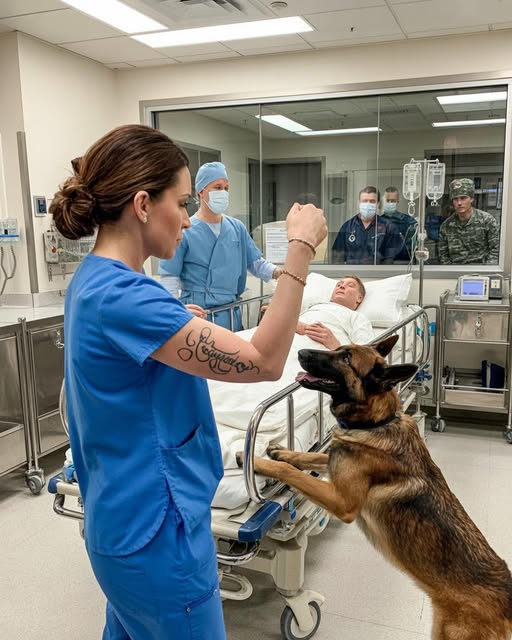
A Belgian Malinois entered with his body tight and low, front paws striking the gurney rail with controlled precision. He was not panicked. He was not disoriented. He was performing a function. Seawater clung to his fur, mixed with drying blood across his shoulder. His tactical harness identified him before anyone spoke his name. His eyes scanned the room once—fast, disciplined—and then locked onto every hand that moved toward the unconscious man beside him.
The patient was a naval operator, early thirties, heavily built, his uniform torn and saturated. A pressure dressing covered his chest, already darkening. Even before monitors were attached, Sarah recognized the subtle signs: the pallor, the shallow deterioration of color around the lips, the stillness that suggested more than shock.
One of the escorting operators spoke sharply. “Atlas.”
The dog did not respond by calming. He responded by positioning himself more firmly between the patient and the room. Not chaos, but denial—trained restriction. Every movement near the gurney was being evaluated and rejected with deliberate control.
Briggs saw only obstruction. “Remove the animal.”
A SEAL operator attempted to step forward. Atlas reacted instantly, not wildly but decisively, teeth bared, posture locked. The warning was not emotional—it was procedural. The room adjusted its distance accordingly.
The medical report arrived in fragments: maritime training evolution, Coronado waters, equipment failure, fall trauma, suspected thoracic injury, multiple cardiac arrests en route, failed decompression attempt. The patient was identified as Chief Petty Officer Mason Reed.
Briggs exhaled sharply. “Get me authorization to neutralize it if it interferes again. The patient is dying.”
That statement landed differently with Sarah. Not because it was unusual, but because it revealed something consistent about Briggs: his preference for force when confronted with resistance he did not immediately understand.
Atlas snapped again as a resident moved too close. The gurney shifted. The operator who had accompanied Reed spoke quietly, voice tight. “He hasn’t left his side since the fall. Last command before he went down was ‘Guard.’”
That word changed the tone in Sarah’s mind. Not sentimentally, but structurally. This was not an uncontrolled animal. This was continuity of duty.
Her attention drifted to the harness. Naval Special Warfare markings. A faded tactical webbing system. A stitched identifier on the collar: VELA.
That detail carried weight she did not immediately explain to anyone else. It was not just identification. It was recognition of a program, a lineage of training, and something older than hospital protocol.
Briggs escalated again. “Step away, Callaway. This is not your role.”
But she was already moving.
When she stepped into the bay, she did not do so as defiance. She did it as recognition of pattern. Atlas turned immediately toward her. The growl began, low and controlled. But she did not mirror force. She reduced it.
Slow movement. Open posture. No sudden escalation.
Then she revealed her forearm.
A tattoo: a Navy trident integrated with a paw print.
The effect was immediate, but not dramatic in a theatrical sense. It was behavioral. Atlas stopped advancing. The tension did not vanish, but it reorganized. Recognition replaced uncertainty. Training resurfaced over instinctive defense.
“Atlas,” she said quietly. “Vela protocol. Easy.”
The dog shifted. Not submission, but alignment. He sat.
The trauma bay fell into a silence that felt structurally different from ordinary quiet. Even Briggs paused, briefly disoriented by the loss of control over the room’s direction.
Sarah knelt by the gurney. She assessed first the animal, then the patient. Atlas allowed proximity without resistance. Reed’s condition, however, remained critical. Cold skin. Weak carotid pulse. A right-sided chest dressing partially obscured.
Her eyes caught a secondary detail—an internal pocket under the vest strap. She retrieved a laminated card.
Congenital dextrocardia.
The heart was not where everyone was assuming it was.
That single detail altered the entire framework of treatment. Misplaced intervention. Ineffective decompression. Incorrect anatomical assumptions.
“Stop,” she said sharply.
Briggs turned. “Explain.”
She held up the card. “You’ve been treating the left side. His heart is on the right.”
For the first time, Briggs did not respond immediately. Not agreement. Not dismissal. Just a brief interruption of certainty.
Before he could regain control of the narrative, Dr. Elena Park entered. She assessed the situation in seconds, took the ultrasound, and confirmed what Sarah had already identified: pericardial fluid accumulation consistent with tamponade—on the right.
The room shifted again, this time not under authority, but under correction.
“Massive transfusion protocol,” Park ordered.
Procedures activated. Roles re-assigned. The hierarchy flattened into function.
Sarah remained near Atlas, maintaining visual and physical reassurance as the dog stayed anchored to Reed’s presence. When intervention finally relieved pressure and circulation returned in measurable rhythm, it was not celebration that followed. It was transition—from imminent loss to conditional survival.
They moved Reed to surgery within minutes. Atlas attempted to follow, but Sarah stopped him with a steady hand and a single command. He obeyed.
In the corridor, the operators who had escorted Reed watched in silence. Not because they did not understand what had happened, but because they did. In their world, rare moments of perfect alignment between training, instinct, and timing were not miracles. They were remembered.
The lieutenant stepped toward Sarah as the OR doors swung shut, the sound of them sealing off the chaos behind him. “Who are you?” he asked—not aggressively, but with the kind of directness that comes from exhaustion and adrenaline finally starting to fade.
For a moment, she considered giving the version she always gave now. The safe one. The reduced one. I’m an RN in trauma. Clean. Simple. Easy to forget.
Instead, she answered with something heavier, something that carried a past most people in that hospital had never been trained to recognize.
“I used to be Hospital Corpsman First Class Sarah Callaway,” she said. “Naval Special Warfare canine support.”
The words changed the air between them. Not dramatically, but noticeably, like a pressure shift before a storm. The older operator looked at her more closely now, really seeing her for the first time instead of just passing through her presence. His gaze dropped to her forearm, where the faint outline of ink still showed even under hospital lighting.
“Callaway… from Pendleton,” he said slowly, as if confirming a memory rather than asking a question.
She nodded once. Hearing that name again in that context pulled something distant forward in her mind. “I spent time there after deployment,” she said. “Training K9 casualty response. Instructing handlers.”
The lieutenant exhaled, almost in disbelief. “You were part of the handler program.”
That explanation settled pieces of the moment into place—why Atlas had responded the way he did, why control had shifted in a room that refused to yield control to anyone else. Years earlier, Sarah had been part of a specialized training effort at Camp Pendleton, where medical corpsmen and canine handlers developed protocols for battlefield K9 support. It wasn’t just medicine—it was communication, recognition, conditioning. Dogs were trained to respond not only to commands, but to identity markers: posture, tone, and in some cases, visual cues tied to specific units.
The trident-and-paw insignia on her forearm had originally been an informal symbol shared among a small group of handlers and medics. Over time, it became something more functional during drills—an intentional recognition cue used to stabilize working dogs under stress. Atlas had been conditioned in that environment. He had seen that symbol before, hundreds of repetitions deep in training cycles where trust was built the same way muscle memory is built: slowly, consistently, and under pressure.
The lieutenant finally introduced himself. Cole Donovan. His voice carried the fatigue of someone whose nervous system had only just begun to unwind from crisis mode.
“Reed was on a boarding evolution off Coronado,” he said. “Training scenario. Equipment failure. He came down wrong—hard impact on the railing. Atlas stayed with him through everything. Even in the aircraft.”
He paused, then added more quietly, “Reed kept trying to stay conscious. Last command he gave before losing it was ‘Guard.’ Then he grabbed Atlas’s harness… right over that Vela strip.”
Sarah’s hand moved instinctively to the worn fabric on the dog’s gear. The word Vela didn’t belong in this room, not in the way it existed in her memory.
“Why Vela?” she asked.
Cole hesitated. “Our handler wanted it there. Said he’d read about older program markings. Something about ensuring the dog remembers who protects them if everything collapses.”
Sarah didn’t respond immediately. The name Vela wasn’t just a designation. It was a wound that had never fully closed.
Years earlier, in Helmand Province, she had served alongside a small tactical K9 unit—an unofficial but tightly bonded team. That’s where she had first worked with Nolan Price, a handler with a quiet voice and steadier hands than most people had nerves. He used to say the bond between handler and dog was the only relationship in combat that didn’t lie, because instinct doesn’t pretend.
And Vela had been part of that bond.
A Malinois with a dark mask and an unsettling intelligence, she had been paired with Nolan on two deployments. Sarah, Nolan, and Vela operated like a single system—medical support, handler, and canine—moving through missions with the kind of synchronization that only comes from repetition under danger. They weren’t just teammates; they had become an interdependent unit built on trust that never needed explanation.
The day it broke still lived somewhere under her ribs.
Official reports called it hostile action with delayed extraction. That was technically accurate, the way most official language is technically accurate while still failing to describe what it costs. The truth behind it involved a stalled evacuation window, a chain of decisions made far from the ground, and a timing failure that turned survivable injuries into irreversible ones.
Sarah had been close enough to hear the explosion. Close enough to run. Not close enough to matter in time.
She found Nolan first.
Then Vela.
The dog was still alive when she reached them—barely. Her breathing was shallow, uneven, her eyes locked on Nolan’s hand in the dirt. Sarah had knelt in dust and heat and held her there, trying to anchor something that was already slipping away. Vela’s last breath had been soft. Controlled. Almost like release.
That silence never left her.
When she left the service, she didn’t leave it behind—she carried it forward, repurposed into something she could function inside. Nursing became structure. Hospitals became controlled chaos instead of uncontrolled war. Trauma bays replaced battlefields in a way that felt like substitution, not healing.
Sharp Memorial never asked about any of it. Briggs certainly never cared to.
Cole’s voice brought her back. “Reed said the dog hasn’t left his side since the fall. Even in transport. Last thing he did before blacking out was command him to guard.”
Sarah looked down at Atlas again. The dog was quieter now, but not detached. Present. Focused. As if the crisis had been resolved but the duty still existed.
She noticed the small injuries then—a shallow cut along his shoulder, a split nail, dried blood caught in fur that no one had had time to clean during transport. She guided him gently away from the corridor traffic and knelt beside him. Atlas allowed it without resistance, leaning into her touch with the unquestioning weight of a trained trust that did not require emotional translation.
Briggs did not return from the OR for nearly an hour.
When he finally emerged, his expression carried something unfamiliar—frustration that had nowhere useful to go. Dr. Park followed him out, still in surgical scrubs, mask hanging loose around her neck.
She ignored Briggs entirely and walked straight to Sarah.
“He made it,” Park said. “Stable. Critical, but stable. If we’d gone in on the wrong side any longer, it wouldn’t have mattered how good the rest of the intervention was.”
Sarah nodded slowly, absorbing the weight of what almost had been irreversible.
Cole exhaled sharply beside her, eyes closed for a brief second. Atlas pressed his head lightly against Sarah’s leg, the gesture calm and deliberate, like an exhale in physical form.
Park’s eyes moved to Sarah’s forearm again. “You should have told us who you were,” she said quietly.
Sarah looked down at the floor for a moment before answering. “Would it have changed anything?”
Park paused. Then, honestly, “It changes how people understand what just happened.”
Sarah didn’t argue that. She had stopped believing in the usefulness of explanations that arrive too late to matter.
“Maybe,” she said instead.
By the next morning, the incident had already moved through the hospital like a current.
Not the official version—the unofficial one. The version that spreads through break rooms, shift changes, and half-whispered conversations in hallways.
The quiet trauma nurse. The military dog. The missed diagnosis. The chief surgeon losing control of a room he thought he owned. The correction no one saw coming until it was already irreversible.
Dale confirmed what needed confirming. Security admitted what could no longer be hidden. Park documented everything without softening a single detail.
Briggs’s resignation came quietly after that.
Sarah didn’t celebrate it. She didn’t discuss it.
She worked.
She checked on Atlas. She reviewed Reed’s recovery. She took shifts like nothing had changed, even though everything had.
That evening, Park found her alone in the supply room.
“HR wants clarity on your background,” she said.
Sarah gave a faint, tired smile. “They already have what I gave them.”
“Why not the full record?”
Sarah leaned back slightly against the shelf. “Because people don’t see you anymore once they think they know your story. They stop looking at the present. They start reading a version of you that doesn’t move.”
Park considered that quietly, then left without pushing further.
Reed woke fully the next morning.
His first word wasn’t pain, or confusion, or complaint.
“Atlas?”
Sarah answered before anyone else could. “He’s fine. Annoying everyone. Refusing to be impressed by hospital food.”
Reed closed his eyes briefly, relief loosening something in his face.
Then he looked at her forearm.
“…Callaway,” he said.
She blinked. “You remember?”
“Pendleton,” he replied. “K9 med block. You made half the class redo drills because you said we were thinking like handlers instead of thinking like the dogs.”
Despite everything, Sarah laughed. Quietly. Briefly. Real.
Reed smiled faintly. “Atlas always remembered that mark. That’s why he gave you the space.”
Sarah glanced toward the corner where Atlas now rested, calmer than he had been in days.
“He also knew you were protecting something,” she said.
Reed nodded slowly. “He did his job twice. On the water… and in that bay.”
And for the first time since the incident, Sarah didn’t have anything to add to that.
Because it was true.
And because sometimes, that is where the story ends—quietly, without needing correction.