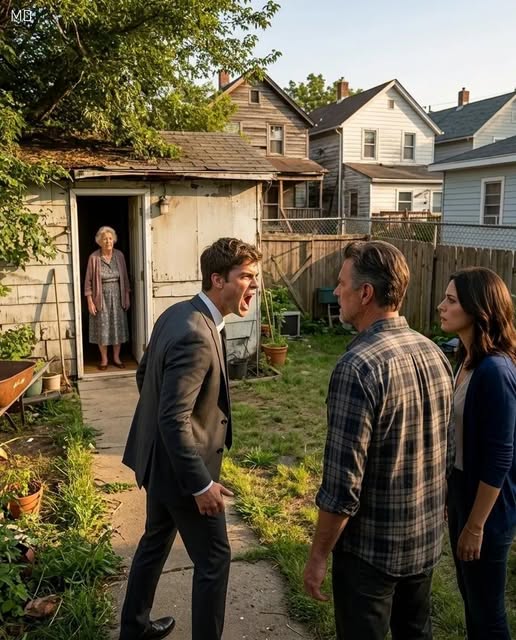
The rain beat steadily against the corrugated metal roof of the narrow space I had been told to call home. To anyone else, it might have been a simple storage shed—meant for old decorations, broken tools, and things no longer needed. To my son, Brian, it was a “guest suite,” a quiet place he insisted I’d chosen for myself. To me, it had become a quiet reminder of how small a life can shrink when you stop speaking up for it. On that gray afternoon, I sat in my worn armchair listening to the rain, watching droplets slide down the single small window, when the door creaked open.
“Grandma?”
The voice was soft, uncertain—Ethan.
My grandson.
For a moment, everything else faded. The damp air, the cold, the quiet neglect of the space—it all disappeared when he stepped inside and wrapped his arms around me. He smelled like rain and travel and something I hadn’t realized I’d been missing. For a brief second, I wasn’t tucked away at the edge of someone else’s life. I was simply someone who was loved.
But when he pulled back, that feeling shifted.
Ethan looked around properly for the first time. The peeling paint. The exposed pipes. The narrow cot where a bed should have been. The small shelf with cans instead of a kitchen. I saw the moment understanding settled in—not confusion, but recognition.
This wasn’t a guest space.
It was displacement.
Before I could say anything, Brian appeared in the doorway.
He spoke first, too quickly—explaining, justifying, shaping the story before anyone else could define it. He talked about space, about independence, about how I “preferred” quiet. His voice had that practiced quality of someone repeating something until it almost stops sounding like a lie.
But Ethan didn’t look at him.
He looked at me.
Then he asked, calmly, “Why is she really living back here?”
The room tightened around us.
Brian hesitated for half a second too long.
And that was enough.
He shifted into defense—finances, responsibility, sacrifice. Words that were supposed to sound reasonable but only made the truth clearer underneath them. This wasn’t about what I wanted. It was about what was convenient.
I felt the old instinct rise in me—to soften things, to smooth the edges, to protect my son from embarrassment even at the cost of my own truth. I had spent years doing that. Years minimizing myself so others could remain comfortable.
But Ethan didn’t let me retreat into that habit.
He took my hand and stayed silent.
That silence did what arguments never could.
It made space for truth.
After Brian left, the house grew quieter again, but it wasn’t the same kind of quiet as before. Ethan sat beside me and listened—not politely, not half-distracted, but fully present.
So I told him.
About grief. About confusion. About the papers I had signed when I was still trying to survive the loss of his grandfather. About how decisions made in exhaustion and trust had slowly been reshaped into something I no longer recognized. First suggestions. Then adjustments. Then removal of choice entirely, always framed as “help.” Until one day I realized I no longer had a home—only a place I was allowed to exist in.
Ethan didn’t interrupt. He didn’t react loudly. He just listened the way people do when they understand something important is being uncovered in real time.
And then he acted.
Not with anger—but with precision.
He found someone who understood elder rights. Someone who could see beyond the family narrative into the structure beneath it. We went through everything I still had—old documents, copies, records I had kept without fully knowing why. Slowly, the story that had been built around me began to fall apart under scrutiny.
What had been presented as “care” looked different when examined clearly.
Control disguised as help.
The process that followed wasn’t dramatic. It didn’t need to be.
It was steady.
Measured.
Reversing what had been done quietly was its own kind of justice.
Eventually, I left the shed for the last time.
I watched it from a distance as it came down—not with satisfaction, but with something calmer. Closure without spectacle. In its place, Ethan helped me plant a garden. Simple rows of color where there had once been neglect.
Brian and I didn’t have a confrontation after that. There were no final speeches, no dramatic apologies. Just distance. A relationship reshaped into something quieter and more distant than it had been before.
But I no longer lived in a place where I was invisible.
I had walls again that were mine. A door that locked. A space that didn’t require permission to exist in.
Ethan visits often. Not out of obligation, but presence. We talk, we cook, we sit without needing to fix anything.
And sometimes I think about how close I came to believing that shrinking was the same as peace.
When people ask what changed, I don’t tell them it was law or conflict or documents.
I tell them it was a question.
A simple one.
Asked by someone who refused to accept the surface of things.
“Why is she really living back here?”
Everything else followed after that.
Because sometimes a life doesn’t change when it is fought for.
It changes when someone finally notices it was never being lived the way it should have been.