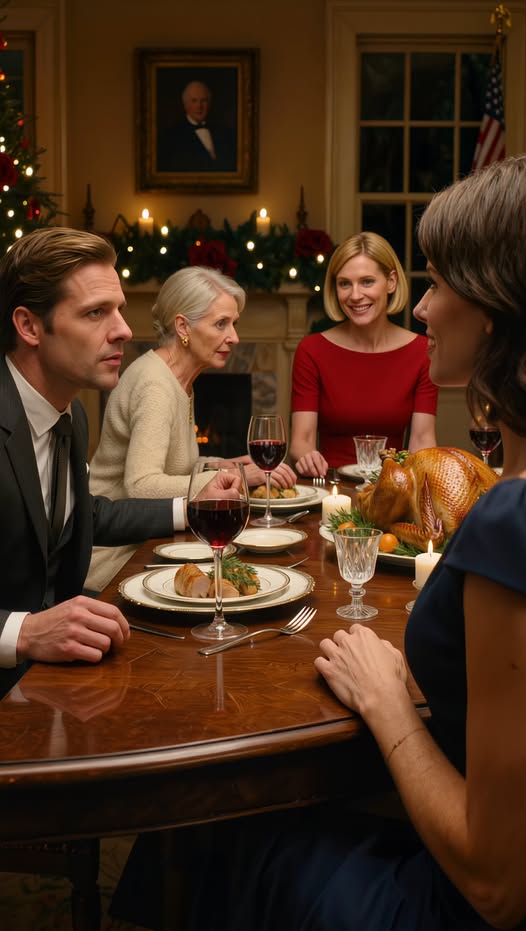
At thirty-three, I had grown used to being the invisible thread in the Shockley family’s tapestry. My mother, Patricia, and my sister, Amanda, lived in a world of cashmere sweaters, country club lunches, and carefully curated success. For seven years, my work as a physician had been reduced to “working in healthcare,” a vague label my mother used to soften the fact that I hadn’t chosen a more “prestigious” path like neurosurgery. In her eyes, I was a glorified babysitter. In reality, I was a high-risk maternal-fetal surgeon working eighty-hour weeks to stand between life and death.
Thanksgiving dinner was meant to be the grand introduction of Amanda’s new boyfriend, Tyler Hutchinson. He fit the Shockley ideal perfectly: a commercial real estate developer with a tailored navy suit and a Rolex that seemed designed to announce wealth before he spoke. Around the table set with Lennox china, Tyler held court with ease, telling stories of multi-million-dollar deals and business trips to Chicago. Amanda watched him like he was a trophy she had finally won.
I sat at the far end of the table, near the kitchen door. From there, I noticed the faint tan line on Tyler’s ring finger—a pale band of skin where a wedding ring had recently been. I also recognized his cologne: Tom Ford Oud Wood. It was familiar in a way that didn’t belong in this room.
When Tyler politely asked what I did at the hospital, the atmosphere shifted. Before I could answer, Amanda laughed—sharp, dismissive. She told him I “hand out stickers to sick kids,” reducing my career to something trivial. My mother quickly tried to smooth it over, saying some things were better left unspoken.
I set my wine glass down. The sound cut through the room.
“That’s interesting,” I said calmly. “Because Tyler saw me every morning last month. He just never saw me without a mask.”
The silence that followed was immediate.
Tyler’s expression changed first—confusion, then recognition, then something closer to dread.
I didn’t stop.
I clarified who I was, not as Amanda had described me, but as an attending physician in obstetrics and gynecology specializing in emergency surgical interventions. I named the reality of my work: fellowship training, high surgical volume, a maternal mortality rate I had spent years trying to keep lower than the national average.
“High-risk obstetrics means I handle the cases most doctors don’t,” I continued. “Hemorrhages. Uterine ruptures. Placental abruptions. The kind of emergencies that don’t wait for permission.”
I looked at Tyler directly.
“Last October, I had a case that stayed with me. A woman named Jennifer. She was actively coding on the table from a placental abruption. Her husband was in the waiting room with their eighteen-month-old daughter. When I told him at 2:43 a.m. that both she and their newborn son were going to survive, he broke down in relief.”
The fork slipped from Tyler’s hand and clattered onto the plate.
He wasn’t looking at Amanda anymore.
He was looking at me.
And he knew.
My mother tried to intervene, to redirect, to restore the illusion, but it was already gone. The version of me they had built their comfort around had collapsed in a single conversation.
I had spent years being edited out of their narrative—cropped from photos, softened into irrelevance, reduced to something palatable. But that night, I didn’t soften anything.
I stood up.
I wasn’t a volunteer. I wasn’t a footnote. I wasn’t a disappointment measured against their expectations.
I was the person who kept strangers’ families intact while my own quietly tried to pretend I didn’t matter.
And as I left the table behind, I understood something clearly for the first time: silence doesn’t make you invisible.
It just delays the moment people finally see you.