Claire arrived at her childhood home with a heavy heart and a single intention: to settle her mother’s estate, sell the property, and return to her city life as quickly as possible. The house felt like a relic of another existence—faded paint, quiet rooms, and the kind of stillness that carried memory rather than comfort.
But on her third night back, something disrupted that stillness.
A low, rhythmic noise pulled her from sleep at around 4:00 a.m. At first she thought it was the wind or an old pipe in the walls. But when she stepped to the window and carefully drew back the curtain, she froze.
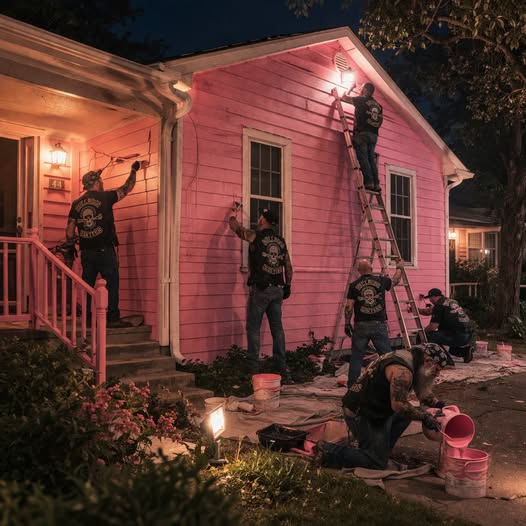
On her front lawn were nine large men—bikers, dressed in worn leather and denim—moving with unexpected coordination. They weren’t loitering. They weren’t chaotic. They were working. And they were painting her mother’s house a vivid, almost defiant shade of bubblegum pink.
Claire’s first reaction was pure alarm. She rushed outside, bare feet on the cold steps, demanding answers—who they were, why they were on her property, and why they were doing this in the middle of the night.
She expected aggression. Defensiveness. Trouble.
Instead, she was met with calm.
The man who stepped forward looked older than the rest, his beard streaked with gray, his hands rough but steady. He didn’t raise his voice. He didn’t argue. He simply said they weren’t strangers.
They were keeping a promise.
As dawn crept over the horizon, Claire stood there listening to a story she had never known existed.
Years earlier, one of them had broken down on the road nearby. Instead of fear or suspicion, her mother had walked out of the house with lemonade and an open invitation to eat. No hesitation. No judgment. Just kindness offered like it was the most natural thing in the world.
That moment had become something else entirely.
What began as a single gesture turned into a weekly ritual. Every Monday, the bikers returned. Not as outsiders, but as guests. They ate at her mother’s table. They fixed what needed fixing. They helped with the garden. And over time, they became something closer to family than anyone Claire had ever known about.
The leader then handed her a folded sheet of paper.
It was her mother’s handwriting.
Not financial records. Not instructions about selling the house.
Wishes.
Simple ones. Honest ones.
At the top of the list: Paint the house pink.
Claire learned that her mother had always loved the color but never chose it out of fear of what others might think. That small hesitation suddenly felt like a symbol of an entire life lived gently, quietly, and far more richly than Claire had ever understood.
The more she listened, the more the house changed in her eyes. It wasn’t abandoned. It had been alive in ways she had never seen from a distance.
In the days that followed, Claire stayed.
The plan to sell the house started to dissolve without a dramatic decision. It simply became irrelevant. She found herself holding a paintbrush alongside men she had initially feared, listening to stories about her mother laughing over meals, offering advice, remembering details about their lives that most people would forget.
Inside the house, she found boxes she hadn’t known existed. Newspaper clippings about her own accomplishments. Notes her mother had written after phone calls. Little fragments of pride and love carefully preserved without ever being loudly expressed.
It began to settle in slowly: her mother hadn’t been isolated. She had been deeply connected in a way Claire had never understood from the outside looking in.
By the time the last shutters were reattached and the final coat of paint dried, something irreversible had shifted.
The “For Sale” sign came down.
Not out of sentimentality alone, but recognition.
The house wasn’t just property. It was a living record of kindness exchanged, maintained, and returned.
Now, on Mondays, the sound of motorcycles still rolls down the driveway. But it no longer signals an intrusion or a mystery.
It signals continuity.
They arrive not because anything is broken, but because something there matters.
And Claire stays.
Because she finally understands that her mother’s legacy wasn’t quiet at all—it was simply built in a language she had to come home to learn.