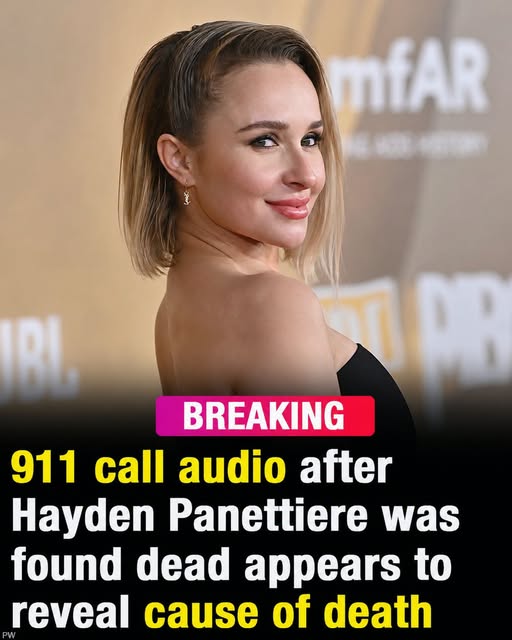
The call came too late. By the time first responders reached Hayden Panettiere, the 36-year-old actress was already in cardiac arrest inside a South Carolina home. Emergency personnel rushed to her aid and began CPR, fighting against the terrifying silence that had suddenly filled the room. Dispatch information indicated that responders were dealing with an unresponsive woman and referenced both cardiac arrest and a possible overdose, sending the story into the public eye almost immediately. But those dispatch details were not a medical determination of cause. As of the latest official information, the exact cause and manner of Panettiere’s death remain undetermined, while authorities continue their investigation.
Hayden Panettiere’s sudden death in Greenville, South Carolina, has left a haunting void that even the stark details of the emergency response cannot fully explain. A friend reportedly discovered her unresponsive and called 911 at approximately 1:51 p.m. on August 16. Police and emergency medical personnel arrived and found Panettiere in cardiac arrest. They attempted resuscitation, including CPR and advanced cardiac life support, but despite their efforts, she could not be revived. She was pronounced dead at the scene at approximately 2:32 p.m.
At just 36 years old, her death feels especially difficult to comprehend because her life and career were still unfolding. To millions of viewers, Hayden had been a familiar face since childhood, growing from a young performer into one of television’s most recognizable actresses. She became internationally known as Claire Bennet on *Heroes* and later as Juliette Barnes on *Nashville*, roles that allowed audiences to watch her portray characters struggling with fear, fame, addiction, resilience, and the complicated consequences of their choices. Her performances often carried an emotional intensity that made her characters feel more vulnerable and human.
The circumstances of her final hours have inevitably generated intense speculation. The 911 dispatch audio reportedly included references to an “overdose” and cardiac arrest, and that language quickly spread across social media and entertainment coverage. Some reports have also described medication associated with overdose treatment being present at the residence. But those details should not be confused with an official finding. Authorities have not confirmed that an overdose caused Panettiere’s death, and the coroner’s investigation remains the determining process for establishing the cause and manner of death.
That distinction matters because the internet has a tendency to turn uncertainty into certainty within minutes. A dispatcher’s description of what responders suspected at the scene is not the same thing as a toxicology report or a final medical conclusion. The official investigation must consider all available evidence, including the autopsy and toxicology results. The Greenville County Coroner’s Office has reported that an autopsy found no signs of trauma contributing to her death, while the official cause and manner remain under investigation.
For those who knew Panettiere personally, the uncertainty may be especially painful. When someone dies unexpectedly, people naturally search for a single explanation that can make the event easier to understand. But sometimes the answers take time. Toxicology testing can require additional analysis, and the circumstances surrounding a sudden death may not be fully understood immediately. Until officials release definitive findings, speculation can create a story that may ultimately prove inaccurate.
What is already known is that emergency responders fought to save her. The call came in reporting an unresponsive woman, and within minutes the scene became a desperate attempt to restart a heart that had stopped functioning normally. CPR and advanced life support were performed, but the efforts were unsuccessful. For the people inside that home, the difference between one ordinary afternoon and an irreversible tragedy unfolded with frightening speed.
That suddenness is part of what makes her death so painful for fans. Hayden had spent much of her life in front of cameras, but the final moments of her life were private and intensely human. There was no audience, no script, no carefully written ending—only emergency responders trying to help. The contrast is difficult to ignore. A woman who had spent decades portraying fictional characters facing extraordinary circumstances was suddenly at the center of a real-life emergency that no performance could control.
Panettiere had also been unusually open about some of the battles she faced throughout her life. In her memoir, *This Is Me: A Reckoning*, she discussed addiction, postpartum depression, the pressures of growing up in Hollywood, and the complicated experiences that shaped her adulthood. Her willingness to speak publicly about those struggles had allowed many people to see beyond the polished image of a celebrity. She did not pretend that her life had been easy, and she often spoke about recovery as an ongoing process rather than a simple destination.
That history makes the speculation surrounding her death particularly sensitive. Her previous struggles with addiction are part of her documented story, but they should not automatically become an explanation for her death before authorities establish one. A person’s past does not provide enough evidence to determine what happened in a specific medical emergency. Hayden deserves the same presumption of accuracy and dignity that anyone else would receive while an official investigation is underway.
Her family is now facing a loss that extends far beyond the entertainment industry. Panettiere leaves behind her daughter, Kaya, as well as her parents and other loved ones. The family had already experienced profound grief after Hayden’s younger brother, actor Jansen Panettiere, died in 2023 at just 28. His death was later attributed by the family to heart complications involving an enlarged heart and aortic valve problems.
That earlier loss makes Hayden’s death even more heartbreaking. Losing a sibling is devastating under any circumstances; losing another family member only a few years later creates another layer of grief that is difficult to put into words. The public may know Hayden through television, movies, interviews, and photographs, but her family knew her as a daughter, sister, and mother. For them, the headlines cannot capture the full reality of who has been lost.
Her daughter will also carry a complicated legacy. Kaya will grow up with memories of her mother, but also with an enormous archive of performances, interviews, photographs, and stories left behind. In that sense, Hayden’s career means that pieces of her remain visible in a way that is unusual after a sudden death. People can still watch Claire Bennet. They can still hear Juliette Barnes sing. They can still see the young actress who appeared on television before she was old enough to understand how much of her life would eventually belong to the public.
But none of those images can replace the person herself. A performance can preserve a moment, but it cannot create another conversation. A photograph can capture a smile, but it cannot recreate a mother’s presence. That is the painful difference between a public legacy and a private life. Fans may continue returning to her work, but the people closest to her are left confronting an absence that no screen can fill.
Panettiere’s career was extraordinary in part because it began so early. She worked as a child actor and continued performing through different stages of her life, eventually taking on roles that became defining parts of her identity. *Heroes* introduced her to a massive international audience, while *Nashville* allowed her to demonstrate a different kind of dramatic and musical range. She also appeared in films including *Remember the Titans* and the *Scream* franchise.
Her final years were not simply a story of struggle. They also included attempts to rebuild, reflect, work, and tell her own story. Her memoir gave her an opportunity to discuss experiences that had previously been filtered through celebrity coverage and public speculation. Her work continued as well, including her final film role in the 2026 psychological thriller *Sleepwalker*.
That makes her sudden death feel even more abrupt. There was still a sense of a future ahead—more possibilities, more conversations, more opportunities to redefine herself. She had already survived difficult chapters and was trying to make sense of them. Her story did not feel finished. Yet life does not always provide the closure that people expect.
Now, fans are returning to the moments that made Hayden memorable. They are watching her performances again, sharing photographs, remembering interviews, and talking about the young woman who became a household name. Some remember her primarily as Claire Bennet, the seemingly indestructible teenager from *Heroes*. Others remember Juliette Barnes, the complicated country singer whose emotional struggles often mirrored themes that Hayden herself understood painfully well.
The similarities between those characters and parts of Hayden’s real life make her performances feel especially poignant now. She understood how to portray someone fighting to regain control of her life because she had experienced her own battles away from the camera. That does not mean her characters were autobiographical, but there was a depth to her performances that came from somewhere real. Viewers felt it even when they could not have explained why.
Still, her legacy should not be reduced to addiction, tragedy, or the circumstances of her final day. Hayden Panettiere was more than the struggles she discussed publicly. She was an actress, singer, daughter, sister, mother, colleague, and friend. She was someone who worked from childhood, achieved international fame, endured deeply personal difficulties, and tried to speak honestly about them. Her life contained far more than its darkest moments.
The investigation will eventually provide more information. For now, officials have confirmed that there were no signs of foul play or trauma contributing to the death, but they have not established the final cause or manner. That means the most responsible response is to resist turning suspicion into fact. The unanswered questions are real, but so is the uncertainty.
And perhaps that uncertainty is one of the hardest parts for the people mourning her. When someone dies suddenly, the mind searches for a reason. It wants a final sentence that explains everything. But sometimes there is no immediate answer. Sometimes the medical evidence takes weeks to interpret. Sometimes even after an official cause is released, it cannot fully explain the life that preceded it or the people left behind.
What can be said now is that Hayden Panettiere’s final moments were met by people who tried to save her. Paramedics performed CPR and advanced life support. Emergency responders stayed and worked until there was nothing more they could do. Her death was sudden, devastating, and unexpected, but the public should not allow speculation about those final moments to overshadow the person she was for 36 years.
She leaves behind a body of work that will continue to introduce her to people who were not even born when she first appeared on television. She leaves behind a daughter who will carry her memory into the future. She leaves behind family and friends who knew the woman beyond the screen. And she leaves behind fans who will remember the voice, the performances, the characters, and the vulnerability she showed when she chose to tell her own story.
The call came too late, but Hayden’s story did not begin with that call, and it should not end there. It began with a little girl entering an industry that would eventually make her famous. It continued through television sets, movie screens, music, motherhood, heartbreak, recovery, and a determined effort to understand the life she had been given. Her final chapter may remain surrounded by unanswered questions for some time, but the larger story is already clear.
Hayden Panettiere fought through difficult years, spoke openly about experiences many people hide, and continued trying to move forward. Now, those who loved her are left with the memories she created and the work she left behind. Until officials determine exactly what happened, the most honest thing anyone can say is also the hardest: we know she is gone, we know efforts were made to save her, and we do not yet know why she died.
The answers may eventually come. But no toxicology report, autopsy finding, or official statement will ever fully explain the value of the life that was lost. For now, Hayden Panettiere should be remembered not simply as the woman at the center of a tragic emergency call, but as the performer, mother, daughter, sister, and human being whose life touched millions long before the sirens arrived.