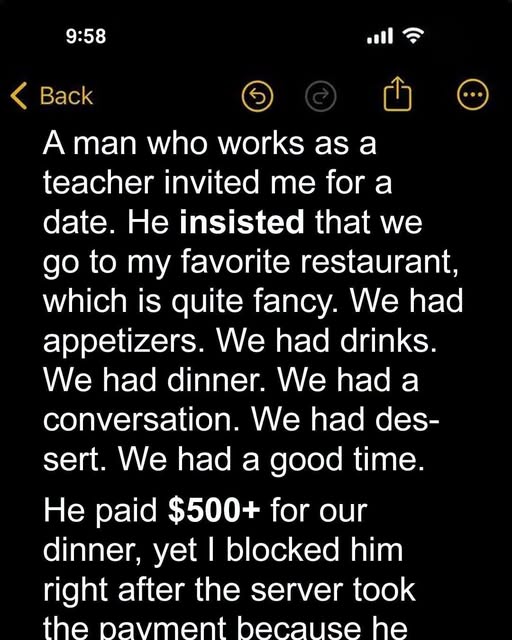
She walked away from what should have been an unforgettable first date—but not for the reasons anyone expects. One moment, dinner was filled with easy conversation and laughter inside an elegant restaurant. The next, a single comment about a credit card transformed an expensive evening into an experience she couldn’t stop replaying. By the time she arrived home, she had already made up her mind. Before her date could even send a message asking if she’d made it home safely, his number was blocked. The meal had cost hundreds of dollars, but the real price, she later said, was the trust that disappeared in an instant.
From the beginning, she hadn’t been chasing a lavish night out. In fact, she had suggested choosing somewhere far more affordable. She recommended a casual neighborhood Mexican restaurant where they could relax, talk, and get to know one another without worrying about extravagant prices. To her, a first date wasn’t about luxury—it was about conversation and compatibility. But he insisted on something nicer, assuring her the upscale restaurant would make for a memorable evening.
Reluctantly, she agreed.
When they arrived, she immediately noticed the prices. Every page of the menu featured dishes costing significantly more than she normally spent on dinner. She quietly reminded him they could still leave and go somewhere simpler if he preferred. Once again, he brushed aside her concerns, smiling confidently and encouraging her to order whatever she wanted.
Trying not to make the evening awkward, she selected a modest meal while carefully avoiding the restaurant’s most expensive options. Throughout dinner, conversation flowed naturally. They discussed work, family, travel, favorite movies, and childhood memories. For a while, everything felt surprisingly comfortable. She even found herself thinking there might be enough chemistry for a second date.
Then the check arrived.
The total approached five hundred dollars.
Her first instinct wasn’t surprise—it was discomfort. She immediately reached for her purse and offered to split the bill. She explained that she never expected someone she had only just met to pay such a large amount for dinner. To her, contributing her share seemed respectful and fair.
He paused.
Instead of immediately accepting or declining, he watched her carefully.
Only later would she wonder whether he had been studying her reaction all along.
Both of them placed their credit cards on the table.
For a brief moment, she believed they had quietly solved the situation.
Then, without warning, he reached across the table, picked up her card, and handed it back.
“I’ve got it,” he said.
She thanked him politely, assuming the matter was finished.
But then he smiled and added something unexpected.
“Now I finally know your last name.”
She froze.
It wasn’t the fact that he had paid.
It was the way he said it.
The comment lingered in the air far longer than either of them seemed to expect.
To many people, learning someone’s last name might seem completely harmless. But her professional background caused her to hear those words differently. She worked in a field involving financial transactions and understood how much personal information could be connected to payment cards. Years of security training had taught her to remain cautious about how financial details were handled and who had access to them.
Suddenly, she replayed the previous few minutes in her mind.
Had he intentionally waited for her to place her card on the table?
Had he been hoping to see her full name?
Why hadn’t he simply asked earlier if he wanted to know?
The more she considered it, the less comfortable she felt.
As they left the restaurant, conversation became noticeably more strained. Nothing openly confrontational happened. He remained polite, walked her to her car, and wished her a safe drive home.
She thanked him.
They hugged briefly.
She drove away.
But during the trip home, the uneasy feeling only grew stronger.
She replayed every conversation from the evening.
Every glance.
Every pause.
Every moment surrounding the bill.
Eventually another possibility entered her thoughts.
What if the expensive restaurant itself had been part of some unspoken test?
She remembered how carefully he had watched her when the check arrived.
She remembered offering to split the bill immediately.
She remembered his expression before taking her card away.
Whether intentional or not, she couldn’t shake the feeling that she had been evaluated rather than simply getting to know someone over dinner.
By the time she reached home, she trusted her instincts.
She blocked his number.
Not out of anger.
Not out of revenge.
Simply because something no longer felt right.
Later, still wondering whether she had overreacted, she described the experience anonymously online and asked others what they thought.
Thousands of responses poured in.
Some readers believed she had misunderstood an awkward attempt at humor. They argued that paying for dinner while mentioning her last name was merely an unfortunate joke delivered at exactly the wrong moment.
Others strongly disagreed.
They pointed to the combination of circumstances rather than any single comment. They noted that she had suggested a less expensive restaurant, immediately offered to split the bill, and never expected an extravagant evening. From their perspective, the discomfort wasn’t really about the money—it was about boundaries, communication, and the subtle feeling that she had become part of an experiment without her knowledge.
The discussion quickly expanded into a broader conversation about modern dating.
Who should pay on a first date?
Is offering to split the bill enough?
Can financial situations unintentionally create power imbalances?
How much personal information should strangers exchange during an initial meeting?
People shared wildly different opinions, reflecting how dating expectations continue evolving across generations and cultures.
After reading countless responses, she decided there was one final matter she wanted to settle.
Although he had insisted on paying, she transferred him half the cost of the meal.
Not because he requested it.
Not because she felt guilty.
But because she wanted complete closure.
The payment removed any lingering sense that she owed him anything—not another conversation, not another explanation, and certainly not another date.
Once the transfer was complete, she never contacted him again.
Looking back, she acknowledged that perhaps he never intended to make her uncomfortable. Maybe his comment had been innocent. Maybe the expensive restaurant had simply been his preferred choice. Maybe there had never been any hidden test at all.
But trust doesn’t depend solely on intentions.
It also depends on how safe another person feels in your presence.
For her, that feeling disappeared the moment an ordinary dinner became something she felt compelled to analyze long after the plates had been cleared away.
Sometimes people end relationships because of dramatic betrayals or obvious dishonesty.
Other times, they walk away because of something much quieter.
A single moment.
A single sentence.
A single instinct that whispers something isn’t quite right.
Whether others agreed with her decision mattered less than one simple reality.
She listened to her own judgment.
She protected her own comfort.
And for her, that was reason enough to close the door on what would become both the first and the last date.