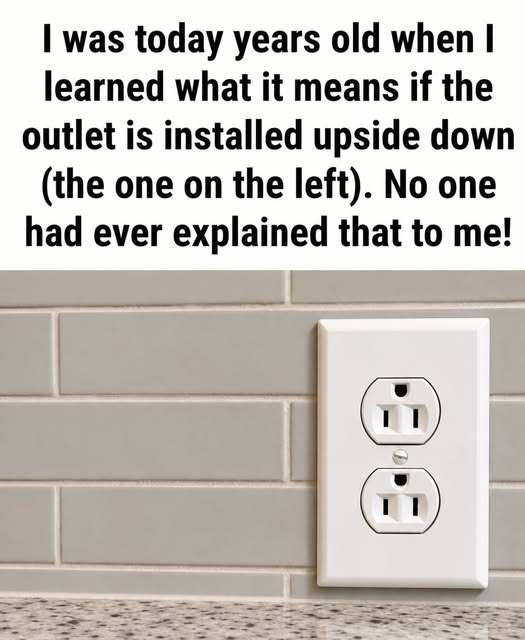
That odd, upside-down outlet in your living room isn’t necessarily a mistake. It could be a clue—a quiet, easily missed signal about how your home was wired and why some outlets that appear “dead” may not be dead at all. In countless homes, flipped receptacles have been hiding in plain sight for decades, confusing homeowners who assume the unusual orientation means something is wrong. But sometimes, that tiny difference in how an outlet sits on the wall can tell you something about the way electricity was originally designed to move through the room.
One quick test with a lamp can completely change the way you use that space.
The strange-looking outlet is often a relic of a simple, clever workaround used by builders and electricians in homes where ceiling fixtures were never installed. Instead of putting a permanent light fixture overhead, they wired a wall switch to control one half of a standard electrical receptacle. The idea was surprisingly practical: plug a floor lamp or table lamp into the controlled portion of the outlet, flip the wall switch, and the room immediately fills with light.
It allowed homeowners to control their primary room lighting without having to walk over to a lamp every time they entered the room.
Before modern lighting designs became common, this could be an inexpensive and efficient way to give a room switched lighting without the extra work of installing a ceiling fixture. In many houses, especially older ones, that wiring choice became part of the original electrical design and remained in place long after the people who installed it had forgotten why it was there.
To help people recognize the difference, some electricians turned the receptacle upside down as a subtle visual hint. The inverted orientation could signal that something about the outlet was different from the others nearby. Instead of having to label it with a sticker or write an explanation on the wall, the unusual position itself served as a small clue.
But there is an important catch.
There is no universal rule requiring a switched outlet to be installed upside down.
That means you should never look at an inverted receptacle and automatically assume that it is connected to a wall switch. It might indicate a switched half, but it could just as easily be the result of a particular electrician’s habits, a safety preference, a renovation, or simply the personal choice of whoever installed or replaced the receptacle.
Electrical work is full of regional practices and individual conventions, and outlet orientation is one of those details that can mean something—or absolutely nothing.
In some homes, the upside-down position may have a purpose. In another house, the exact same orientation could simply reflect how the receptacle was installed. That is why appearance alone cannot tell you what the outlet actually does.
The only reliable way to find out is to test it.
Plug a lamp into the receptacle and turn the lamp on. Then walk around the room and try every nearby wall switch. If the lamp turns off when you flip one of the switches, you have discovered that the receptacle—or at least that half of it—is controlled by the switch.
Then move the lamp to the other socket.
This is important because many switched receptacles control only one half of the outlet. One plug may respond to the wall switch while the other remains powered continuously. What looks like a single outlet can therefore behave like two separate electrical points with completely different functions.
Once you understand which portion is controlled, the mystery disappears.
What you thought was a broken outlet may simply have been waiting for a switch.
What you assumed was an unnecessary wall switch may actually control the lamp beside your sofa.
And what looked like an oddly installed receptacle may turn out to be a small remnant of the home’s original lighting plan.
This can also explain why some rooms seem to have switches that apparently do nothing. Before assuming a switch is broken, check the outlets around the room. There may be a switched receptacle connected to it, especially in rooms without a ceiling-mounted light fixture.
The design is particularly useful because it gives homeowners flexibility. A lamp can become the room’s primary source of light while still being controlled from the doorway. Instead of reaching behind furniture or bending down to find a tiny switch on a lamp cord, you can simply use the wall switch as you would with an overhead fixture.
Of course, if you are dealing with an outlet that is loose, damaged, sparking, warm, discolored, or behaving unpredictably, that is a different situation. Those signs should not be dismissed as harmless quirks of an old electrical system. In those cases, professional inspection is the safer choice.
But if the only unusual thing about the receptacle is that it is installed upside down, there may be no problem at all.
It may simply be telling you something.
So the next time you notice that odd, inverted outlet in your living room, don’t immediately assume someone installed it incorrectly. Look around. Check the nearby switches. Plug in a lamp and test both halves.
You might discover that your house has been quietly offering you a lighting feature you never knew you had.
And once you know which outlets are controlled, you can stop treating them like broken electrical points and start using them intentionally—placing lamps where they work best, designing your lighting around the existing wiring, and making the room function the way its original builders intended.
Sometimes, the smallest details in an old house aren’t mistakes.
They’re clues.