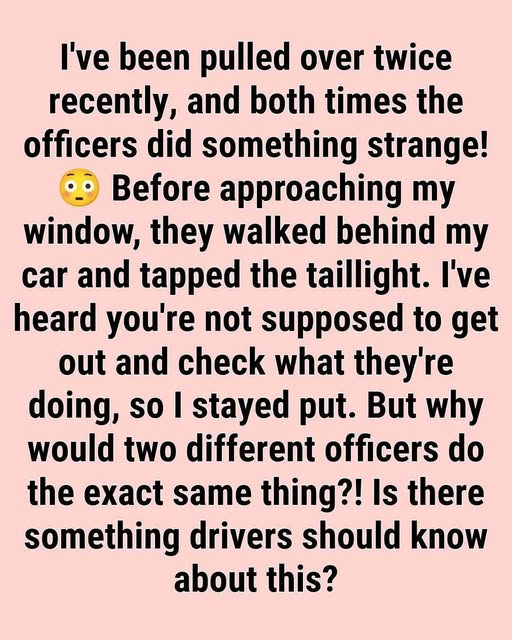
That tiny tap on the back of your car during a traffic stop may seem like an insignificant gesture, but it has traditionally been associated with an important safety precaution in law enforcement. Drivers who notice an officer briefly touching the rear of their vehicle may wonder why it happens and whether it means they are being treated with suspicion. In reality, the action is often connected to older police practices developed around the risks officers can face when approaching an unfamiliar vehicle.
For many years, one commonly discussed explanation has been that an officer touches the vehicle near the taillight to leave a fingerprint behind. The idea is that if something goes wrong during the encounter, the fingerprint could potentially help establish that the officer had been in contact with that particular vehicle. It was considered a simple way of creating a physical connection between the officer and the car before more advanced recording technology became widely available.
Although this explanation is frequently repeated, it is important to understand that it does not describe a universal procedure. Police practices differ between departments, and individual officers may have different reasons for touching a vehicle. Some may follow techniques learned during training, while others may not use the practice at all.
Another explanation involves checking whether the trunk is securely closed. As an officer approaches a vehicle, briefly checking the trunk latch may be part of a precautionary routine. The purpose is connected to the uncertainty of approaching a car when the officer cannot immediately see every possible area around or inside it. However, a simple tap should not be considered a dependable method of detecting someone hiding in the trunk.
Traffic stops can involve unpredictable circumstances. Officers approach vehicles occupied by people they may not know, and they often have limited information about what is happening inside. Even an ordinary stop for a broken taillight or a minor traffic violation requires awareness of the surrounding environment. For this reason, law enforcement training has traditionally emphasized observation, positioning, communication, and maintaining control of an encounter.
Over time, technology has changed how officers document traffic stops. Body-worn cameras and dashboard cameras can record interactions, while dispatch systems and location records can provide additional information about where an officer was and when an encounter occurred. These tools can offer a more detailed record than a fingerprint alone, particularly when questions arise about what happened during a stop.
Despite these technological changes, older habits can remain part of everyday police work. Procedures learned during training may continue because officers become accustomed to them or because certain departments maintain traditional approaches. This helps explain why some officers may still briefly touch the rear of a vehicle while others simply approach without doing so.
For drivers, the most important point is that seeing an officer touch the back of a car does not automatically mean something is wrong. It does not, by itself, indicate that the officer suspects criminal activity, believes the driver is dangerous, or has made an accusation. In many cases, the gesture is simply connected to a routine safety practice.
If you are pulled over, remaining calm and communicating clearly can help keep the encounter straightforward. Keep your hands visible, avoid sudden movements, and follow lawful instructions. If you need to reach for your license, registration, or another document, explain what you are doing before moving whenever possible.
Understanding these small details can make traffic stops feel less confusing. What may look like a mysterious gesture from the driver’s seat often has roots in traditional police safety procedures. While the exact reason can vary from one officer to another, a brief touch on the rear of a vehicle should not be interpreted as a warning or an indication that the driver has done something wrong.