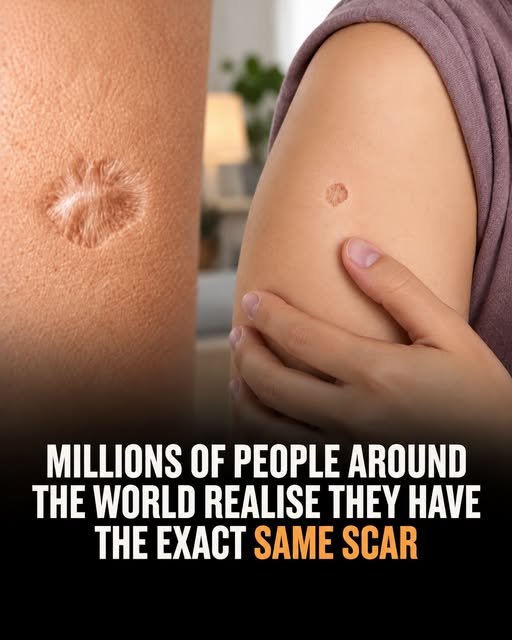
Have you ever stared at that tiny, round scar on your upper arm and wondered where it came from?
For some people, it is barely noticeable anymore. For others, it is one of the clearest physical reminders of childhood—a small mark that has been there for as long as they can remember. But behind that seemingly ordinary circle is a story far larger than most people realize.
It connects generations to one of the deadliest battles in human history.
It is a clue.
A relic.
A reminder of a disease that once terrified entire populations.
And for millions of people, that little scar is evidence that they were vaccinated against an illness humanity eventually managed to eliminate completely.
That small, circular mark on the upper arm is not simply a random blemish or childhood accident. In many people, it is the lasting result of smallpox vaccination, a procedure that used a distinctive technique very different from the injections most people know today.
Smallpox was extraordinarily dangerous. The disease could cause high fever, severe illness, blindness, permanent scarring, and death. For centuries, outbreaks moved through communities with devastating consequences, leaving families terrified that a single infection could spread from one household to another.
There was no modern antiviral treatment waiting at the hospital.
No guarantee that a healthy person would survive.
No easy way to stop an outbreak once it began.
For generations, smallpox was simply part of the human experience—and a terrifying one.
Then vaccination changed the fight.
The distinctive scar associated with smallpox vaccination was created by a method that involved repeatedly puncturing the skin with a specialized needle. Later, the bifurcated needle became especially important because its two-pronged tip could hold a tiny amount of vaccine and deliver it through a series of quick punctures.
The vaccination caused a localized reaction.
The area could blister, heal, and eventually leave behind the familiar circular scar.
To a child, it may have been nothing more than an uncomfortable appointment.
To the adults who understood what smallpox could do, it represented something much more significant.
Protection.
For older generations, the scar became so common that it almost disappeared from notice. Parents and grandparents might have carried the mark for decades without thinking about it. It became part of the background of everyday life, something people rarely discussed unless someone suddenly noticed that familiar circle on another person’s arm.
But history was sitting there in plain sight.
The scar represented a time when vaccination was not merely a personal medical decision—it was part of a massive global effort to stop a disease that had harmed humanity for centuries.
And eventually, that effort succeeded.
In 1980, the World Health Organization declared smallpox eradicated, marking one of the greatest achievements in public-health history.
Think about what that means.
Humanity did not merely reduce the disease.
It did not simply make it less common.
The naturally occurring disease was eliminated worldwide.
A virus that had caused unimaginable suffering across generations was pushed out of circulation through coordinated surveillance, vaccination, international cooperation, and extraordinary persistence.
The little scar therefore carries a remarkable contradiction.
It is evidence of something that once existed everywhere—and something that, because of collective action, eventually stopped existing in the wild.
For younger people born after routine smallpox vaccination ended in many countries, the scar can seem almost mysterious. They may look at a parent’s or grandparent’s arm and wonder why there is a small circle there when they have never received anything similar.
That difference between generations tells its own story.
One generation remembers vaccination as an ordinary part of childhood.
Another may know smallpox only from history books.
The scar sits between them.
It becomes a conversation starter.
What was that?
Why did you get it?
What disease was it for?
And suddenly a tiny mark becomes a doorway into history.
It reminds us that many things people consider normal today were once the result of enormous struggles. Diseases that seem distant now once shaped decisions about schools, travel, families, hospitals, and entire communities.
Smallpox was not defeated by one miraculous discovery alone.
It took scientists developing and improving vaccines. It took healthcare workers traveling into difficult areas. It took surveillance teams identifying cases and tracing transmission. It took governments and international organizations coordinating campaigns across borders.
And it took ordinary people agreeing to participate.
That final part matters.
Public-health victories require trust.
A vaccine can exist in a laboratory, but stopping a disease requires people to actually receive it. Communities have to cooperate. Health workers have to be supported. Information has to reach people. Systems have to keep working even when the immediate danger seems far away.
Smallpox became a powerful demonstration of what coordinated human effort can accomplish.
The scar, then, is more than a mark left by an old medical procedure.
It is a reminder of vulnerability.
A reminder of fear.
A reminder of science.
And ultimately, a reminder of victory.
For some people, it may be one of the oldest physical traces of a global health campaign they personally participated in without ever fully understanding its historical importance.
They were simply children getting a vaccine.
Years later, they carried the evidence on their skin.
And their children may never have needed the same protection.
That is what successful prevention often looks like. When it works, the next generation may barely understand what was prevented.
The danger becomes invisible because it is no longer part of everyday life.
That is not evidence that the danger was exaggerated.
It is evidence that prevention worked.
So the next time you notice that tiny circular scar on an older relative’s upper arm—or perhaps your own—look at it differently.
It is not just a scar.
It is a piece of living history.
It connects one person to generations who lived through a disease that killed and disabled enormous numbers of people. It tells the story of a vaccine, a global campaign, and a scientific achievement that changed the course of human history.
And perhaps its most powerful message is the simplest one:
Some of humanity’s greatest victories are almost invisible.
Sometimes they look like nothing more than a tiny circle on someone’s arm.
But behind that circle is proof that science, cooperation, courage, and public trust can accomplish something extraordinary.
They can stop a killer.
And, in the case of smallpox, they helped erase it from the earth.