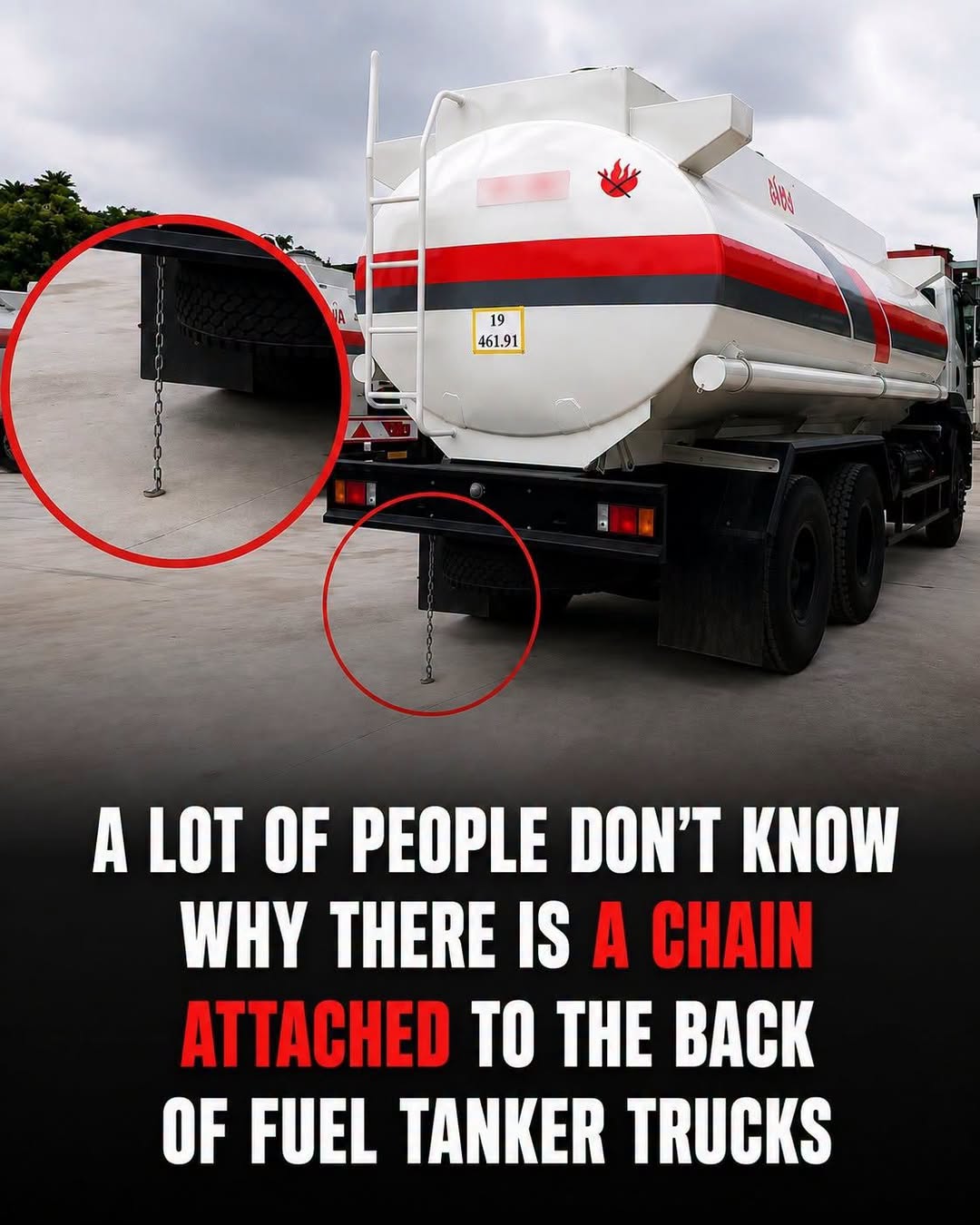
That small chain hanging near the back of a fuel truck is easy to overlook.
It may look like nothing more than a loose piece of metal dragging close to the road.
But when you’re dealing with gasoline and other flammable fuels, static electricity is a serious safety consideration.
Fuel tankers operate in environments where electrical charges can build up naturally.
As the truck moves, friction occurs between tires and the road, air moves across the vehicle, and fuel inside the tank shifts during transportation.
Those processes can contribute to static charge.
Under the wrong conditions, a spark near flammable fuel vapors can become extremely dangerous.
That is why fuel transportation involves carefully designed safety procedures.
The dangling chain is often assumed to be a grounding device, but modern fuel tankers rely on much more sophisticated grounding and bonding systems than a simple chain dragging on the pavement.
The most important protection usually happens during loading and unloading.
Before fuel begins flowing, workers follow procedures designed to prevent dangerous differences in electrical potential between the tanker, equipment, and fuel system.
Grounding and bonding connections can provide a controlled path for electrical charges and help prevent static discharge from occurring where flammable vapors may be present.
These steps may take only moments, but they are extremely important.
The tanker is connected to a verified grounding point.
Equipment is bonded appropriately.
Hoses and other components are positioned according to established procedures.
Only after the required safety checks have been completed does fuel transfer begin.
To someone watching from a distance, it may look like an ordinary delivery.
A truck arrives.
A hose is connected.
Fuel moves.
The truck leaves.
But behind that routine is a carefully controlled process designed to prevent a chain of small hazards from becoming one catastrophic event.
Static electricity is particularly concerning around flammable liquids because the liquid itself may not be the only hazard.
Fuel can produce vapors, and those vapors can mix with air.
If an ignition source appears in the wrong place at the wrong time, the consequences can be severe.
That is why eliminating potential ignition sources is a fundamental principle of fuel handling.
It is also why workers in the fuel industry are trained to follow procedures rather than rely on assumptions.
Something that appears harmless to the public may be treated very differently by professionals who understand the risks.
The truck itself is designed around these hazards.
Fuel tanks, hoses, valves, grounding points, and loading equipment are all part of a larger safety system.
No single component is responsible for preventing every accident.
Instead, multiple layers of protection work together.
That concept is important because people often focus on the most visible object.
They see a chain and assume the chain is doing all the work.
In reality, the most important safety measures may be the things you never notice.
The grounding cable connected during loading.
The bonding connection between components.
The inspection performed before fuel transfer.
The worker checking that equipment is functioning correctly.
The procedures that determine when fuel can begin flowing.
Those invisible steps are what make routine fuel transportation possible.
The same principle applies to many other safety systems.
The most effective protection is often the least noticeable.
We rarely think about the engineering behind a fire extinguisher, an emergency shutoff valve, or a properly grounded electrical system until something goes wrong.
Fuel transportation is similar.
Millions of gallons of fuel are moved every day, and the process depends on people taking seemingly ordinary precautions seriously.
For the public, the lesson is simple: don’t assume that something hanging from a fuel truck is decorative, and don’t attempt to interfere with fuel equipment or grounding systems.
Fuel loading and unloading should be handled by trained personnel following established procedures.
What looks like a simple truck is actually a carefully engineered piece of safety-critical equipment.
The dangling chain may attract attention because it is visible.
But the real protection happens through an entire network of engineering, grounding, bonding, inspections, training, and procedures.
Every part has a role.
Every check matters.
And every worker who follows those procedures is helping prevent a hazard most people never think about.
The next time you see a fuel tanker traveling down the highway, you may notice that little chain.
But remember that it represents only a small, visible piece of a much larger safety system.
The most important protection isn’t always the thing you can see.
Sometimes, it’s the quiet procedure happening behind the scenes that keeps an ordinary fuel delivery from becoming something far more dangerous.