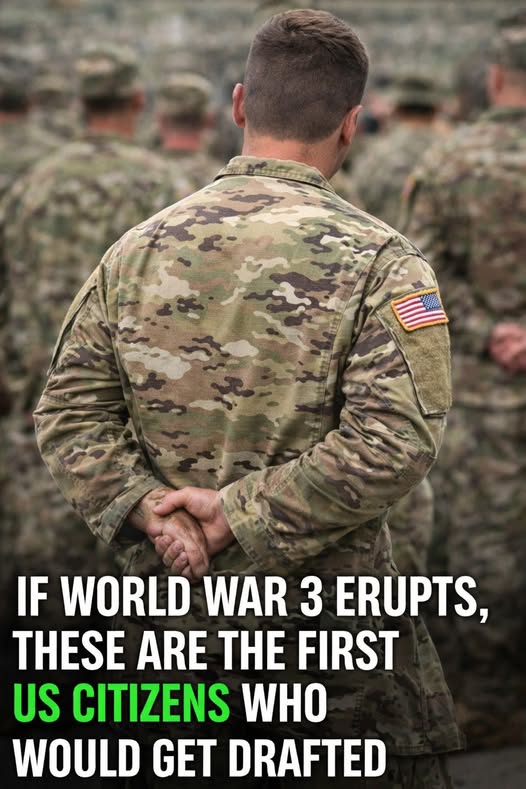
A well-known subject has resurfaced in public discourse due to escalating international tensions and political rhetoric: who might be recruited into the U.S. military in the event of a major conflict? The subject, which many Americans have never had to give much thought to, has come up again as rumors about global instability and the potential—however remote—of a wider conflict increase.
The United States does not currently have an active military draft, despite the worry. The nation has been totally dependent on a volunteer military force since 1973, when the Vietnam War ended. Many people are unaware, nevertheless, that the legal foundation for conscription has never vanished. It is still in place, enshrined in federal law, and available for activation should the government decide that it is necessary for national security.
The Selective Service System, an autonomous federal organization in charge of keeping a database of people who might be called upon in the case of a draft, is at the heart of this system. This system works silently in the background even during times of peace, guaranteeing that the nation has a mechanism in place for quick mobilization if necessary. (Wikipedia)
Nowadays, the law mandates that almost all male immigrants and citizens of the United States between the ages of 18 and 25 register with the Selective Service. Natural-born citizens, permanent residents, refugees, asylum seekers, and even unauthorized immigrants residing in the nation are all included in this. (USAGov) Registration guarantees that a person’s information is on file in case it becomes necessary, but it does not guarantee that they will be drafted.
There are a few exceptions. Certain non-immigrant visa holders, those who are constantly institutionalized, and certain groups like ministers or elected officials might not be obliged to register. But for the most majority, registration is required, and not registering can have repercussions. Penalties can include fines, possible legal problems, and loss of eligibility for some government programs or employment possibilities, even if criminal prosecution is uncommon. (Administration of Social Security)
The system is changing as a result of recent advances. Automatic registration is anticipated to be a major change starting in late 2026. The government would locate and register eligible men between the ages of 18 and 26 using already-existing federal databases rather than requiring individuals to join up on their own. (Wikipedia) This change indicates an attempt to provide more thorough coverage and close system gaps, but it does not indicate that a draft is about to be released. Congress and the President would still need to approve activation.
The procedure would probably be incremental and structured if a draft were ever revived. A nationwide lottery system such to the one in place during the Vietnam War would be the first step. The order in which people are called for review would be determined by a random selection of birthdates. (Los Angeles, FOX 11)
Men who turn 20 in the year of the draft would normally be called first under the existing planning models. The system would subsequently grow to cover 21-year-olds, older people up to age 25, and eventually younger groups—19- and 18-year-olds—if more staff were required. (Military.com) Prioritizing those deemed most urgently eligible, this order aims to strike a balance between readiness and equity.
But winning a lottery does not ensure that you will serve in the military.
To ascertain their eligibility, those selected would go through a number of assessments. These include of background investigations as well as physical, medical, and psychological evaluations. For a variety of reasons, including as health issues, family difficulties, or conscientious objection based on moral or religious convictions, people may be postponed or exempted. (US Department of War)
Not everyone who is eligible on paper would actually be able to serve. According to studies and military estimations, a sizable percentage of the eligible population might be disqualified for reasons like health problems, not having the necessary education, or other requirements. (Military.com) This implies that even in the case of a draft, fewer people may be inducted in the end than many people believe.
Gender is another crucial component of the conversation.
As of right now, only men must register for the Selective Service. Despite recent discussions in Congress, women are not part of the system. New legislation would be necessary for any modification to include women, and as of right now, no such requirement has been put into place.
For younger generations who grew up in an era where military duty was completely voluntary, the concept of a draft can seem esoteric. It is more of an idea than a lived reality for many. However, the underlying infrastructure is still in place and is maintained as a backup plan rather than an active policy.
Practically speaking, it would take time to activate a draft.
Implementing the procedure would take time, even with legal authorization. Current plans call for a timeframe that includes notice, evaluation, and categorization before the first people are inducted into duty. (Administration of Social Security) The difficulty of organizing a sizable number of people while maintaining equity and appropriate screening is reflected in this delay.
Keeping speculation and truth apart is also crucial.
During times of geopolitical unrest, public anxiety frequently rises, particularly when political figures make declarations regarding military action or strategic expansion. But talks about possible conflict do not always result in a draft being activated. Such decisions require several levels of government clearance and are impacted by a variety of circumstances, such as domestic policy considerations, foreign relations, and military preparedness.
As of right now, the United States still relies on its voluntary military, which is funded by recruitment campaigns rather than conscription. The Selective Service system serves as a fallback—a structure intended for situations that, although conceivable, do not yet exist.
Reducing uncertainty requires an understanding of how the system operates.
It makes clear who would be impacted, how the process would work, and what requirements would need to be fulfilled before any draft could be made. Although the concept of conscription can be unpleasant, it is actually more controlled and structured than most people realize.
Ultimately, the draft is a backup plan that embodies the larger idea of readiness rather than an instant actuality. It exists because the prospect of requiring it has never been completely eliminated, not because it is likely to be needed.