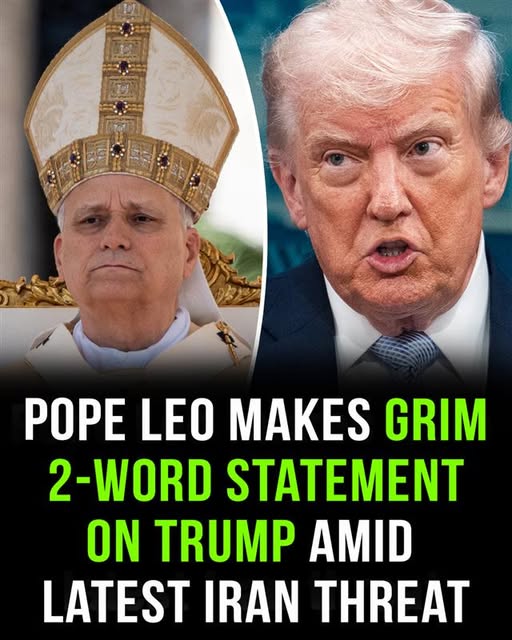
Not only did the world’s political and spiritual tectonic plates move this week, but they also broke. In a public argument that will be studied for centuries, two of the world’s most powerful individuals engaged in high-stakes brinkmanship that literally brought humanity to the verge of a civilizational reset. Pope Leo XIV, a Chicago native whose two-word denunciation has sent shockwaves through the corridors of power from Washington to the Vatican, is on one side, while President Donald Trump issued a horrifying ultimatum that threatened to eradicate a whole civilization.
Just hours before a deadline that many feared would mark the beginning of a disastrous escalation, the anxiety peaked on Tuesday morning. Using his Truth Social platform, President Trump shared a statement that seemed more like a biblical prophecy than a diplomatic ploy. Trump added, “A whole civilization will die tonight, never to be brought back again,” alluding to Iran, a country with more than 90 million citizens and some of the planet’s oldest historical sites. “I hope that doesn’t occur, but it most likely will.”
The President’s rhetoric was linked to an unrelenting bombing campaign and a call for the Strait of Hormuz, the world’s most important oil chokepoint, to be immediately reopened. Trump’s 8:00 PM Eastern Time deadline hung over the world like a ticking clock, and many saw his remarks as a covert threat to unleash the most powerful weapon in the American arsenal. The 2026 Iran War had already destroyed military infrastructure for five weeks, but Trump’s new emphasis on “power plants and bridges”—civilian lifeblood—marked a grave turn in the fight.
The Holy See’s quiet was short-lived. Pope Leo XIV, the first American to head the Catholic Church, stood outside his home at Castel Gandolfo as the clock crept down to Trump’s ultimatum and gave a succinct yet deadly rejoinder. He didn’t conceal himself with diplomatic words. Rather, the Chicagoan pope turned to face the cameras and delivered a somber two-word assessment of the American president’s threat: “Truly unacceptable.”
As everyone is aware, there was a threat against all Iranians today. “This is absolutely unacceptable,” Leo said to the assembled reporters. The world was reminded by his calm but intensely urgent voice that attacking civilian infrastructure is not only against international law but also a moral failure that tarnishes mankind. He reminded Trump that this “unjust war” was targeting “innocent children, the elderly, and the sick” and called on leaders to “come back to the table.”
The intervention by the Pope was unheard of. Pope Leo XIV, who only started his papacy earlier this year, has shown that he is prepared to take on the leader of the free world head-on, in contrast to previous pontiffs who have frequently been cautious when criticizing their own countries. He urged everyone to send messages to their political representatives urging them to “work for peace and to reject war.”
A storm of political realignment was the response on a global scale. Along with individuals like Tucker Carlson and global leaders like Nigel Farage, some of Trump’s closest supporters in the MAGA movement also voiced deep concern about the possibility of the destruction of civilization. Citing the moral and legal duty to reject blatantly illegal orders, Democratic leaders in Congress went one step further and demanded that the Pentagon reject any command that would result in the annihilation of an entire people.
The globe held its breath as the 8:00 PM deadline drew near. Then, in a turn of events as dramatic as the threat itself, the diplomatic machinery began to turn. A last-minute agreement was reached through Pakistani mediation. President Trump declared a two-week truce just ninety minutes before the world anticipated the “end of a civilization.”
Iran agreed to quickly reopen the Strait of Hormuz as part of the truce, while the US agreed to halt its bombing campaign in order to facilitate high-level talks. Ever the showman, Trump quickly changed course, calling the ceasefire a “total and complete victory” and implying that “smarter and less radicalized minds” were now in control in Tehran. He asserted that the Iranian people “welcome the sound of bombs” since it heralds the end of their oppressors, but he also mentioned that “something revolutionarily wonderful” might occur over the following fourteen days.
However, the rhetoric of the past 48 hours has left deep wounds, and the ceasefire is brittle. The Vatican has not wavered in its moral criticism, although applauding the end of hostilities as a “genuine hope.” The “hatred, division, and destruction” that marked the height of the crisis are still sharply condemned in Pope Leo’s “Urbi et Orbi” speech.
What happens after the two-week window closes is the question that now plagues chancelleries around the world. The gap between the Church’s moral authority and the United States’ military might is more apparent than ever, even though the Strait of Hormuz may remain open for the time being. Pope Leo XIV has stated unequivocally that he will not stand by and watch American foreign policy, particularly when it threatens to veer beyond the bounds of conventional conflict and into what many have referred to as “genocidal incitement.”
The world community is left to consider a new reality as the Middle East recovers after forty days of fierce fighting and New Jersey declares a state of emergency due to winter storms. These days, a free world leader can use social media to endanger the survival of an entire civilization, only to be chastised in the vernacular of the street by an American pope. The bombs have stopped dropping for the time being, but Pope Leo’s two-word warning still reverberates, serving as a reminder that the truth is frequently the most lethal weapon when confronted with total authority.