## When the Wild Comes Home: Understanding Unexpected Wildlife Encounters
Experiencing the natural world up close can be both fascinating and unsettling, especially when that encounter happens unexpectedly within the spaces we consider our own. Most people imagine wilderness as something distant—hidden in forests, mountains, fields, or protected areas safely separated from neighborhoods and cities. We tend to think of our homes, gardens, porches, and driveways as distinctly human environments.
Yet nature does not always respect those invisible boundaries.
Wildlife frequently finds its way directly into residential areas, sometimes without residents ever realizing it. A set of tracks in the mud, feathers scattered across a lawn, an overturned trash container, or unexplained animal remains on a porch can suddenly remind us that the boundary separating human civilization from the natural world is much thinner than it appears.
This article explores the experience of discovering evidence of wildlife activity around a typical residential home and considers what these encounters reveal about the complicated relationship between people and the animals living around them. Understanding why wildlife enters neighborhoods can replace unnecessary fear with awareness while helping residents coexist more safely and responsibly with local fauna.
## Understanding the Proximity of Wildlife
Wild animals are remarkably adaptable. As cities and suburbs continue expanding into areas that were once forests, grasslands, wetlands, or open countryside, many species have learned to survive surprisingly close to people.
Raccoons, foxes, coyotes, deer, opossums, birds of prey, and numerous smaller animals can all appear in residential environments. Some may simply be passing through established territories, while others discover that neighborhoods provide exactly what they need to survive.
Food is one of the strongest attractions.
Trash containers, outdoor pet food, compost piles, fallen fruit, bird feeders, gardens, and even small animals living around houses can provide reliable food sources. To a wild animal, these resources are not part of someone’s property—they are simply opportunities.
Shelter is another reason wildlife moves closer to homes. Sheds, decks, crawl spaces, abandoned structures, dense shrubs, and quiet corners of yards may provide protection from weather and predators. Some species become so comfortable in suburban environments that generations can live relatively close to humans.
As natural habitats shrink or become fragmented by roads, housing developments, and commercial construction, interactions between wildlife and people may become increasingly common.
The boundary between wilderness and home is therefore not a solid line.
It is better understood as a constantly changing zone of interaction.
Wild animals do not recognize fences, street addresses, or property lines in the way people do. Their movements are driven primarily by instinct, territory, food availability, reproduction, and survival. A backyard that feels deeply personal to a homeowner may simply look like part of a hunting route to a fox or coyote.
This means signs of wildlife activity can appear almost anywhere.
Tracks may cross a driveway overnight.
Feathers may suddenly appear beneath a tree.
An animal may investigate a garbage container.
Or something far more unsettling may be discovered directly outside the front door.
## A Morning Discovery: Signs of the Wild Near Home
Imagine beginning an ordinary morning.
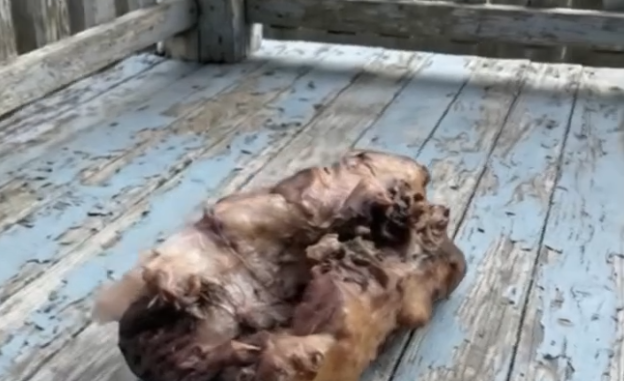
You prepare a warm drink, open the door, and step outside expecting the familiar quiet of the neighborhood. Birds are calling from nearby trees. Cars haven’t fully begun filling the streets. Everything feels completely normal.
Then something on the porch catches your attention.
At first, you aren’t sure what you’re seeing.
It is small enough to overlook but strange enough that your eyes immediately return to it. The shape doesn’t belong there. Neither do the texture or color.
Curiosity pulls you closer.
Then discomfort takes over.
What initially looked like debris may appear biological. Perhaps there is fur, tissue, feathers, or some other fragment suggesting that an animal had been there during the night.
The peaceful morning suddenly feels different.
Questions begin immediately.
What animal did this come from?
How did it get onto the porch?
Was something killed nearby?
Is there a predator living close to the house?
Could the remains indicate disease?
Or, perhaps most unsettlingly, did someone intentionally leave them there?
When there is no obvious explanation, imagination can quickly produce frightening possibilities.
But many discoveries like this have relatively ordinary wildlife explanations.
## Predation Close to Human Homes