Chapter 1: The Chemistry of Deception
The first thing I heard when I stepped out of the yellow cab was my wife telling our neighbor, Mrs. Gable, that my father had lost his mind.
The second thing I heard was the muffled, rhythmic thud of a heavy fist striking the inside of a locked, solid-oak bedroom door.
Only sixteen hours earlier, I had been strapped into the canvas webbing of a C-17 military transport plane, staring at the corrugated metal ceiling, thinking about the simple comforts of home. I had survived a grueling eight-month deployment in a kinetic combat zone. I had dreamt of hot, black coffee in my favorite ceramic mug, the smell of fresh rain on the Ohio pavement, and my wife, Abigail, rushing across the front lawn to collapse into my arms.
Instead, Abigail was standing on the wraparound porch in a pristine, cream-colored sundress, holding a pitcher of iced tea, smiling at the neighbor like she was hosting a mid-summer charity gala. Behind her stood a man I didn’t recognize—broad-shouldered, wearing clinical scrubs that stretched tight over heavily muscled arms.
“He gets so terribly confused,” Abigail was saying, her voice dripping with practiced, velvety sorrow. “Sometimes he hurts himself. He doesn’t know where he is or what year it is. Marcus here is a registered psychiatric nurse. We’re… we’re trying to arrange professional memory care. It breaks my heart.”
I froze at the edge of the driveway, the gravel crunching softly beneath my combat boots. I looked up toward the second-story window of my father’s bedroom. The heavy blackout curtain twitched. Just a fraction of an inch, but enough for me to know someone was standing in the suffocating dark, watching.
Abigail turned, the pitcher of tea slipping slightly in her grip as she saw me. For a microsecond—a fraction of time only a trained military interrogator or a husband who suddenly realizes he doesn’t know his wife would catch—her eyes flared with absolute panic. Then, the mask slammed back into place.
She put the pitcher down and rushed toward me, wrapping her arms around my neck. Her perfume smelled like lavender and something synthetic.
“Sam! Oh my god, you’re home early!”
I hugged her back, feeling the rigid tension in her spine. The instant the neighbor waved and walked away, I pulled back just enough to look into my wife’s eyes. I glanced at the muscle-bound man on the porch. “Who is that, and why is my father’s door locked from the outside, Abigail?”
Her body went entirely stiff. The warm, loving wife vanished, replaced by something cold and calculating. “That is Marcus, Sam. For your father’s safety,” she answered, her voice dropping an octave. “I didn’t want to tell you while you were deployed. You had enough to worry about. He’s… he’s slipping away from us. He gets violent.”
I smiled. A tight, perfectly engineered smile. “Of course. I understand.”
If my time in military intelligence and my previous years as a forensic auditor for the state attorney general’s office had taught me one unshakeable rule, it was this: panic gives away your position. When you realize you are walking through a minefield, you do not run. You tread lightly. You smile. You agree.
I kissed her forehead, hoisted my heavy canvas duffel bag over my shoulder, and walked inside the house I had paid for. The silence in the hallway was heavier than the desert heat I had just left behind.
I waited until Abigail and her “nurse” went into the kitchen to prepare dinner. The bedroom key, I knew, would be hidden where she kept things she didn’t want my father to find. I walked into our master bedroom, opened her mahogany jewelry box, and found the small brass key resting beneath a string of pearls I had bought her for our first anniversary.
When I unlocked my father’s door and pushed it open, the stench of stale air and clinical antiseptic hit me first. The room was bathed in shadows. A bare mattress sat on the floor. A plastic cup of water rested next to a cold bowl of oatmeal.
And there was my father, Arthur.
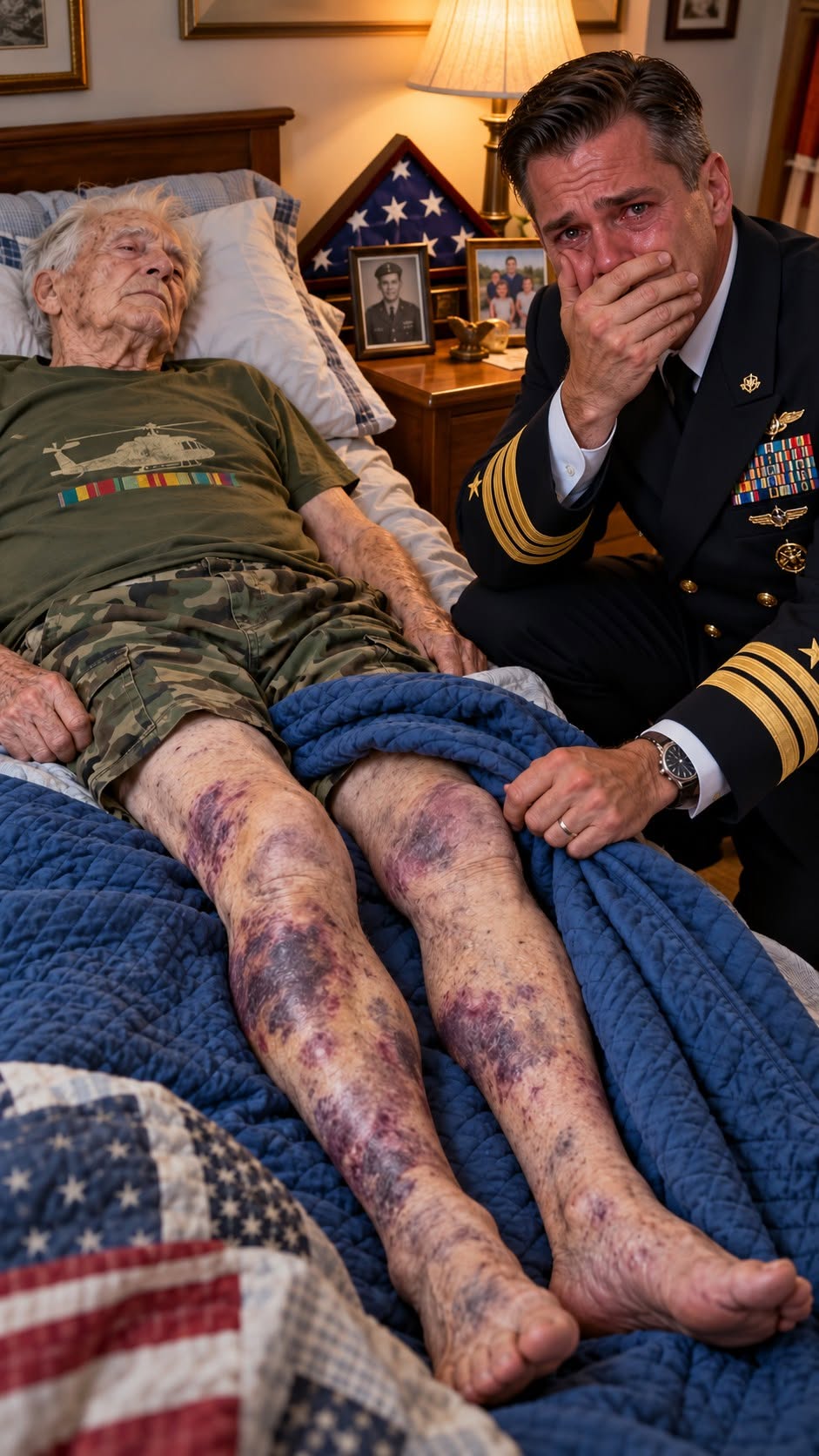
Thirty years he had given to the FBI as a senior field agent. He was a man made of iron and black coffee. Now, he sat slumped in a wheelchair by the window, his eyes seemingly vacant, staring at a wall. His jaw hung slack. But what made my blood turn to ice were the deep, mottled purple bruises circling both of his wrists, extending up his forearms in violently dark patches.
“Dad?” I whispered, dropping to my knees beside his chair.
He didn’t turn his head. He didn’t blink. But his right hand, resting limply on the armrest, twitched. His index and middle fingers began to tap against the leather.
Tap. Tap. Pause. Tap-tap-tap.
I stared at his hand, the tactical gears in my mind snapping into place. It wasn’t a tremor. It was Morse code. The language he had taught me when I was nine years old, tapping on the kitchen table while my mother cooked dinner.
M-O-T-H-E-R W-A-S M-U-R-D-E-R-E-D.
My breath caught in my throat. My mother, Eleanor, an investigative journalist, had died of a highly aggressive cancer eleven years ago. At least, that’s what the death certificate said.
His fingers kept moving. Precise. Desperate.
W-I-F-E I-S E-N-E-M-Y. T-R-U-S-T N-O O-N-E.
“Dad,” I breathed, my voice barely audible. “Did she do this to your arms?”
His fingers tapped again.
F-O-U-G-H-T T-H-E N-U-R-S-E. T-E-S-T-I-N-G H-I-S S-T-R-E-N-G-T-H.
I looked at the horrific black-and-blue marks on his skin, realizing the sheer, terrifying willpower it took for a seventy-year-old retired agent to endure this torture. He was faking the dementia. He had let that thug beat him just to map the man’s combat reflexes.
His fingers tapped one last sequence.
P-O-I-S-O-N I-N F-O-O-D. I H-I-D-E P-I-L-L-S U-N-D-E-R T-O-N-G-U-E. S-P-I-T I-N M-A-T-T-R-E-S-S.
Footsteps creaked heavily on the hardwood floor in the hallway outside.
My father’s tapping stopped instantly. The fierce, lucid warrior vanished back into the shell of a broken old man. A line of drool escaped the corner of his mouth.
I stood up just as the doorknob turned. Abigail stood in the doorway, a look of profound, manufactured tragedy on her face, with the hulking mass of Marcus looming right behind her.
“He doesn’t know you, Sam,” Abigail whispered, her hand resting on my shoulder. “We have a doctor’s evaluation tomorrow. It’s time to let him go.”
I hated myself as I nodded, playing the grieving son perfectly. “You’re right,” I said.
As I walked out of the room, Marcus stepped forward to lock the door behind me. But just before the wood clicked into the frame, my father’s eyes darted toward mine through the crack. They weren’t dead. They were blazing with the fury of a caged tiger.
The war had officially begun.