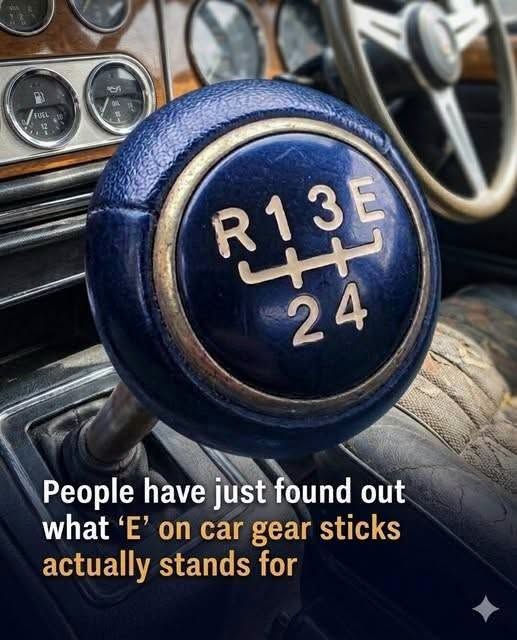
Most drivers today would barely recognize it, yet for years it quietly sat beside the familiar P, R, N, and D on countless automatic transmissions. It was only a single letter—“E”—but it represented an entirely different way of driving. Long before modern vehicles featured digital displays, customizable drive modes, and sophisticated onboard computers, that small symbol gave drivers a simple choice: prioritize performance or save fuel. Many people shifted into it without fully understanding what it actually did, while others ignored it completely, never realizing they were overlooking a feature designed to make every journey smoother, quieter, and more economical.
The mysterious “E” stood for more than just a transmission setting—it reflected a philosophy of efficiency. During an era when fuel prices frequently fluctuated and large engines dominated the roads, manufacturers began searching for practical ways to reduce fuel consumption without sacrificing everyday comfort. Selecting the E mode instructed the transmission to behave differently. Instead of allowing the engine to rev aggressively before changing gears, it shifted earlier, keeping engine speed lower and reducing unnecessary fuel use. The result was a calmer driving experience, less engine noise, smoother acceleration, and fewer trips to the gas station. For many motorists, it was one of the earliest examples of technology quietly working in the background to improve efficiency.
Drivers who paid close attention could immediately feel the difference. Acceleration became more gradual, gear changes happened sooner, and the vehicle encouraged a more relaxed driving style. Rather than chasing maximum performance, the car focused on conserving energy whenever possible. While it wasn’t the ideal setting for rapid acceleration or steep mountain roads, it proved extremely useful during everyday commuting, long highway journeys, and city driving where smoothness mattered more than speed. Without complicated menus or electronic screens, a simple movement of the gear selector completely changed how the vehicle responded to the driver’s commands.
At the time, this feature represented an important shift in automotive thinking. Manufacturers realized that not every journey required maximum engine power. Instead, many drivers appreciated lower operating costs, quieter cabins, and improved fuel economy. The small letter “E” quietly reminded motorists that efficiency could be an intentional choice rather than simply a byproduct of careful driving. It encouraged people to think differently about how they used their vehicles, proving that comfort and economy could often go hand in hand.
As automotive technology advanced, however, the visible “E” gradually disappeared from many gear selectors. Computer-controlled transmissions became increasingly intelligent, automatically adjusting shift patterns based on driving conditions without requiring drivers to make manual selections. Modern vehicles introduced multiple drive modes—such as Eco, Comfort, Normal, Sport, and Individual—that performed similar functions through sophisticated software instead of a single mechanical setting. The original letter vanished from many dashboards, but the concept behind it remained alive, hidden within complex electronic systems that continuously optimize fuel efficiency without most drivers ever noticing.
Today, the philosophy represented by that forgotten letter has become even more important as the automotive industry moves toward hybrid and fully electric vehicles. In many electric cars, efficiency is once again placed at the center of the driving experience. Drivers now encounter Eco modes that reduce energy consumption, regenerative braking systems that recover electricity during deceleration, and intelligent software designed to maximize driving range. Although the technology has evolved dramatically, the underlying principle remains remarkably familiar: use only the energy you truly need and preserve as much as possible for the journey ahead.
Regenerative braking, in particular, reflects the same mindset that inspired the original E mode decades ago. Instead of allowing energy to disappear as wasted heat during braking, electric vehicles capture much of that energy and return it to the battery for future use. This creates a driving experience focused not only on performance but also on sustainability, efficiency, and thoughtful energy management. What was once achieved through earlier gear changes is now accomplished through advanced software, electric motors, and intelligent battery systems capable of constantly adapting to road conditions.
Looking back, it’s remarkable how one small letter quietly anticipated the future of driving. What appeared to be a simple marking beside the gear selector represented the beginning of a much larger transformation in automotive engineering. It encouraged drivers to think beyond speed and horsepower, introducing the idea that saving fuel could be just as valuable as gaining performance. Although modern vehicles hide these decisions behind touchscreen menus, digital displays, and automatic algorithms, the spirit of that little “E” continues guiding today’s technology. From gasoline-powered sedans to cutting-edge electric vehicles, its message remains unchanged: the smartest journey isn’t always the fastest one—it’s the one that uses energy wisely while still getting you exactly where you need to go.