## The Mystery of Everyday Objects: When Familiar Things Become Unfamiliar
Encountering unfamiliar objects in our own homes or in the homes of friends, relatives, and coworkers is a surprisingly common experience. A strange little device sitting on a kitchen counter, an oddly shaped utensil hidden inside a drawer, or a mysterious tool left on a desk can immediately spark curiosity, confusion, and sometimes even amusement.
When we come across an item whose purpose is not immediately clear, our minds instinctively begin filling in the missing information. We examine its shape, size, material, buttons, wires, handles, or moving parts and compare them with objects we already recognize. Sometimes our first guess is remarkably accurate. Other times, the explanation we invent is completely wrong—and occasionally far more entertaining than the object’s actual purpose.
This process reveals something interesting about the way people understand the physical world around them. Everyday objects may seem obvious when they are being used in their intended environment, but remove them from that context and even simple household tools can suddenly look mysterious.
This article explores why ordinary objects can become confusing when encountered without context, how culture and technology influence the things found inside our homes, and how a little investigation can transform an unfamiliar item into something completely understandable.
## The Nature of Everyday Objects and Context
Most household items are created with a specific function in mind.
A whisk mixes ingredients.
A bottle opener removes caps.
A remote control operates electronics.
A vegetable peeler removes thin layers of skin from produce.
When we see these objects being used normally, their purpose appears obvious because the environment provides clues.
A whisk sitting beside a mixing bowl filled with batter requires almost no explanation. The same whisk placed unexpectedly on an office desk might make someone wonder why it is there.
Context shapes interpretation.
This becomes particularly noticeable with tools designed for specialized tasks. Modern homes can contain hundreds of objects intended to perform very specific functions, from avocado slicers and milk frothers to electronic cleaning brushes and unusual charging accessories.
Someone familiar with the product may recognize it instantly.
Someone seeing it for the first time may have absolutely no idea what it does.
Cultural differences can make the mystery even greater.
Kitchen utensils provide an excellent example. Food traditions around the world have produced specialized tools that make perfect sense within their original culinary context but can look unusual to people unfamiliar with that tradition.
A utensil used daily in one country might be mistaken for a decorative object somewhere else.
Similarly, traditional tea equipment, coffee-making devices, fermentation tools, baking accessories, and specialized serving utensils can all become puzzles when removed from the environment in which they are normally used.
Technology adds another layer.
As household devices become smaller and more specialized, their purpose can become harder to determine from appearance alone. Rechargeable gadgets may have only one button and a strangely shaped attachment, giving almost no obvious clue about their intended function.
Without packaging or instructions, identifying them can require genuine detective work.
## Why Our Minds Guess
Human beings naturally attempt to recognize patterns.
When we see something unfamiliar, the brain searches through previous experiences for anything similar. If the object has a handle, we assume it is meant to be held. If it contains wires, we may assume it has an electrical or mechanical purpose. If it has delicate loops or unusual shapes, we may imagine it belongs to cooking, cleaning, crafting, or personal care.
These guesses are useful because they allow us to navigate unfamiliar situations quickly.
But they can also be spectacularly wrong.
An object designed to prepare food might resemble a beauty accessory. A specialized cleaning tool could look like medical equipment. A simple kitchen gadget might appear complicated enough to belong in a laboratory.
The fewer contextual clues available, the more imaginative our explanations can become.
This is why mysterious-object photographs are so popular online. Someone posts a picture asking, “Does anyone know what this is?” and within minutes hundreds of people begin offering theories.
Some answers are serious.
Others are jokes.
Eventually, someone recognizes the object and provides an explanation that suddenly makes its strange design appear completely logical.
Once the purpose is known, it can become difficult to see the object as mysterious again.
## Case Study: The Electric Matcha Whisk
Consider the example of a small kitchen tool discovered unexpectedly on a desk.
At first glance, it looks unusual.
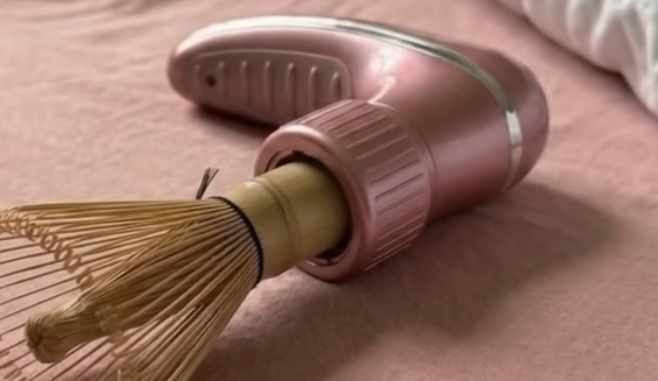
There is a lightweight handle, perhaps containing a small motor or battery compartment, with delicate wire loops extending from one end. The loops may form a rounded or flower-like pattern that doesn’t immediately resemble an ordinary kitchen whisk.
Without context, the imagination begins working.
Is it a small massage device?
A craft tool?
Some kind of decorative accessory?
A specialized cleaning instrument?
Its location on a desk only makes identification more confusing.
But after a little investigation, the mystery disappears.
The object is an electric matcha whisk or frothing tool designed to help mix powdered tea with liquid.
Suddenly, every strange feature makes sense.
## Understanding Matcha and Why It Needs Whisk