The threat landed like a diplomatic grenade.
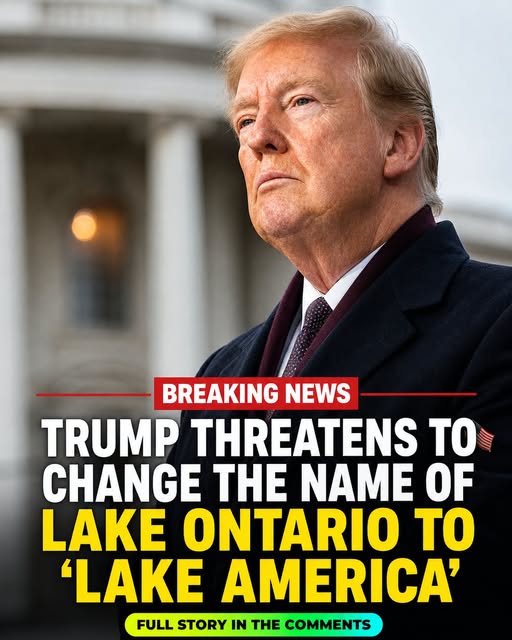
In the middle of an increasingly bitter trade war between the United States and Canada, President Donald Trump suddenly floated an idea that sounded almost surreal: renaming Lake Ontario **“Lake America.”**
The comment appeared on Truth Social as tensions between Washington and Ottawa were already reaching another dangerous level. Trump said the United States was giving “serious consideration” to the name change because it no longer expected to do much business with Ontario.
A lake.
A name.
A few words on social media.
And yet the symbolism was enormous.
Lake Ontario is not some remote body of water sitting entirely inside the United States. It stretches across the border between New York and Ontario and has long been part of the geography shared by two countries whose economies and communities are deeply intertwined.
So when Trump suggested replacing “Ontario” with “America,” Canadians did not hear merely a branding exercise.
They heard another message.
Another reminder that the relationship between the two countries had entered territory few people would have imagined only a short time ago.
The proposal arrived after trade negotiations had broken down and the Trump administration imposed additional **50% tariffs on roughly $20 billion worth of Canadian goods**. The White House says the tariffs are intended to counter what it considers discriminatory treatment of American commerce by Canada.
The products caught in the dispute are not abstract numbers.
They include things people actually recognize.
Wine.
Alcohol.
Hockey sticks.
Cement.
Dairy products.
Other goods moving through one of the world’s most deeply integrated trading relationships.
Suddenly, ordinary products were caught inside a political confrontation that was becoming increasingly personal.
Canada responded with retaliatory measures of its own.
Canadian officials announced tariffs on hundreds of U.S. products, with the measures scheduled to take effect in September. The response is designed to pressure American industries while protecting Canadian businesses and workers from the impact of Washington’s tariffs.
The economic consequences could extend far beyond the products appearing in headlines.
American and Canadian businesses have spent decades building supply chains that cross the border repeatedly.
A component can be manufactured in one country, shipped to the other, assembled, and then sent back again.
Cars and auto parts are particularly sensitive.
Energy is deeply connected.
Agriculture is deeply connected.
Manufacturing is deeply connected.
The border may be international, but the economies on both sides often function as if the border is barely there.
That is why tariffs can become so disruptive.
A company may not have an easy alternative supplier.
A farmer may depend on access to the neighboring market.
A factory may depend on components arriving on time.
And consumers ultimately absorb some of the increased costs.
But the dispute has become about more than economics.
It has become personal.
Prime Minister Mark Carney has adopted increasingly forceful language as the negotiations deteriorated, portraying the dispute as an attack on Canada’s economic sovereignty and major industries.
Trump, meanwhile, has accused Canada of unfair trade practices and has continued escalating his rhetoric.
At one point, Carney compared the situation to being attacked and emphasized Canada’s determination to defend itself economically.
Those words matter because Canada has historically been one of America’s closest allies.
These are not two distant countries with little history together.
They share one of the longest international borders in the world.
Families cross it.
Businesses depend on it.
Communities on both sides interact every day.
Millions of people have relatives, friends, customers, suppliers, or business partners across the border.
That makes the deterioration particularly unsettling.
Because when the relationship between two countries this connected begins to fracture, the consequences are not confined to politicians.
They reach ordinary people.
The name “Lake Ontario” suddenly became a symbol of that tension.
Trump’s proposal is not the first time his administration has pursued a controversial geographical renaming.
In 2025, Trump moved to rename the Gulf of Mexico as the **Gulf of America**, and the Lake Ontario proposal echoes that earlier effort.
But Lake Ontario presents a different symbolic problem.
The lake is shared.
Its northern shore belongs to Canada.
Its southern shore belongs to the United States.
Toronto sits on its northern edge.
New York borders its southern shore.
A name imposed by one side does not erase the history or identity attached to it by the other.
And that is where the symbolism becomes much larger than geography.
Names carry history.
They carry identity.
They tell people who belongs.
They tell people whose version of history is being recognized.
Changing a name can therefore become an act of political messaging even when the physical landscape remains exactly the same.
The lake doesn’t change.
The water doesn’t change.
The border doesn’t move.
But the argument over what to call it can become a proxy for something much deeper.
Respect.
Sovereignty.
Power.
And trust.
Canadian officials have tried not to give every social-media statement from the Trump administration the response it might be seeking.
Trade Minister Dominic LeBlanc said Canada had decided not to respond to the daily social-media posts of the president or his cabinet officials.
That restraint may be strategic.
Because responding emotionally to every provocation can create another cycle of escalation.
One statement produces another.
One tariff produces retaliation.
Another post produces another threat.
And before long, the original economic dispute becomes buried beneath an avalanche of political anger.
Yet the economic damage continues underneath the rhetoric.
The United States has imposed 50% tariffs on covered Canadian goods.
Canada has prepared retaliatory tariffs.
Businesses are calculating the cost.
Consumers are watching prices.
Industries are wondering how long the dispute will last.
And negotiators are trying to determine whether there is still a path back to an agreement.
The biggest danger may not be one tariff or one social-media post.
It may be the accumulation of them.
Every new threat makes compromise politically harder.
Every retaliation creates another constituency demanding that leaders stand firm.
Every public insult makes it more difficult for officials to quietly change course without appearing weak.
That is how trade disputes can become political traps.
The longer they continue, the harder it becomes for either side to be the first to step back.
And yet neither country can easily afford a permanent rupture.
The economic relationship is too large.
The supply chains are too interconnected.
The geographic reality is too permanent.
The United States and Canada cannot simply stop being neighbors.
They cannot move their factories to another continent overnight.
They cannot relocate the Great Lakes.
They cannot erase decades of commercial relationships with a single executive order or social-media post.
That is why the real question is what happens after the rhetoric fades.
Eventually, negotiations have to resume.
Businesses need certainty.
Workers need stability.
Consumers need predictable prices.
And governments need to remember that today’s political victory can create tomorrow’s economic problem.
A lake can be given a new name in a political speech.
A tariff can be imposed with a signature.
A retaliatory measure can be announced in minutes.
But rebuilding trust is much harder.
Trust develops over years.
It depends on predictability.
It depends on the belief that agreements will mean something tomorrow.
And it depends on the understanding that two countries can disagree without treating each other as enemies.
That may be the greatest danger hidden behind the “Lake America” controversy.
The lake itself will remain.
The water will continue moving.
Toronto will remain on the northern shore.
New York will remain on the southern shore.
But the relationship surrounding it can change.
And that relationship has already changed dramatically.
What once seemed like an almost automatic partnership now requires negotiation.
What once felt like routine trade now involves tariffs and retaliation.
What once sounded like friendly political disagreement increasingly resembles economic confrontation.
The name of a lake should not matter this much.
But now it does.
Because the argument is no longer really about a name.
It is about what happens when two countries that have depended on one another for generations begin treating economic pressure and public humiliation as weapons.
When the shouting eventually stops, the real damage may not be measured only in dollars.
It may be measured in broken supply chains, lost business opportunities, higher prices, damaged industries—and something much harder to quantify.
Trust.
A lake can be renamed on a map.
A tariff can be removed.
A trade agreement can eventually be rewritten.
But repairing the belief that two neighbors are still partners can take much longer.
And that may be the real confrontation now unfolding beneath the surface.