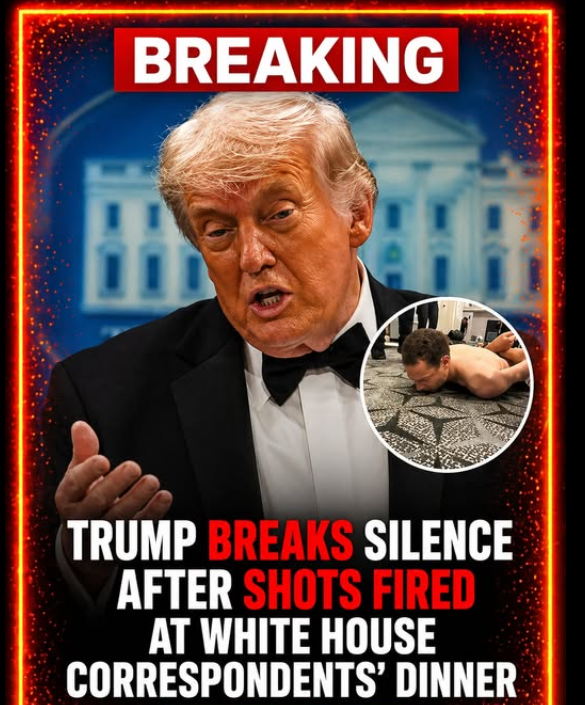
The room didn’t just fall silent—it seized, as if time itself hesitated in the space between sound and understanding. What had begun as an evening built on wit, performance, and political theater fractured in an instant. Laughter and applause gave way to confusion, then fear, as the sharp crack of gunshots cut through the illusion of safety. Within seconds, the energy shifted completely. The president, the First Lady, and some of the most powerful figures in Washington were no longer guests at a formal gathering—they were potential targets being urgently moved out of harm’s way.
According to Donald Trump, the moment didn’t immediately register as danger. Seated beside Melania Trump and surrounded by senior officials, he had been preparing to deliver a speech expected to be sharp, direct, and politically charged. The setting was controlled, familiar, almost routine. When the first noise rang out, he reportedly assumed it was something trivial—a dropped tray, perhaps, or an accident easily explained. But that assumption dissolved almost as quickly as it formed.
The realization came not just from the sound itself, but from the reaction around him. Movement replaced stillness. Agents closed in. Conversations cut off mid-sentence. Melania, by his account, was among the first to recognize that something was wrong, describing it simply but tellingly as “a bad noise.” It was a small phrase, but in that moment, it carried urgency. Within seconds, they were being escorted out, the carefully orchestrated evening unraveling into controlled chaos.
What makes accounts like this unsettling isn’t just the violence—it’s the speed at which normalcy disappears. One moment, there is structure, expectation, even spectacle. The next, there is only instinct: protect, move, survive. For those in the room, the shift from ceremony to crisis wasn’t gradual; it was absolute.
In the aftermath, Trump emphasized the response of law enforcement and security personnel, praising what he described as their speed and discipline. He insisted that the threat had been contained before any breach of the secured area, framing the incident as one where preparation and protocol ultimately held. Still, even with that reassurance, the event itself could not continue. The dinner was canceled, its purpose overtaken by the reality of what had just occurred.
Yet his response did not end with acknowledgment of the danger. He also framed it as a moment of defiance, stating that “sick people” should not be allowed to dictate the terms of public life. It’s a familiar tension in moments like these: the need to recognize vulnerability while also projecting strength, to admit that something was shaken without conceding that it can be broken.
The speech he had prepared—likely crafted for impact, for headlines, for political effect—may never be delivered in the form it was written. But the event itself, he suggested, will return. Not unchanged, not untouched by what happened, but still standing.
And that may be the most lasting shift of all. Because once a space like that—carefully secured, symbolically powerful—is disrupted by violence, it doesn’t simply go back to what it was. It continues, but with an awareness that wasn’t there before. The jokes may return, the applause may follow, but beneath it all, there remains a quiet understanding: how quickly everything can change, and how thin the line can be between spectacle and reality.