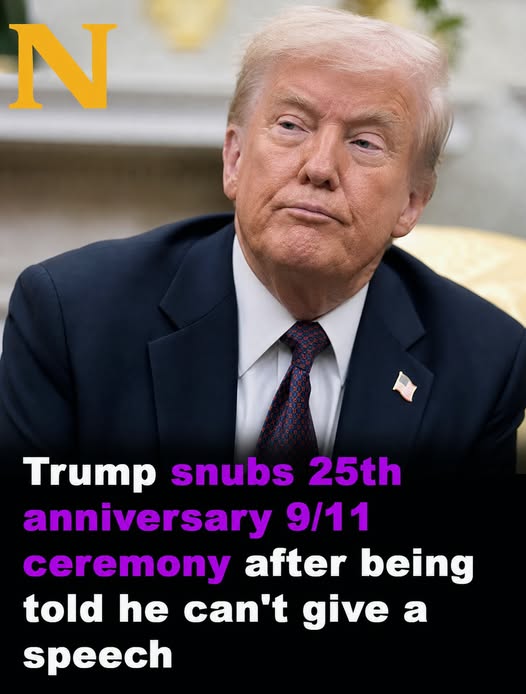
Trump is walking away from Ground Zero — and the silence is deafening.
A sitting president, barred from speaking at the 25th anniversary of 9/11 in New York, is choosing a different stage.
Families of the fallen, three former presidents, and a rule designed to keep politics out of the ceremony now collide with one man’s refusal to stand quietly on the sidelines.
What should be a solemn anniversary has suddenly become another test of power, symbolism, and restraint.
The decision is striking because Ground Zero has never been an ordinary political stage.
For families who lost husbands, wives, parents, children, brothers, sisters, and friends, the anniversary isn’t about political victories or partisan arguments.
It is about remembering names.
It is about hearing the names of people who never came home.
It is about standing in a place where history became painfully personal.
And this year, the rules are reportedly simple.
No political speeches.
No campaign-style appearances.
No politician turning the microphone into a platform.
Only the names of the dead, read by those who were left behind.
For many families, that boundary is sacred.
It represents a hard-won protection after years of bitter arguments over what Ground Zero should represent and who should be allowed to use its symbolism.
The ceremony is supposed to belong to the victims and their families.
Not to the person currently occupying the White House.
Not to a political party.
Not to a campaign.
Not to a debate.
Just remembrance.
That is why Trump’s decision to skip the New York ceremony carries so much weight.
His supporters are likely to see something completely different.
To them, the decision may look like a president refusing to be silenced at a moment when he believes he should be allowed to speak.
They may see the Pentagon appearance as an appropriate alternative—another location directly connected to the attacks, where he can address the public and honor those who died.
From that perspective, choosing the Pentagon isn’t abandoning 9/11.
It’s choosing another place from which to commemorate it.
But critics see a different message.
They argue that the restrictions in New York aren’t personal.
They are not designed specifically to humiliate Trump.
They are meant to preserve the character of the ceremony.
And if every president were allowed to turn the anniversary into a speechmaking opportunity, critics argue, the focus could gradually shift away from the people whose lives were destroyed that day.
That disagreement creates an uncomfortable question:
Is refusing to speak an act of respect?
Or is being denied the microphone something a president should challenge?
The answer depends almost entirely on how someone views the role of political power at a memorial.
For the families, the issue may be simpler.
They don’t need another political argument.
They have already spent twenty-five years living with the consequences of one September morning.
They have attended funerals.
Marked birthdays without loved ones.
Watched children grow up without parents.
Celebrated anniversaries that someone important never reached.
They have carried photographs.
Saved voicemails.
Kept uniforms, wedding rings, letters, and ordinary objects that became priceless because the people who owned them never came home.
For them, the anniversary isn’t history.
It is memory that remains alive.
And that is why the presence of three former presidents in Manhattan makes the contrast even more powerful.
Bill Clinton.
George W. Bush.
Barack Obama.
Three presidents from different political eras and different parties, standing together at a site that has become one of America’s most painful symbols.
Beside them will be JD Vance, representing the current administration in Trump’s absence.
The image almost writes itself.
Former presidents standing together.
Names being read.
Families listening.
A crowd gathered in silence.
And somewhere else, another ceremony where Trump will have the ability to speak.
Two locations.
Two approaches.
One wound.
The split-screen image may linger long after the ceremonies are over.
One side defined by silence.
The other by a microphone.
One focused on names.
The other centered on a president speaking in his own voice.
Both claiming to honor the same tragedy.
That contrast is almost impossible to ignore.
Trump’s decision also reflects something larger about modern American politics.
Presidents are no longer simply political leaders.
They are symbols.
Every appearance carries meaning.
Every absence can be interpreted as a statement.
Every speech becomes part of a larger political narrative.
Even choosing where to stand can become news.
And on an anniversary as emotionally charged as 9/11, symbolism becomes even heavier.
A president standing at Ground Zero sends one message.
A president standing at the Pentagon sends another.
A president remaining silent communicates something different again.
There may be no single interpretation.
Supporters will say Trump is honoring the victims in a place where he can speak freely.
Critics will say the choice proves he places his own voice above the traditions of the memorial.
Some families may simply wish neither interpretation were necessary.
They may want the anniversary to exist outside the endless political fight.
That’s the painful irony.
The rules were created to keep politics away from the ceremony.
Yet the rules themselves have now become political.
The debate over who gets to speak has become part of the story.
And Trump’s refusal to participate under those conditions ensures that the absence itself becomes a form of presence.
He doesn’t have to stand at Ground Zero for people to talk about why he isn’t there.
His empty place becomes part of the image.
His decision becomes part of the ceremony’s surrounding narrative.
And the silence becomes louder precisely because everyone knows it is intentional.
There is also something deeply complicated about the idea of a president being “barred” from speaking.
The president is one of the most powerful people in the country.
But memorials have their own rules.
Power does not automatically grant ownership over sacred spaces.
A president may command armies, sign legislation, address Congress, and speak to millions of people.
But a memorial ceremony can still say:
Not here.
Not today.
Not this way.
That boundary is important to some people precisely because it reminds everyone that the victims come first.
At the same time, supporters of Trump can reasonably argue that honoring the dead should not require political silence from the person currently leading the country.
They may believe the president has a responsibility to speak to the nation during moments of national remembrance.
And the Pentagon gives him exactly that opportunity.
There, he can speak.
He can frame the anniversary according to his own message.
He can honor the military, first responders, and victims.
He can address the country without being bound by the restrictions imposed on the New York ceremony.
That is why the decision is so symbolically complicated.
Trump isn’t disappearing from the anniversary.
He’s choosing a different stage.
And that distinction matters.
The Pentagon was itself attacked on September 11, 2001.
People died there.
Families were changed there.
The building became one of the physical symbols of the attacks alongside the World Trade Center and the field in Pennsylvania where Flight 93 came down.
So Trump can argue that he isn’t stepping away from the history.
He’s stepping into another part of it.
But the New York absence will still be noticed.
Because Ground Zero carries a unique emotional weight.
It is where the towers once stood.
It is where thousands of lives were lost.
It is where the names are engraved.
It is where families return year after year to stand beside the names of people they still miss.
That location has become almost sacred to the national memory.
And on the 25th anniversary, every detail will be magnified.
Who stands where.
Who speaks.
Who remains silent.
Who reads the names.
Who is absent.
The political implications may eventually fade.
The photographs may eventually become historical artifacts.
The arguments online may eventually disappear beneath newer controversies.
But for the families, the essential reality will remain unchanged.
Their loved ones are still gone.
The anniversary will still hurt.
The names will still be read.
And the people standing there will still be carrying memories that began twenty-five years ago.
That is why the most important question may not be whether Trump is right or wrong.
It may be whether the ceremony can remain about the people who died despite the political storm surrounding it.
Can the families have their silence?
Can the country remember without immediately turning memory into a partisan weapon?
Can a president honor the dead without making the moment about himself?
Can political opponents disagree without allowing the disagreement to consume the anniversary?
Those questions are bigger than Trump.
They go to the heart of how a country remembers trauma.
Every generation eventually decides what its memorials mean.
Some become political stages.
Others become protected spaces where politics is deliberately left outside.
Ground Zero has spent years trying to establish that boundary.
Whether everyone agrees with it is another question.
But for the families who fought to preserve it, the principle is clear.
The dead don’t need a campaign speech.
They need to be remembered.
And so the image of this anniversary may become strangely divided.
In Manhattan, names.
Silence.
Families.
Three former presidents.
A current administration represented by JD Vance.
At the Pentagon, another ceremony.
Another crowd.
Another microphone.
And Trump speaking from a place where he is allowed to do so.
Two ceremonies.
Two interpretations.
One national wound that has never completely healed.
Perhaps the most haunting part isn’t that Trump will speak somewhere else.
It is that twenty-five years after the attacks, America is still struggling with the same question in different forms:
Who owns the memory of September 11?
The families?
The nation?
The government?
The president?
Or does the memory belong to everyone—and therefore to no politician at all?
The answer may never be completely settled.
But one thing remains undeniable.
When the names begin to be read in New York, the politics will become smaller.
For a few minutes, there will be only names.
People.
Lives.
Families.
And an absence that can never be repaired.
Whatever happens at the Pentagon, whatever Trump says, and whatever arguments follow afterward, that should remain at the center of the day.
Because the most powerful statement at Ground Zero may not come from a microphone.
It may come from the silence between the names.