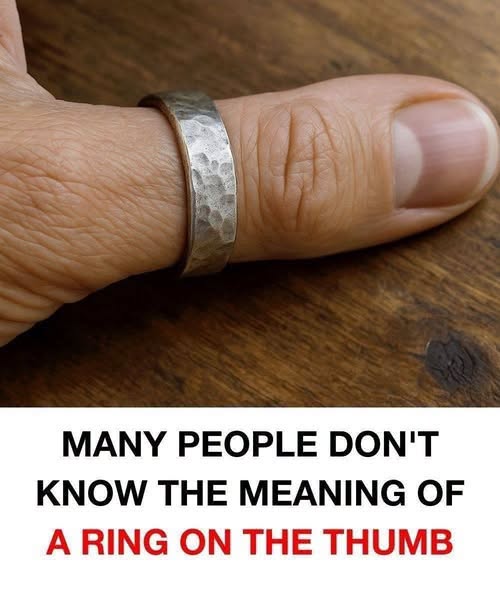
It seems like the smallest detail—just a ring worn on a thumb. Yet for centuries, that single piece of jewelry has carried meanings far deeper than fashion. Across cultures, generations, and personal journeys, the thumb ring has symbolized everything from strength and independence to heritage, status, and self-expression. Some wear it simply because they like the way it looks. Others choose it as a quiet reminder of who they are, where they come from, or what they have overcome. The mistake many people make is assuming they already know what it means. In reality, a thumb ring rarely tells a complete story on its own. Behind every band of silver, gold, or steel may be a deeply personal history that only its wearer truly understands. Before making assumptions, it is worth remembering that the most meaningful symbols are often the ones that speak softly rather than loudly.
Throughout history, the thumb has occupied a unique place in human symbolism.
Unlike other fingers, it represents strength, willpower, and the ability to act.
Ancient civilizations often associated the thumb with authority and personal control.
Because of this, rings worn there naturally became symbols of confidence and individuality.
In many cultures, thumb rings were never considered ordinary jewelry.
They often belonged to people of influence.
Warriors wore them as practical tools while drawing powerful bows.
Archers in Asia, the Middle East, and parts of Europe frequently used specially crafted thumb rings to protect their hands during battle.
Over time, these functional pieces evolved into symbols of courage, discipline, and honor.
Royal families and noble leaders also embraced thumb rings.
Beautifully crafted designs decorated with gemstones became visible reminders of wealth and authority.
A thumb ring wasn’t simply an accessory.
It quietly communicated social standing without requiring a single word.
Centuries later, the meaning gradually expanded.
As fashion evolved, thumb rings became less about status and more about personal identity.
Many people began wearing them simply because they appreciated their distinctive appearance.
Unlike rings traditionally associated with marriage or engagement, a thumb ring carries fewer social expectations.
That freedom allows it to become deeply personal.
For many women, a thumb ring symbolizes independence.
It may represent confidence.
Resilience.
Self-discovery.
Or simply the decision to define life on their own terms rather than according to someone else’s expectations.
For others, it serves as a quiet celebration of personal growth after difficult chapters.
Some wear one as a reminder of challenges they have overcome.
Others see it as an expression of creativity or individuality.
There is no universal meaning.
Each story belongs to its wearer.
Among men, thumb rings continue to reflect a wide range of personal choices.
Some appreciate the historical connection to warriors and leaders.
Others simply enjoy breaking traditional fashion rules.
Modern jewelry has become increasingly expressive, allowing people to wear pieces that reflect personality rather than convention.
A thumb ring often represents confidence rather than conformity.
Over the years, certain communities have also embraced thumb rings as symbols connected to identity or belonging.
Because of that history, some people mistakenly assume every thumb ring carries a hidden message.
In reality, there is no single code that applies universally.
The same style may hold completely different meanings for different individuals.
For one person, it represents heritage.
For another, artistic expression.
For someone else, it may simply match their favorite outfit.
That variety is precisely what makes personal jewelry so meaningful.
Cultural traditions add even more depth.
In some regions, thumb rings have been passed from one generation to another as treasured family heirlooms.
Elsewhere, handcrafted designs reflect local craftsmanship and centuries-old artistic traditions.
Each culture contributes its own layer of symbolism without replacing the others.
Today’s global world allows those traditions to blend in fascinating ways.
Fashion designers have also embraced thumb rings because they naturally stand out.
Their placement draws attention without appearing overly formal.
Simple minimalist bands, textured silver designs, bold statement pieces, or gemstone settings all allow wearers to express different aspects of their personality.
Unlike many fashion trends that quickly disappear, thumb rings have remained remarkably timeless because their appeal extends beyond appearance alone.
Perhaps the most important lesson surrounding thumb rings is also the simplest.
Avoid assumptions.
It is easy to attach stories to symbols.
It is far wiser to recognize that every individual chooses jewelry for personal reasons that may never be visible from the outside.
A respectful question reveals far more than an uninformed guess ever could.
Looking closely at a thumb ring tells us surprisingly little about the person wearing it.
Listening to their story tells us everything.
In the end, the true meaning of a thumb ring cannot be found in online charts or lists of secret symbols.
Its significance lives in memory.
In identity.
In family history.
In resilience.
In fashion.
In personal milestones.
Sometimes it represents nothing more complicated than someone finding a piece of jewelry they genuinely enjoy wearing.
And sometimes it quietly carries an entire lifetime inside a simple circle of metal.
That is what makes it beautiful.
Its greatest meaning is not the one others assign to it, but the one its wearer chooses every single day.