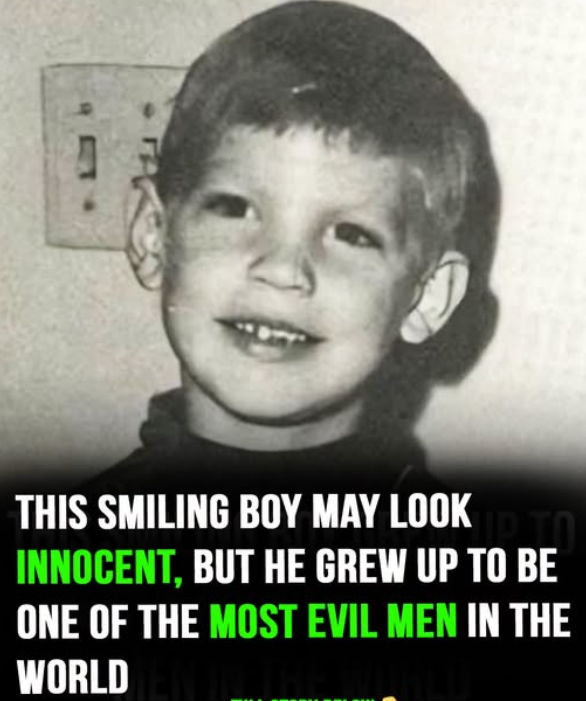
He looked like countless other babies—round cheeks, curious eyes, and tiny fingers wrapped tightly around his father’s hand. Nothing about those early photographs hinted that he would eventually become known as the Milwaukee Cannibal. To anyone looking at those images, he seemed like an ordinary child with an entire future ahead of him. There was no obvious sign of the darkness that would later define his name. Yet, when investigators, psychologists, and the public later examined his early years, many pointed to subtle warning signs that had appeared long before his crimes. His unusual fascination with bones, his habit of collecting animal remains, and his growing emotional detachment became details that, in hindsight, painted a far more troubling picture than anyone recognized at the time.
From the outside, his life appeared ordinary and even promising. He was a wanted child born to educated parents who hoped to give him every opportunity for success. On the surface, there seemed to be little reason to expect that his future would take such a horrifying direction. Behind the walls of the family home, however, life was far less stable than it appeared. His mother struggled with serious emotional and personal difficulties, while his father was often emotionally distant or absent for long periods. The household was filled with frequent arguments, uncertainty, and ongoing family conflict that created an environment of constant instability. As the tension inside the home grew, the young boy spent more time retreating into himself, becoming increasingly isolated from the people around him. Instead of finding security and comfort, he learned to cope with loneliness in ways that would eventually become deeply disturbing.
His fascination with death, control, and the anatomy of animals did not emerge overnight. It developed gradually over many years, beginning with a curiosity that slowly evolved into something much darker. He became increasingly interested in collecting bones and examining dead animals, behaviors that many dismissed as strange childhood curiosity rather than possible indicators of deeper psychological problems. Because the changes happened slowly, few people recognized how serious they had become. Teachers remembered him as a quiet, polite student who rarely caused trouble in the classroom. Classmates often described him as someone who used humor to make others laugh, masking much of what he kept hidden inside. His parents understood that he was struggling emotionally but never fully grasped the extent of the darkness growing beneath the surface. By the time authorities finally uncovered the horrifying crimes hidden inside his apartment, the smiling child seen in family photographs had long vanished. The innocent face remembered by those who knew him had been replaced by one of the most infamous serial killers in American history, leaving behind a question that continues to haunt psychologists, investigators, and the public alike: how can a child who once appeared so ordinary gradually transform into someone capable of unimaginable cruelty, and could anyone have recognized the warning signs before it was far too late?