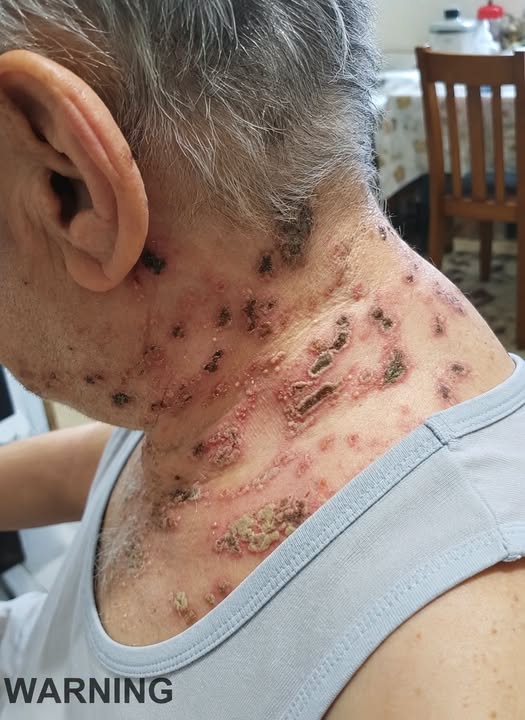
It starts as a whisper your doctor can’t see.
A sting.
A strange patch of skin that suddenly feels wrong.
A burning sensation you can’t quite explain.
You tell yourself it’s stress. Bad sleep. Too many responsibilities. Too many nights without enough rest. Maybe you’ve been working too hard, carrying too much, or simply having one of those weeks when everything seems to pile up at once.
So you ignore it.
You wait for it to disappear.
Then the rash erupts.
Suddenly, every breath, every brush of fabric, every movement against your skin can feel like fire against raw nerves. What began as a vague discomfort becomes something impossible to dismiss.
And that is one of the frightening things about shingles.
The warning may arrive quietly.
The pain may arrive before the rash.
And by the time you realize something is seriously wrong, the virus may already be reawakening along a nerve.
What makes shingles so terrifying isn’t just the rash.
It’s the betrayal.
The virus responsible for shingles is the varicella-zoster virus—the same virus that causes chickenpox. After a person recovers from chickenpox, the virus doesn’t necessarily disappear completely. It can remain dormant inside nerve tissue for years or even decades.
Then, under certain circumstances, it can reactivate.
Suddenly, something from childhood becomes a problem in adulthood.
A virus you may have forgotten about can return without warning.
And when it does, it doesn’t simply announce itself with a rash.
It can begin with sensations that are easy to misinterpret.
Pain.
Tingling.
Itching.
Burning.
Sensitivity to touch.
Sometimes the affected skin can feel almost painfully alive, as though something as harmless as clothing has suddenly become unbearable.
That early stage can be confusing.
There may be no obvious explanation.
You may look at your skin and see nothing unusual.
You may assume you’ve slept awkwardly.
You may think you’ve pulled a muscle.
You may blame stress.
You may convince yourself that you’re imagining it.
But shingles can sometimes begin with nerve pain before the characteristic rash appears.
That’s why paying attention to unusual, localized sensations can matter.
The pain doesn’t respect your plans.
It doesn’t care about your deadlines.
It doesn’t care that you have children to care for, work to finish, appointments to keep, or responsibilities you can’t simply put down.
It arrives when you’re already tired and demands everything you have left.
For some people, the pain can be intense enough to interfere with sleep, concentration, movement, and ordinary daily activities.
And once the rash appears, the experience can become even more unmistakable.
Small groups of fluid-filled blisters can develop, often appearing in a band or area on one side of the body. The pattern happens because the virus travels along a nerve pathway.
That unusual distribution can be one of the clues that separates shingles from many ordinary skin problems.
But shingles doesn’t look exactly the same in everyone.
Some people experience relatively mild symptoms.
Others experience severe pain.
Some develop a rash that is easy to recognize.
Others may initially notice mostly pain or sensitivity.
And in certain cases, the condition can occur without a typical rash, making diagnosis much more difficult.
That’s why unexplained nerve pain should not automatically be dismissed.
Especially when the discomfort is localized, burning, tingling, or unusually sensitive to touch.
The good news is that shingles is not simply a story about suffering.
There are ways to reduce the risk and ways to respond when symptoms begin.
One of the most important is recognizing the condition early.
Antiviral medications can help shorten the illness and reduce the severity of symptoms when started promptly, particularly when treatment begins soon after the rash appears. Early medical evaluation can therefore be important when shingles is suspected.
Waiting and hoping that the rash will disappear on its own may not be the best strategy.
The earlier the condition is recognized, the sooner appropriate treatment can be considered.
And there is another reason not to ignore it.
For some people, the pain doesn’t end when the rash disappears.
A complication called postherpetic neuralgia can cause persistent nerve pain in the affected area after the skin has healed. The risk increases with age, and severe shingles can increase the likelihood of prolonged discomfort.
That means shingles can sometimes leave behind something you can’t see.
The skin may look normal again.
But the nerves may continue sending pain signals.
Months can pass.
For some people, even longer.
Sleep can be affected.
Work can become harder.
Concentration can suffer.
Simple contact with clothing or bedding can remain uncomfortable.
That possibility makes prevention especially important.
Vaccination is one of the most effective ways to reduce the risk of shingles and its complications for people who are eligible.
The shingles vaccine is designed to strengthen the immune system’s ability to prevent the dormant virus from reactivating or to reduce the severity of the illness if it occurs.
It doesn’t guarantee that someone will never develop shingles.
But reducing risk is enormously different from having no protection at all.
This is why vaccination recommendations matter, particularly for older adults and certain people with increased risk.
The specific recommendations can vary by country and individual circumstances, so discussing eligibility with a healthcare professional is the safest way to determine whether vaccination is appropriate.
There is also an important misconception worth correcting.
Shingles is not caused by catching shingles from another person.
A person develops shingles when their own dormant varicella-zoster virus reactivates.
However, someone with active shingles can potentially transmit the varicella-zoster virus to a person who has never had chickenpox or been vaccinated against it, usually through direct contact with fluid from the blisters. That person could develop chickenpox rather than shingles.
This is another reason to keep a shingles rash covered when possible and avoid direct contact with people who are particularly vulnerable until the blisters have crusted over.
The condition can therefore affect more than the person experiencing it.
But perhaps the most important lesson is simpler.
Listen to your body.
You don’t have to panic over every unusual sensation.
But you also don’t have to dismiss persistent or unexplained pain simply because you are busy.
Burning isn’t always stress.
Tingling isn’t always poor sleep.
A strange patch of hypersensitive skin isn’t necessarily something you should simply push through.
Sometimes the body whispers before it starts shouting.
And recognizing that whisper can change what happens next.
If a painful or unusual rash appears, particularly with burning, tingling, or sensitivity on one side of the body, seeking medical advice promptly can help determine whether shingles is the cause and whether antiviral treatment is appropriate.
Don’t wait for the pain to become unbearable before taking it seriously.
Don’t assume that because the skin initially looks normal, nothing is happening.
And don’t let embarrassment or inconvenience convince you to ignore symptoms that are getting worse.
Shingles can be painful.
It can be disruptive.
It can interfere with the most ordinary parts of life.
But it is not inevitable.
And it is not something you simply have to endure without options.
Awareness can turn vague burning into a recognizable warning.
Prompt treatment can reduce the burden of illness.
Vaccination can reduce the risk of developing shingles and its complications.
And paying attention to unusual symptoms can help you seek care before the situation becomes harder to manage.
What begins as a tiny sensation can become a major interruption if ignored.
But that same sensation can also be a signal.
A signal to stop.
To look closer.
To ask questions.
To seek medical advice.
Because listening to your body is not weakness.
It is self-defense.
You don’t have to prove your strength by suffering silently.
You don’t have to push through every warning simply because life is busy.
When your body tells you something has changed, paying attention is one of the most practical things you can do.
And when those first whispers of discomfort appear, taking them seriously may protect far more than your skin.
It may protect your sleep.
Your work.
Your ability to care for the people you love.
Your peace of mind.
Your ordinary routines.
Your joy.
And ultimately, the life you still want to live.
Shingles may begin with a whisper.
The important thing is learning not to ignore it.