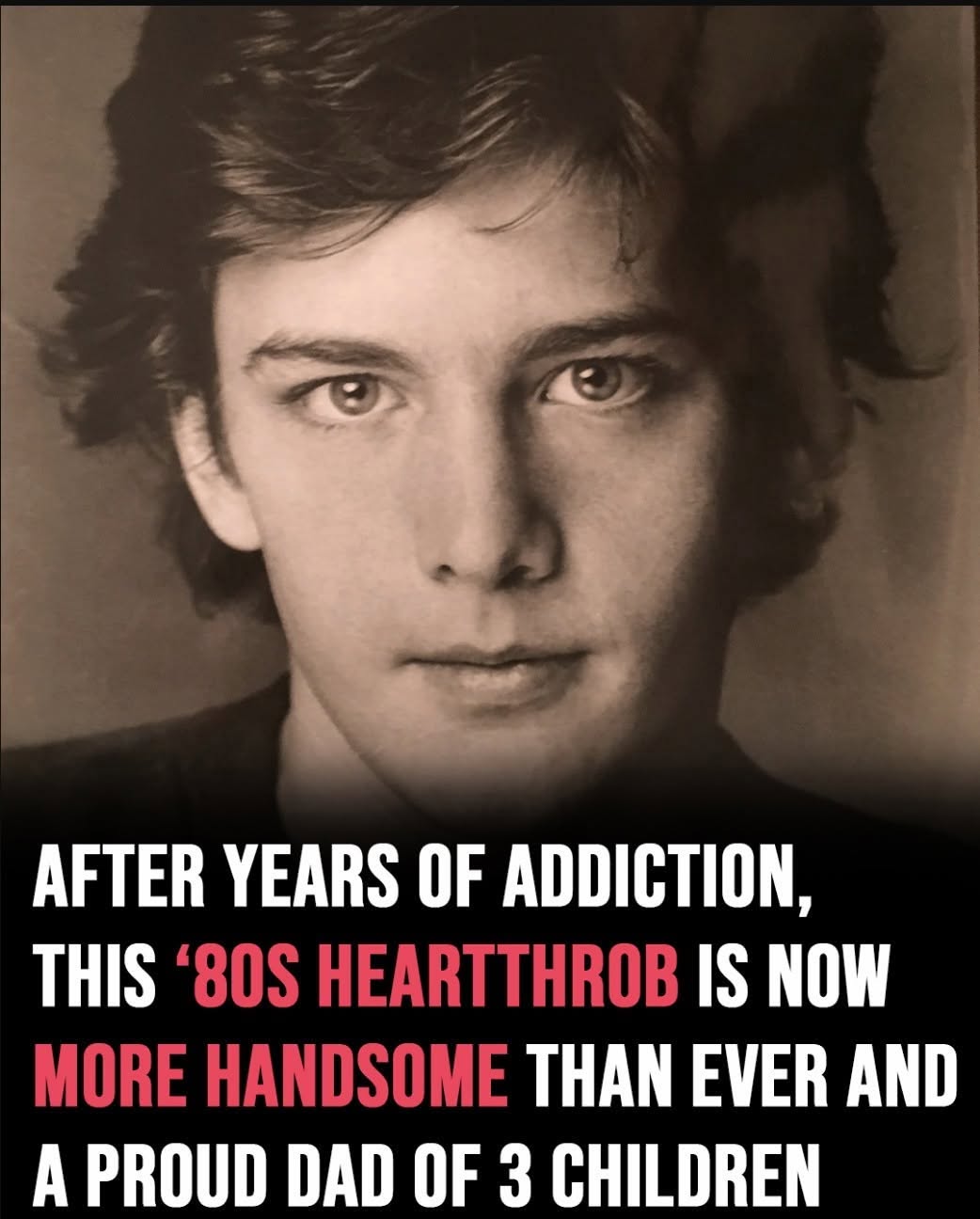
His greatest legacy isn’t the boyish heartthrob on a bedroom wall, but the proof that you can walk yourself back from the edge, and start again.
The transformation did not happen overnight.
Sobriety rarely arrives as a single breakthrough moment. More often, it is built through thousands of difficult decisions made one day at a time.
For Andrew, recovery meant confronting parts of himself he had spent years trying to escape.
The fear.
The loneliness.
The constant feeling that he never quite belonged.
Long before fame arrived, those emotions were already there.
Hollywood simply amplified them.
As a young actor, he found himself thrust into a world that celebrated attention while simultaneously consuming the people who received it. Fans adored him. Studios wanted more films. Magazines wanted interviews. Everyone seemed fascinated by Andrew McCarthy.
Everyone except Andrew McCarthy.
The public saw confidence.
He felt anxiety.
The public saw success.
He felt pressure.
The public saw a rising star.
He saw someone desperately trying to keep up with a life moving faster than he could understand.
Alcohol became the bridge between those two realities.
At first it seemed harmless.
A way to relax.
A way to fit in.
A way to silence the voice constantly questioning whether he deserved any of it.
But addiction is patient.
What begins as an escape slowly becomes a prison.
By the time he recognized the damage, drinking was no longer making life easier.
It was making survival harder.
Friends worried.
Opportunities slipped away.
Relationships suffered.
And perhaps most frightening of all, he began losing sight of the person he wanted to be.
Rehab became the turning point.
Not because it solved everything.
Because it forced honesty.
For the first time in years, there was nowhere left to hide.
No movie set.
No after-party.
No distractions.
Just a man sitting face-to-face with himself.
That process was painful.
But it was also liberating.
Recovery allowed him to rediscover parts of his identity that had existed long before fame arrived.
His curiosity.
His creativity.
His love of storytelling.
Instead of chasing the spotlight, he began exploring the world.
Travel became more than a hobby.
It became a new way of seeing life.
He visited countries far from Hollywood, immersing himself in cultures and experiences that reminded him how large the world truly was.
The perspective mattered.
In places where nobody cared about movie posters or celebrity status, Andrew found something surprisingly valuable.
Freedom.
He no longer had to perform a version of himself for public consumption.
He could simply be present.
Those experiences eventually inspired a second career.
Writing.
Directing.
Documentary filmmaking.
New creative paths emerged, proving that reinvention is possible at any stage of life.
Many former stars spend years trying to recreate their peak.
Andrew chose a different approach.
He moved forward.
Rather than living inside memories of the 1980s, he built a future that reflected who he had become.
A father.
A husband.
A traveler.
A storyteller.
A sober man.
Today, when people remember the Brat Pack era, his name remains firmly connected to that cultural moment.
But the version of Andrew McCarthy that inspires many people now is not the teenager staring from old movie posters.
It is the man who survived his own collapse.
The man who admitted he needed help.
The man who accepted that success means very little if you lose yourself along the way.
His story resonates because it reflects a universal truth.
Every life contains chapters we wish we could rewrite.
Mistakes.
Regrets.
Periods of darkness.
Moments when the future seems impossible to imagine.
Yet Andrew’s journey demonstrates that our worst chapter does not have to become our final chapter.
People can change.
Healing is possible.
And sometimes the most remarkable comeback is not returning to fame.
It is returning to yourself.
Looking back now, the screaming fans, the magazine covers, and the Hollywood glamour feel like only one small piece of a much larger story.
The real triumph happened away from the cameras.
In the quiet moments.
The difficult choices.
The ordinary days that followed.
Because in the end, Andrew McCarthy did something far more impressive than becoming famous.
He learned how to live.
And for him, that turned out to be the greatest role of all.