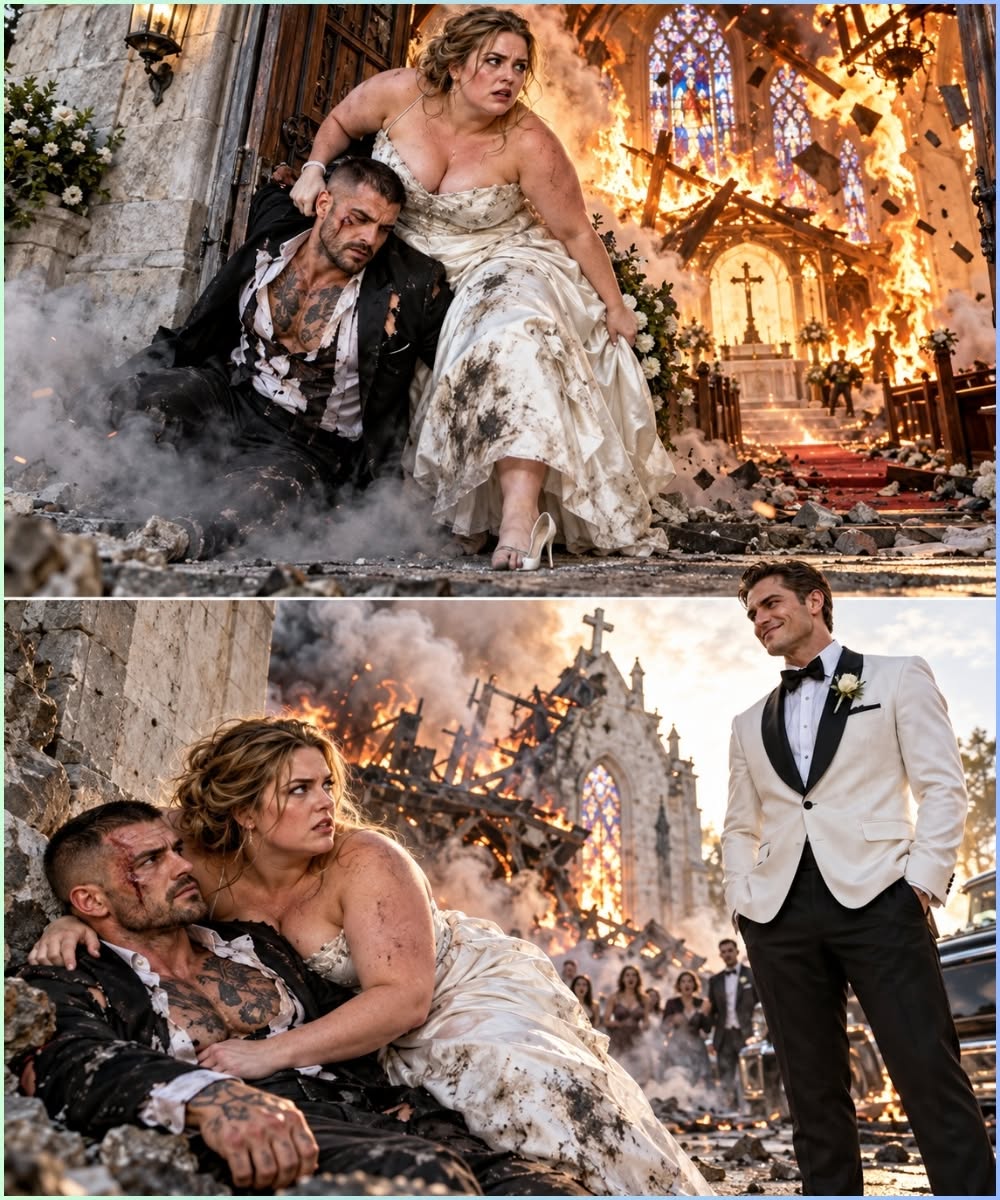
Then she noticed one of Leo’s men slipping quietly through the side door.
Matteo noticed him too.
Their eyes met.
Cora saw suspicion appear on Matteo’s face.
Then someone outside shouted.
The first explosion lifted the back three pews off the floor.
People screamed.
The second blast shattered every window on the north wall.
Fire rolled across the chapel ceiling.
Cora hit the floor.
Leo disappeared.
Matteo didn’t.
Something struck him.
He collapsed between the pews.
People pushed toward the front entrance.
Cora crawled through smoke.
“Matteo!”
He was bleeding beneath his ribs.
His eyes found hers.
“Run.”
“No.”
“Bride…”
“Save your oxygen.”
She hooked both arms under his shoulders.
The man probably weighed two hundred and twenty pounds.
Cora planted her bare feet against the tile and pulled.
For once, nobody called her body too large.
Her weight gave her leverage.
Her legs gave her power.
The thick muscles beneath years of softness did exactly what she asked them to do.
She dragged Matteo toward the side exit.
Three seconds after they crossed the doorway, part of the ceiling collapsed where his body had been.
Now they were in the alley.
And Leo was smiling at them.
“You set the fire,” Cora said.
Leo shrugged.
“You weren’t supposed to make it out.”
Behind Cora, Matteo coughed.
Leo reached inside his jacket.
Cora moved immediately, placing herself between them.
Leo laughed.
“You think being wide makes you bulletproof?”
“No.”
Her voice was steady.
But it makes me difficult to shoot around.”
His expression changed.
A black sedan screeched around the corner.
Matteo’s lieutenant, Gino Mercer, jumped out.
Leo retreated immediately, disappearing through the smoke toward another vehicle.
Gino ran to Matteo.
“What happened?”
“Gunshot,” Cora said. “Possible collapsed lung. We need to move him.”
Gino stared at her.
“You’re the baker’s daughter.”
“Yes.”
“How do you know—”
“Because your boss is turning blue.”
That ended the conversation.
They got Matteo into the back seat.
Cora climbed in beside him.
As the sedan sped away, she cut open Matteo’s shirt.
Gino kept looking at her through the rearview mirror.
“What are those?”
“Trauma shears.”
“You brought surgical scissors to your wedding?”
Cora pressed cloth hard against Matteo’s wound.
“Women are allowed hobbies.”
Matteo’s eyes opened.
Despite the blood loss, something almost like amusement appeared there.
Then his gaze dropped to her hands.
Not the shears.
Her hands.
There was a pale scar crossing the base of her right thumb.
Another along her index finger.
Surgical scars.
Matteo had seen hands like hers before.
“You’re not a baker,” he whispered.
“My father is.”
“You knew the fire was coming.”
“I smelled accelerant.”
“You knew what that wound meant.”
Cora said nothing.
Matteo gripped her wrist weakly.
“Who are you?”
Cora looked down at the man everyone in the city feared.
Then she said the sentence she had spent seven years trying never to say again.
“Dr. Cora Bellamy.”
Gino nearly drove into a parked truck.
Cora had been thirty when she last worked in a trauma operating room.
Four years earlier, she had been Dr. Cora Bellamy, attending trauma surgeon at Allegheny Cross Medical Center.
She had lived on coffee, adrenaline and four hours of sleep.
She had been excellent.
Not glamorous.
Not charming.
Excellent.
Patients survived under her hands.
Residents feared disappointing her.
Nurses trusted her.
Then nineteen-year-old Adam Voss arrived after a late-night crash.
His passenger, a seventeen-year-old girl, died.
Adam survived.
His father was wealthy, connected and terrified of what toxicology would show.
A hospital administrator asked Cora to change the time recorded on a blood sample.
She refused.
Then someone altered it anyway.
Cora reported it.
Within a month, two senior physicians claimed she had mishandled Adam’s surgery.
A complication became negligence.
Negligence became scandal.
The hospital settled.
Cora was not convicted of anything. She did not lose her license.
But newspapers used the words “controversial surgeon.”
Online strangers used worse ones.
Her hospital quietly encouraged her to resign.
Her fiancé left.
Her mother became sick two months later.
Cora went home.
And never went back.
Walter told everyone his daughter had grown tired of medicine.
Cora let him.
It was easier than explaining that sometimes doing the right thing did not make your life better.
Sometimes it simply left you with fewer things to be ashamed of.
The sedan stopped beneath an abandoned printing warehouse.
Gino helped Cora carry Matteo inside.
There were emergency supplies in a locked room.
Not enough for surgery.
Enough to keep him alive.
Cora worked beneath harsh fluorescent lights while Gino paced.
Matteo remained conscious only in fragments.
At one point he opened his eyes and found Cora holding pressure against his side.
“You saved me.”
“Don’t make it sentimental.”
“I’m dying. I’m allowed.”
“You’re not dying.”
“You sound offended.”