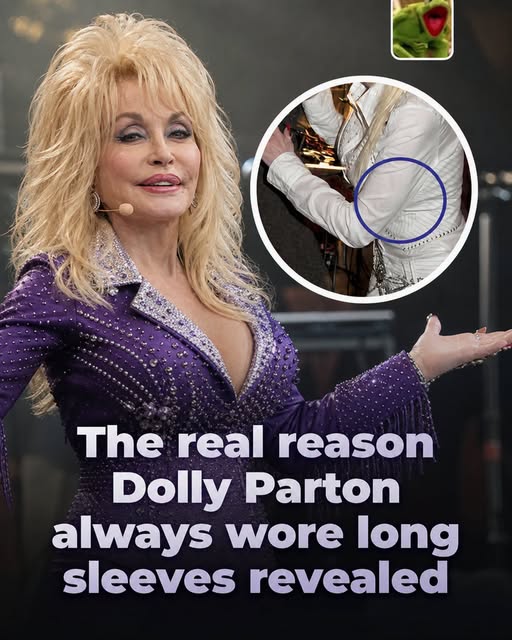
For years, we thought it was just fashion.
The glittering sleeves.
The gloves.
The lace.
The carefully covered arms.
Dolly Parton had always understood how to create an unforgettable image. Sequins caught the light. Rhinestones sparkled under stage lights. Sleeves moved dramatically when she lifted her hands. Everything about her appearance seemed carefully chosen, and audiences naturally assumed there was a simple explanation.
It was Dolly being Dolly.
It was glamour.
It was performance.
It was part of the look.
But behind those iconic outfits was something far more personal.
A private struggle she never wanted to become the definition of who she was.
Only later did she reveal more about the scars, the tattoos, and the choice that allowed her to stop feeling as though she owed the world an explanation.
For decades, Dolly lived under an extraordinary level of public attention.
People examined everything.
Her hair.
Her makeup.
Her clothes.
Her body.
Her voice.
Her age.
Even the smallest changes in her appearance could become the subject of speculation.
Yet there were parts of herself she simply chose to keep private.
Among them were the scars on her arms.
Dolly has spoken about developing keloid scars, raised scars that can form after injuries or procedures. For someone constantly appearing in public, especially someone whose career depended so heavily on visual presentation, having visible scars could easily become a source of insecurity.
But Dolly’s response was not to spend the rest of her life apologizing for them.
She found her own solution.
She spent a lifetime wrapped in sequins, lace, rhinestones, and carefully designed costumes, but the most powerful part of her story was always the part she didn’t feel obligated to explain.
Instead of chasing some impossible idea of perfection, she learned to make peace with the parts of herself she once wished were different.
And eventually, she chose to decorate rather than hide.
Delicate tattoos of butterflies.
Flowers.
An angel.
Small pieces of art placed in areas where scars had once made her self-conscious.
The tattoos weren’t simply decoration.
They became part of the story.
The scars remained.
But they no longer had to be the first thing she saw when she looked at herself.
That distinction is important.
Dolly didn’t erase what had happened to her.
She didn’t pretend the scars weren’t there.
She simply changed the way she related to them.
Something that had once made her uncomfortable became something she could transform into beauty.
And that choice feels remarkably consistent with the woman the public has known for decades.
Dolly has always had an unusual ability to take difficult things and turn them into something lighter without pretending the difficulty never existed.
She grew up with very little.
She turned hardship into songs.
She experienced rejection.
She turned it into determination.
She was underestimated.
She turned it into a career.
She became enormously successful.
And instead of keeping everything for herself, she used much of that success to help other people.
The same spirit can be seen in the way she approached her scars.
The world saw something that needed to be hidden.
Dolly saw something she could make her own.
That doesn’t mean she suddenly loved every part of having scars.
It means she refused to let them dictate how she felt about herself.
There is something quietly powerful about that.
We live in a culture that constantly tells people to correct, conceal, smooth, erase, or improve anything that doesn’t fit an ideal.
Wrinkles should disappear.
Scars should be covered.
Bodies should look a certain way.
Age should be hidden.
Imperfections should be edited out of photographs.
Dolly’s approach offered a different message.
You don’t necessarily have to erase everything that makes you different.
Sometimes you can incorporate it into the person you are becoming.
Her tattoos became part of that philosophy.
The butterfly is especially fitting.
A butterfly is associated with transformation, change, and becoming something new.
Flowers carry their own symbolism—beauty, growth, fragility, and renewal.
And the angel adds another deeply personal dimension.
Together, the images created something softer around a subject that had once made her uncomfortable.
Instead of allowing scars to remain simply scars, she surrounded them with images that made her feel more confident.
And perhaps that is why the story resonates.
It’s not really about tattoos.
It’s about ownership.
It’s about taking something that made you feel vulnerable and deciding that it doesn’t get to control the story anymore.
For Dolly, that mattered because she spent much of her life being judged by appearance.
People often saw the larger-than-life image before they saw the person.
The big hair.
The dramatic clothes.
The unmistakable voice.
The humor.
The confidence.
The rhinestones.
The glamorous persona became so powerful that it could be easy to forget there was a private human being underneath it.
Someone who could feel insecure.
Someone who could be hurt.
Someone who had scars.
Someone who didn’t necessarily want every part of herself examined by strangers.
But Dolly never needed to become less glamorous to become more authentic.
She could wear the rhinestones and still acknowledge vulnerability.
She could make jokes about herself without denying the difficult parts.
She could embrace her image while refusing to let that image tell the entire story.
That may be one of the reasons people have connected with her for so long.
She never seemed interested in pretending she was perfect.
She simply knew how to turn imperfection into personality.
And the tattoos became another example.
They weren’t a declaration that the scars didn’t matter.
They were a declaration that the scars didn’t own her.
That is a subtle but powerful difference.
While the world was busy analyzing her appearance, Dolly was focused on things she considered far more important.
Music.
Family.
Faith.
Books.
Children.
Education.
Helping people.
Creating opportunities.
Giving hope.
Her philanthropy became one of the most important parts of her legacy, even though it often received less attention than her clothes.
Through the Dollywood Foundation and the Imagination Library, she helped put books into the hands of children, encouraging reading and giving families resources that could shape a child’s future.
The costumes dazzled.
The hair became iconic.
The photographs became unforgettable.
But those things were never the whole story.
Behind the glamour was a woman who understood what it meant to come from very little and still dream enormously.
Someone who knew that beauty could be powerful but kindness could be transformative.
Someone who understood that fame was temporary, while the things you do for other people can continue long after the applause stops.
That’s why the story of her scars feels larger than the scars themselves.
They remind us that even people who appear completely confident can carry private insecurities.
Someone can walk onto a stage in front of thousands of people and still have parts of themselves they don’t want strangers examining.
Someone can look fearless while quietly learning how to accept their own imperfections.
And someone can be photographed constantly while still keeping important pieces of their personal life entirely their own.
Dolly’s solution was personal.
It doesn’t have to be anyone else’s.
Not everyone wants tattoos.
Not everyone wants to cover scars.
Not everyone feels the same way about their body.
The important part is having the freedom to decide what your scars mean to you.
Maybe you cover them.
Maybe you leave them visible.
Maybe you decorate them.
Maybe you eventually stop thinking about them altogether.
There is no single correct answer.
What matters is that the choice belongs to you.
Dolly’s story simply offers an example of what can happen when someone stops allowing an imperfection to become a source of shame.
She didn’t need to make the scars disappear.
She needed to make peace with seeing them.
And perhaps that is the deeper lesson hidden beneath all those sparkling sleeves.
The sleeves were never just fashion.
The gloves weren’t simply part of a costume.
The layers and careful styling gave her privacy in a world that constantly demanded access.
But eventually, she also found a way to reclaim the very things she had once wanted to hide.
She took scars and surrounded them with beauty.
She took insecurity and turned it into self-expression.
She took something private and made it hers without allowing the public to own the story.
That is courage of a very different kind.
Not the courage of standing beneath a spotlight.
The courage of looking at yourself when nobody else is watching and deciding that you are still worthy of love exactly as you are.
And perhaps that’s why the tattoos feel so fitting.
Butterflies.
Flowers.
An angel.
Small, delicate reminders that the human body can carry evidence of pain without becoming defined by it.
The scars tell one story.
The tattoos tell another.
And Dolly gets to decide how those stories exist together.
For years, audiences saw only the glitter.
Now, knowing a little more about what existed beneath it, the glitter means something different.
It wasn’t necessarily hiding weakness.
Sometimes it was simply part of the armor of a woman who had spent her entire life under observation.
And underneath that armor was someone who learned to turn vulnerability into creativity.
That’s the Dolly Parton story in miniature.
She never pretended to be flawless.
She simply refused to be reduced to what made her vulnerable.
While the world obsessed over her appearance, she quietly gave away books, hope, opportunity, laughter, and kindness.
While people debated the clothes, she was thinking about children.
While cameras focused on the sparkle, she was building something that could last beyond the stage.
The costumes dazzled.
The tattoos carried their own quiet meaning.
The scars remained part of her history.
But her courage, humor, generosity, and ability to turn pain into something beautiful are what people will remember.
Because eventually, the rhinestones stop catching the light.
The music fades.
The photographs become memories.
What remains is the person underneath it all.
And Dolly’s most enduring lesson may be this:
You don’t have to erase every scar to become beautiful.
Sometimes, you simply have to stop letting the scar decide what you see when you look at yourself.