It was expected that the 2026 White House Correspondents Dinner would adhere to a relatively well-known and predictable script. The spectacular event, which brought together the highest levels of political and media power, was planned to be formal, tightly controlled, and painstakingly supervised. It was held at the esteemed Washington Hilton. A glittering assemblage of journalists, celebrities, and political insiders attended, including high-profile individuals like Donald Trump and JD Vance. With immaculate looks, glamorous red carpet moments, and the customary banter expected at such an elite gathering, the evening started exactly as planned. However, in a couple of hours, the anticipated storyline was destroyed twice, sending the entire incident in entirely unheard-of directions.
A terrible security fear was the first significant disturbance of the evening. The Secret Service and local law police responded quickly and forcefully to reports of a possibly armed suspect circulating close to the event. The bright lights and upbeat chatter gave way to an aura of fear and uncertainty for a short but terrifying moment. Attendees were relocated to safe areas, and the media’s attention completely shifted to the event’s interruption and safety. For a brief moment, it appeared like the evening would be remembered for all the wrong reasons rather than the planned entertainment, and it served as a striking reminder of the unstable environment in which these public personalities operate.
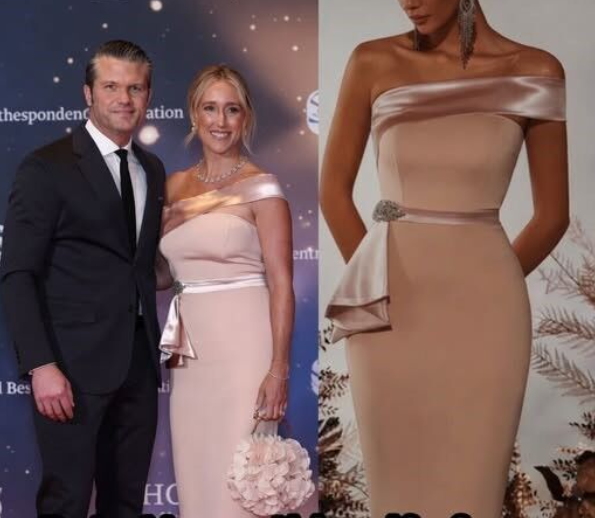
But once things calmed down and the threat was eliminated, the tense mood restored, enabling the throng to carry on with their evening. At that point, a whole other narrative—one that was much more commonplace but considerably more divisive than a security threat—took over the internet world. When images of Jennifer Rauchet started to circulate on different social media sites, people soon noticed her sophisticated yet fairly modest outfit. Many people were drawn to the gown because of its flowing elements, which many would connect with high design. However, the retailer’s catalog and price range gave an entirely different impression. When a perceptive user pointed out that her clothing closely matched an inexpensive, budget-friendly item offered on the global retail site Temu, what had begun as casual appreciation quickly escalated.
A side-by-side comparison of the clothing quickly went viral, transforming the straightforward decision of attire into a major cultural flashpoint. As is often the case, the internet took advantage of this revelation and sparked a frenzied discussion that totally obscured the important events of the previous evening. The outfit’s detractors claimed that the conventional expectations of rank, wealth, and presentation associated with the Washington elite were dramatically at odds with wearing such an inexpensive or low-cost clothing at an event of this kind. Some commenters even made an effort to connect the fashion decision to more general political messaging, raising concerns about whether an inexpensive ensemble was in line with the traditional American First principles that many in the audience supported.
However, Jennifer Rauchet’s supporters responded to the criticism with equal vigor. They stated that judging a garment based solely on its price is totally out of touch with the realities of regular Americans, pointing out that inexpensive fashion is extremely widespread in the present era. They said that a person’s value and elegance shouldn’t be correlated with an outrageous price tag, and they applauded her decision to wear whatever she chose, regardless of the designer label or cost. This viewpoint portrayed her attire as a practical genius rather than a fashion faux pas, highlighting a growing indignation toward the extreme riches and excess frequently demonstrated at elite Washington parties.
The discussion that followed soon went well beyond Rauchet and the particular outfit she was wearing. It rekindled heated debates on the morality of fast fashion, the people’s access to fashionable apparel, and the tremendous pressure public figures have to create an image of excessive affluence. What started out as a trifling inquiry about an evening gown evolved into a much larger discussion on social symbolism, class dynamics, and how the public views their representatives and leaders. Fashion historians and analysts offered their opinions, pointing out that throughout history, clothing has served as a major medium for social and political communication.
The debate became ten times more intense due to the timing of the occurrence. The sharp contrast between a minor fashion dispute and a serious, potentially dangerous security situation demonstrated how rapidly public attention can change in today’s media environment. In the current digital era, a single tweet or image can quickly divert national attention, transforming a serious political event into a viral online spectacle that enthralls millions of users worldwide.
Ultimately, the garment itself was never the main focus of the viral event. It concerned the perceptions that various individuals had of the attire. While some saw it as a contradiction in rank, others saw it as a symbol of relatability and a breath of fresh air. In the end, the strong response reveals much more about the audience and the fragmented character of our cultural dialogue than it does about the ensemble. It serves as a potent reminder of how the contemporary audience engages with the lives of celebrities, continuously looking for significance and controversy in the most mundane of settings.