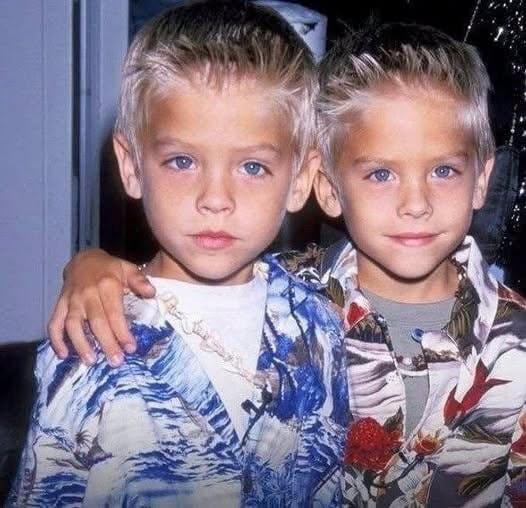
Dylan and Cole Sprouse were never meant to be interchangeable, even if the world insisted on treating them that way. From their very first birthday, cameras were already part of the background of their lives, shaping moments that most children never have to think about. Expectations began to build almost immediately, not just around their talent, but around their identity as a shared entity. They were introduced to the public as a unit—“the Sprouse twins”—a branding convenience that quietly blurred the line between two separate lives. But even in those earliest years, something was already happening beneath the surface: two personalities pulling gently, then steadily, in different directions, each trying to become something singular inside a world that kept insisting they were one.
As they grew older, the divergence became impossible to ignore. One gravitated toward noise, visibility, and social momentum; the other leaned toward stillness, curiosity, and internal depth. Dylan moved with a kind of chaotic confidence, shaped by charisma and instinct, the type of presence that fills a room without trying to understand it first. Cole, on the other hand, began retreating into observation—books, geology, photography, and a precise, almost analytical way of interpreting people and environments. Even as Disney turned them into global figures through shared roles and synchronized performances, their inner worlds were already separating. The industry may have seen symmetry, but life was already writing contrast.
When adulthood arrived, the split didn’t become a fracture—it became clarity. Dylan stepped into roles and relationships that matched his more outward, spontaneous energy, eventually building a public life that included romance, visibility, and a willingness to engage directly with fame rather than resist it. Cole took a more deliberate path, choosing projects that leaned into darker, more complex storytelling while also pursuing education and interests far removed from Hollywood’s constant spotlight. He often seemed more interested in understanding systems than participating in spectacle. Where one embraced momentum, the other cultivated distance, not out of rejection, but out of necessity.
Years passed without the kind of reunion the industry loves to imagine. The idea of them working together again became a recurring question in interviews, almost a nostalgic script others wanted them to perform. But both brothers pushed back, each in their own tone. Dylan treated it with humor, often dismissing the idea of forced nostalgia or artificial twin-centered narratives. Cole, more direct, resisted the simplification of identity into novelty, especially the notion that two real adults should reenact a childhood construct for entertainment. They were no longer interested in being packaged as a concept.
And yet, the connection between them never disappeared—it simply stopped being performative. It exists now in smaller, quieter gestures: public praise without exaggeration, private support without spectacle, and the occasional moment where one acknowledges the other’s milestones with genuine, uncomplicated pride. Cole’s reflections on Dylan’s marriage or Dylan’s comments about Cole’s work reveal something more enduring than branding ever captured. They are no longer a single marketed identity, but two individuals who understand each other in a way no outside narrative can fully reduce.
So when Hollywood circles back, hoping for a reunion framed as nostalgia, the real story isn’t about whether they will share a screen again. It’s about how thoroughly they have already separated what was once fused for convenience. They are not unfinished halves of a whole—they are complete, parallel lives that began in the same place but refused to remain the same shape. And while the world still reaches for the idea of “the twins,” the truth is simpler and more grounded: they are still connected, but no longer defined by sameness.