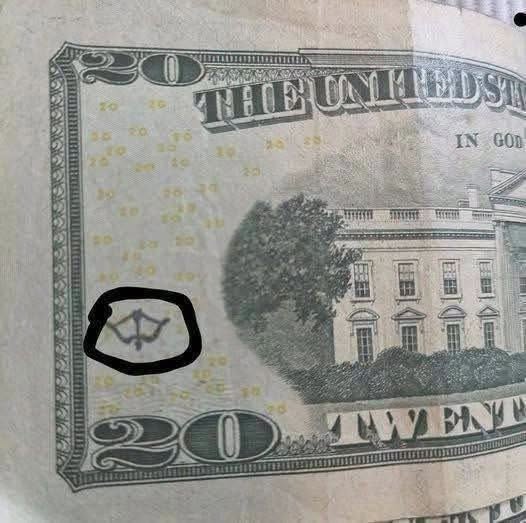
The Small Chop Marks That Tell a Story on US Dollar Bills
Have You Ever Noticed Tiny Stamps, Symbols, or Strange Marks on a U.S. Dollar Bill? Some May Tell a Fascinating Story About Where That Money Has Been.
Take a dollar bill out of your wallet and look at it closely. Beyond the familiar portraits, serial numbers, and official seals, you might notice something unusual: a tiny stamp, a handwritten symbol, or a small mark that doesn’t appear on most other bills.
These details can spark curiosity. Who put them there? Are they official markings? And could they make the bill more valuable?
The answer depends on the type of mark—and the story behind it.
1. What Are Chop Marks?
<AsyncImageGroup query={[“US dollar bill with small red ink stamp collector marked banknote”,”one dollar bill with small unusual stamp markings close up”,”marked US dollar banknote small ink symbol close up”]} aspectRatio=”5:4″ layout=”bento” numPerQuery={1}/>
The term chop mark is most commonly associated with historical trade coins, especially silver coins that merchants stamped to indicate that they had examined and accepted the metal’s quality.
On U.S. dollar bills, however, small stamps or symbols are not generally official currency markings known as chop marks.
A mark on a banknote could instead be a collector’s stamp, a private promotional mark, graffiti, or an accidental stain.
The distinction matters because a mark’s appearance alone cannot establish who made it or why.
2. Why Would Someone Stamp a Dollar Bill?
There are several possible explanations for unusual markings on paper currency.
Collectors and enthusiasts: Some people stamp or annotate currency as part of a personal project or collection.
Promotional messages: Businesses or individuals may stamp banknotes with messages, artwork, or website information.
Personal markings: A previous owner may have written initials, dates, or symbols on the bill.
Accidental marks: Ink transfer, dirt, and other stains can resemble deliberate symbols.
Without additional evidence, it is difficult to determine the origin of a particular mark.
3. Could a Marked Dollar Bill Be Worth More?
<AsyncImage query=”currency collector examining circulated one dollar bill with magnifying glass” aspectRatio=”16:9″ width=”100%”/>
Sometimes, unusual banknotes attract collectors, but an ordinary stamp or handwritten mark does not automatically increase a bill’s value.
Collectors generally consider factors such as:
The bill’s series and printing characteristics.
Its condition and degree of wear.
Unusual serial numbers or verified printing errors.
Whether the marking has a documented connection to a recognized collecting category.
In many cases, added writing or ink marks can reduce a banknote’s appeal to collectors who prefer unaltered examples.
If you think a bill may be unusual, compare it with reliable currency references or consult a reputable banknote dealer before assuming it is valuable.
4. Are These Marks Made by the U.S. Government?
Ordinary decorative stamps, handwritten symbols, and private markings on dollar bills should not be confused with official currency features.
U.S. banknotes contain standardized design elements, including Treasury and Federal Reserve identifiers, serial numbers, and other security features.
A strange stamp on a bill is not, by itself, evidence of a secret government code or an official tracking system.
Likewise, the presence of a mark does not establish that a bill has passed through a particular country, business, or historical event.
5. What Should You Do If You Find One?
If you discover an unusual mark on a dollar bill, start by examining it carefully.
Check whether the mark appears printed as part of the original design or added afterward.
Compare the bill’s series, serial number, and design with reliable currency references.
Take clear photographs of the mark and the surrounding area.
Ask a qualified currency collector or dealer if the marking appears unusual.
Avoid cleaning, erasing, or altering the bill, since doing so could damage it and make identification more difficult.
The Fascinating Journey of a Dollar Bill
U.S. currency circulates through countless hands, businesses, cities, and countries. Along the way, bills can acquire stains, annotations, stamps, and other signs of everyday use.
Some marks may have an interesting personal or historical story. Others are simply evidence that a banknote has been handled many times.
The important thing is not to assume that every unusual symbol has a hidden meaning.
The next time you notice a tiny mark on a dollar bill, take a closer look. It may reveal something about the bill’s history—but identifying that story requires evidence, not just an intriguing symbol.