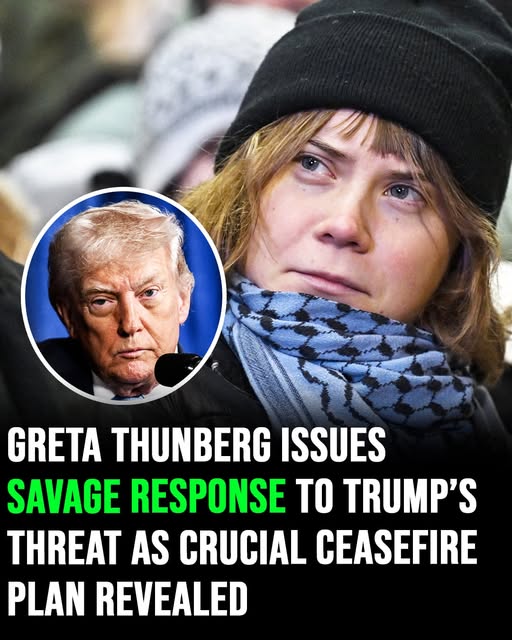
2026’s geopolitical environment has felt like an unrelenting plunge into a fever dream, but last week the fever broke in the most visible and divisive manner imaginable. The world’s attention was fixed on the Strait of Hormuz for more than a month as Iran and the United States danced on the brink of a battle that offered only survivors rather than winners. The global sigh of relief was almost palpable on Tuesday night when a precarious two-week ceasefire was finally declared. However, as the immediate threat of bombings subsided, a new and possibly more important conflict arose: one involving words, morals, and the destiny of human conversation. Greta Thunberg, a climate activist, responded to President Donald Trump’s terrifying ultimatum with a scathing, brutal rejoinder that has since redefined the stakes of contemporary diplomacy.
A miracle of last-minute negotiations led to the ceasefire itself. The agreement, which is based on a broad 10-point plan from Tehran and a grudging halt to US military activities, depends on the reopening of crucial maritime lanes and a brief end to hostilities. Both Washington and Tehran quickly declared “total victory,” a well-known political ploy. But the horror of how near the world had been to the unimaginable was too great to be covered up by diplomatic small language. President Trump had made a comment on social media only hours before the agreement was reached that sounded more appropriate for the dark ages than the twenty-first century. He implied that his ultimatum would likely result in the extinction of thousands of years of Persian history by threatening to destroy “a whole civilization.”
Greta Thunberg refused to overlook this normalization of devastation. Thunberg released a scathing assessment that cut through the façade of “strategic interests,” while many world leaders responded with carefully worded communiqués or cautious optimism for the truce. Her response was a broad critique of a global culture that has grown dangerously indifferent to the rhetoric of genocide and total war, rather than merely a refutation of a particular policy. Thunberg compelled a worldwide audience to face an uncomfortable reality by connecting Trump’s promise to destroy a civilization with the larger systemic failures of environmental collapse and the acceptance of war crimes: we have evolved into a culture that ignores the unimaginable until it is nearly too late.
The “normalization of the monstrous” was the target of Thunberg’s rage. She maintained that the moral fabric of humanity starts to fall apart when threats of eradicating 90 million people are thrown into public spaces like mere political slogans or campaign rhetoric. Her “savage” remark brought to light the horrifying fact that we have come to the point when a people’s complete annihilation is used as leverage in trade negotiations. According to Thunberg, the ceasefire is a stay of execution that exposes the complete recklessness of contemporary leadership rather than a success story. She asked when the world stopped responding to the possibility of mass murder with visceral dread, pointing out that the same indifference that permits the planet’s destruction also permits the casual threat of nuclear-adjacent conflict.
Every political spectrum has been affected by the consequences from this discussion. Thunberg has been written off as an alarmist by the President’s supporters in the United States, who claim that “tough talk” was what forced Iran to negotiate and resulted in the truce. They see the Strait of Hormuz’s reopening as a concrete victory for the US economy and the stability of the world’s energy supply. However, a rising number of foreign observers and Thunberg’s followers perceive something much darker. They perceive a precedent being formed where a nation’s survival is now a conditional privilege bestowed by a superpower rather than a given.
The globe is already experiencing a sense of ongoing catastrophe at the time of this ideological conflict. The “Urbi et Orbi” message from Pope Leo XIV had already set the stage for a moral reckoning, with New Jersey currently under a state of emergency due to record-breaking winter storms and the world economy faltering under the weight of the Iran conflict. Thunberg supplied the unadulterated, generational rage, but the Pope’s denunciation of Trump’s threats as “truly unacceptable” gave the protest a spiritual weight. She addressed a younger audience that sees the current geopolitical maneuvering as a risky gamble with their future existence rather than as a game of chess.
The 10-point ceasefire plan’s conciliatory rhetoric belies an evident and scary reality: we live in a time when a single man’s ego may decide millions of people’s fates over a social media post. A world that has become silent in the face of oppression was reflected back by Thunberg’s involvement, which acted as a psychological mirror. Her cry of “stop” was directed not only at the Iran-US confrontation but also at the broader culture of apathy that permits the dehumanization of “the other” and the deterioration of international law.
Tension is still high as the two-week truce clock starts to tick. Even though the aircraft are currently grounded and the Strait of Hormuz is open, the discourse of “civilizational death” cannot be silenced. It has poisoned the well of next discussions by seeping into our political discourse. This won’t be overlooked as a minor detail in a successful negotiation thanks to Thunberg’s reaction. She has described it as a pivotal moment in human history, when we either accept that everything is negotiable, including the survival of our species and cultures, or we decide that some things are genuinely “unthinkable.”
She poses the eerie query, “What happens when the next deadline arrives?” We are headed toward a day when the truce is only a stopgap before a final, irreversible collapse rather than a bridge to peace if the world keeps seeing threats of genocide as mere “negotiating tactics.” Greta Thunberg has challenged every person on the earth to awaken from their slumber of normality rather than merely responding savagely to a president. In addition to Trump’s remarks, our own silence also contributes to the “shock” of the revelation. As 2026 progresses, it is becoming increasingly evident that the only thing preventing the globe from experiencing the “revolutionarily wonderful” catastrophe that certain leaders seem so willing to invite is the voices calling for “stop.” Thunberg’s remarks are intended to buy us a conscience, but the truce bought us time.