The architecture of a family is often built on an unspoken rule: protection. But for some, that “protection” becomes nothing more than a gilded cage—designed to suffocate the truth and hide bruises beneath a polished surface of perfection. My life changed in a single moment, during what was supposed to be an ordinary family dinner. It began with the soft clinking of silverware and ended with the sound of a body crashing onto concrete. For years, I had mastered the art of making excuses. I had learned to smile when I should have cried, to stay silent when I should have spoken, and to minimize my pain to preserve a peace that was never truly mine. But when my mother-in-law, Judith, delivered a cold, calculated shove that sent me tumbling down the basement stairs, everything shattered—not just the porcelain dish in my hands, but the illusion I had built to survive.
The fall wasn’t just physical. As I hit the bottom of the stairs and the air left my lungs, pain shot through my body. But what shook me most was the silence that followed. There were no real screams, no genuine panic—just a cold stillness, as if what had happened was something to be quietly erased and moved past. When I lifted my head, I saw my husband, Graham, kneeling beside me. His face looked concerned, but his eyes weren’t searching for the truth—they were searching the room for witnesses. He didn’t ask who pushed me. He didn’t demand answers. The only thing he asked was whether I could get up—not for my sake, but so the evening wouldn’t be disrupted.
In that moment, something inside me became clear. I realized I wasn’t part of a family that protected me—I was part of a system that controlled me. He wasn’t there to save me; he was there to protect an image. The peace he wanted to preserve had nothing to do with my well-being—it was simply a performance for the outside world.
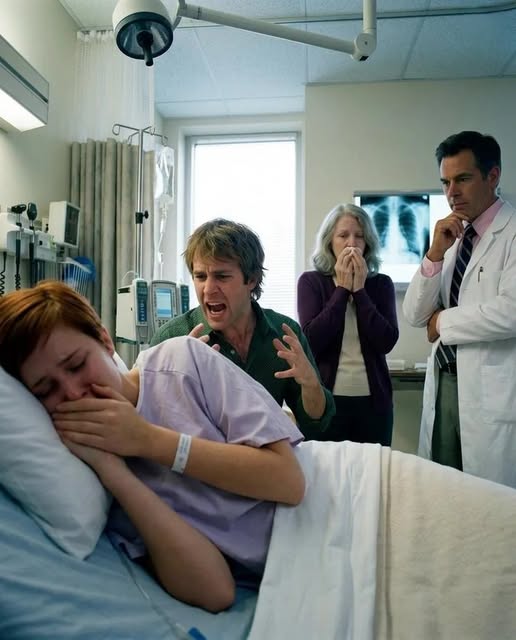
At the hospital, under cold fluorescent lights, the performance continued. Graham played the role of the caring husband, placing his hand on my shoulder in a gesture that felt less like comfort and more like a warning. When the nurse asked what had happened, he answered quickly: a fall, a simple accident. For a brief moment, I felt the familiar weight of expectation—the urge to stay quiet, to agree, to protect the illusion. But something had shifted. Maybe it was the way the nurse looked at me—that quiet, professional awareness that sees beyond words. I turned my head and said, “She pushed me.”
Those three words changed everything.
Suddenly, the room sharpened. I was separated from Graham, taken for examinations, and for the first time, someone was listening without his version shaping the story. He lingered in the hallway, still trying to minimize it—calling it a misunderstanding, insisting his mother was frail, that it was all an accident. But no one was accepting his narrative so easily anymore.
The results came quickly, but what they revealed was heavier than I expected. Yes, I had broken ribs and a severely injured wrist. But there was more—older damage. Marks on my bones, poorly healed injuries, evidence of a past I had refused to acknowledge. My body had been keeping a record of everything I had tried to silence.
The doctor didn’t speak dramatically, but with a calm certainty that made it more real. He wasn’t just talking about that night—he was describing a pattern. A cycle. A truth I had avoided for years.
When they asked if I felt safe, for the first time, I didn’t lie. I said no. And that “no” wasn’t just an answer—it was a beginning.
When Judith arrived at the hospital, she wore her usual mask—calm, composed, controlled. But this time, it didn’t work. When I told her the scans showed everything—not just what happened that night, but what had happened before—something in her expression cracked. For the first time, she wasn’t in control.
What I had been too afraid to say for years was now undeniable.
Healing wasn’t immediate. It wasn’t easy. But it began the moment I stopped protecting other people’s secrets. I realized that my silence had never kept me safe—it had only given space for the abuse to continue.
As I walked out of that hospital, my arm in a cast and my body exhausted, I felt something I hadn’t felt in a long time: freedom. Not because everything was fixed, but because I had finally told the truth.
And sometimes, that’s where everything begins.
I am no longer the woman who stays silent to keep the peace. I am the one who speaks to finally find it.