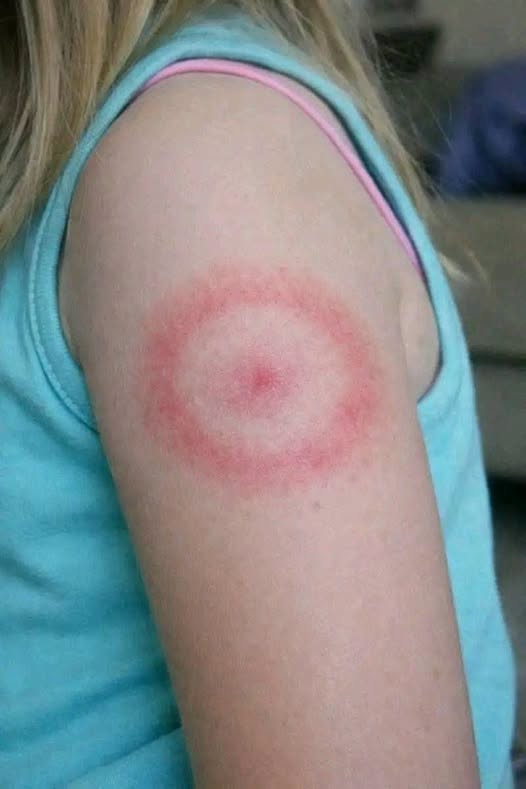
The first thing I noticed that morning wasn’t the sunlight streaming through the curtains or the quiet stillness that usually filled our home before everyone woke up. It was a strange, angry-looking red ring on my daughter’s arm. At first, I thought it was simply an insect bite. Summer had been full of long afternoons outside, barefoot adventures through the grass, evenings spent chasing butterflies, and countless hours exploring the backyard. But as I stepped closer, my stomach tightened. The redness wasn’t random. It formed a nearly perfect circle with a lighter center, standing out sharply against her skin. In that instant, every frightening headline I’d ever read about tick bites, Lyme disease, mysterious infections, and dangerous skin conditions rushed through my mind all at once. I stood frozen beside her bed, wondering whether I was looking at something harmless—or the beginning of a serious medical emergency that could change everything.
Every parent knows that overwhelming feeling of uncertainty. Children collect bumps, bruises, scrapes, and insect bites almost daily, and most disappear without causing any lasting problems. Yet every now and then something appears different enough to make your imagination race far beyond the facts in front of you. My mind jumped from one frightening possibility to another. Was it Lyme disease? Could it be ringworm? Was it an allergic reaction? Had she brushed against poison ivy? Or was this the first visible sign of a bacterial infection spreading beneath the surface? The longer I stared at the rash, the more questions crowded into my head, and the harder it became to think clearly.
Modern parenting often comes with an overwhelming temptation: reaching for a phone before taking a breath. Within seconds, anyone can search symptoms online and find hundreds of articles, discussion forums, and photographs showing every possible diagnosis imaginable. Unfortunately, the internet rarely calms worried parents. Instead, it often magnifies anxiety by presenting the rarest and most frightening possibilities alongside the most common and harmless ones. A simple mosquito bite somehow becomes linked to life-threatening illnesses after only a few minutes of scrolling. In moments like these, the greatest challenge isn’t finding information—it’s knowing which information deserves your attention.
One of the most valuable lessons pediatricians often share is that panic is rarely helpful. While concern is completely natural, anxiety can cloud judgment and make it difficult to notice the details that truly matter. Before rushing toward conclusions, it’s important to look beyond the rash itself and pay attention to the child as a whole. Is your child acting normally? Are they awake, alert, playful, and interested in eating? Do they have a fever? Are they complaining of pain, dizziness, headaches, or unusual fatigue? Sometimes the behavior of the child provides more useful information than the appearance of the rash alone.
If a child continues to behave normally, many healthcare professionals recommend careful observation while arranging appropriate medical evaluation rather than immediately assuming the worst. Observation doesn’t mean ignoring the problem—it means gathering useful information that can help a healthcare provider determine what is happening. In many cases, documenting changes over time provides valuable clues that a single glance cannot reveal.
One simple technique recommended by many clinicians involves taking clear photographs of the rash as soon as it is noticed. Using good lighting and photographing the affected area from the same distance each time creates an objective record that is often far more reliable than memory alone. Skin changes can occur gradually, making it surprisingly difficult to remember exactly how large or red a rash appeared several hours earlier. Photographs allow both parents and healthcare providers to compare progression accurately rather than relying on anxious recollection.
Another commonly suggested method involves gently marking the outer edge of the redness with a washable pen or skin-safe marker. This creates a reference point that makes it much easier to determine whether the rash is expanding over time. If redness begins spreading beyond the original outline, that information can become extremely useful when discussing symptoms with a healthcare professional. This simple technique doesn’t diagnose the problem, but it provides objective evidence that may help guide further evaluation.
Among the first conditions many parents worry about is Lyme disease, particularly if the child has recently spent time in wooded areas, tall grass, parks, or regions where blacklegged ticks are common. Lyme disease is caused by the bacterium *Borrelia burgdorferi*, which is transmitted through the bite of infected ticks. One of its early signs can be a slowly expanding rash known as erythema migrans, often described as having a bull’s-eye appearance, although not every Lyme rash looks exactly the same. Some appear as solid red patches, while others develop central clearing. Because early treatment with antibiotics is highly effective, recognizing possible symptoms and seeking prompt medical evaluation is important whenever Lyme disease is suspected.
However, not every circular rash is caused by a tick bite. Ringworm, despite its misleading name, is actually a common fungal infection rather than an infection caused by worms. It frequently produces ring-shaped patches with raised, slightly scaly borders and central clearing that can resemble Lyme disease at first glance. Ringworm spreads through direct contact with infected people, animals, or contaminated objects and is generally treated with antifungal medications rather than antibiotics. Distinguishing between the two conditions often requires clinical examination because their appearances can overlap.
Allergic reactions represent another possibility. Certain plants, insect bites, soaps, lotions, detergents, and even medications can trigger localized skin inflammation that forms red patches or rings. In many cases these reactions remain limited to one area and improve over time, particularly once exposure to the irritant stops. Other skin conditions—including eczema, hives, contact dermatitis, insect bites, and various viral rashes—can also produce unusual patterns that are difficult to distinguish without medical expertise.
This is precisely why self-diagnosis based solely on internet photographs can be misleading. Many different conditions share similar appearances during their early stages. Experienced healthcare providers evaluate far more than the rash itself. They consider recent outdoor activities, travel history, known insect bites, recent illnesses, medications, vaccination status, allergies, fever, pain, family medical history, and numerous other details before reaching a diagnosis. In some situations, laboratory testing or additional examination may be necessary to determine the exact cause.
Although many childhood rashes are harmless, certain warning signs should never be ignored. Immediate medical evaluation is recommended if a child develops difficulty breathing, swelling of the face or lips, severe pain, persistent high fever, extreme sleepiness, confusion, repeated vomiting, seizures, rapidly spreading redness, significant swelling, pus, or signs of severe illness. Likewise, any rash accompanied by difficulty moving a limb, severe joint pain, neck stiffness, or rapidly worsening symptoms deserves urgent medical attention. Parents know their children better than anyone else, and if something simply feels seriously wrong, seeking professional evaluation is always appropriate.
Even when symptoms appear mild, contacting a pediatrician for guidance is often the best course of action. Healthcare providers can help determine whether the child should be examined immediately, scheduled for a same-day appointment, monitored at home, or referred for additional testing. Many clinics now allow parents to securely send photographs before appointments, giving physicians an opportunity to review changes that may not be visible by the time the child arrives for examination.
One of the most difficult aspects of parenting is accepting that uncertainty is unavoidable. Every fever, unusual cough, unexplained bruise, or mysterious rash forces parents to make decisions using incomplete information. There is rarely a perfect answer available in the first few minutes after discovering a symptom. Instead, parenting often involves balancing vigilance with calm observation, recognizing when careful monitoring is appropriate and when immediate medical care becomes necessary.
Fortunately, the overwhelming majority of childhood rashes turn out to be treatable and temporary. Children’s immune systems constantly encounter new viruses, bacteria, fungi, plants, insects, and environmental irritants as they grow and explore the world around them. Most recover quickly with little more than reassurance, supportive care, or straightforward treatment prescribed by a healthcare professional. Even conditions that initially appear alarming frequently resolve without long-term consequences once properly diagnosed.
Looking back, I realized that my greatest challenge that morning wasn’t simply the rash itself—it was managing the fear that came with not knowing. Fear has a remarkable ability to magnify uncertainty until every possibility feels equally likely. Yet medicine rarely depends upon fear. It depends upon observation, evidence, careful examination, and thoughtful decision-making. Taking photographs, noting changes, watching my daughter’s overall condition, and contacting her pediatrician gave me something far more valuable than immediate certainty—they gave me a clear, rational plan.
If you ever find yourself standing beside your child’s bed staring at an unfamiliar mark on their skin, know that your concern is both understandable and deeply human. Take a deep breath before searching the internet. Observe your child, not just the rash. Document what you see. Contact a healthcare professional if you are concerned, especially if symptoms worsen or warning signs appear. Trust your instincts, but also trust the expertise of qualified medical providers who evaluate these situations every day. Most importantly, remember that you are not alone. Every parent eventually faces moments where fear and uncertainty collide. The goal isn’t to eliminate that fear altogether—it’s to let knowledge, careful observation, and timely medical care guide the decisions that follow.